We use cookies to make your experience better. To comply with the new e-Privacy directive, we need to ask for your consent to set the cookies. Learn more.



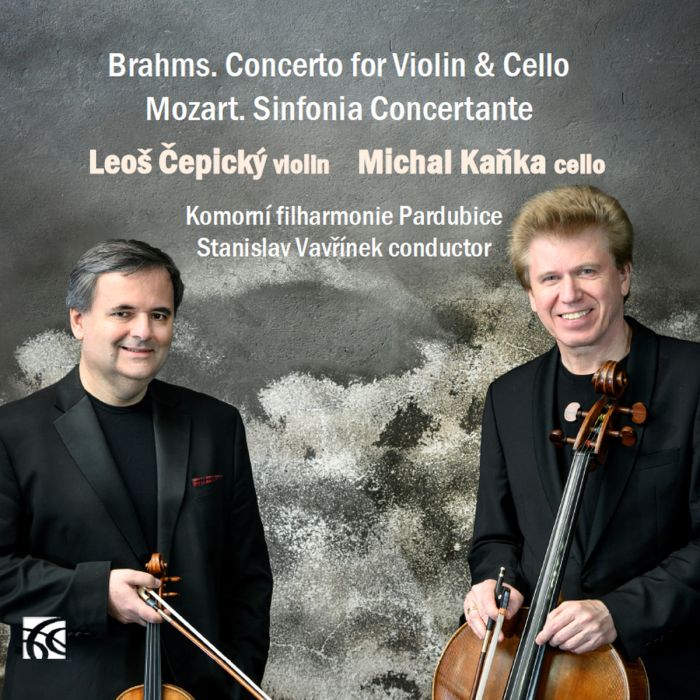
Brahms and Mozart: Works for Violin, Cello & Orchestra
£14.99
In stock
Catalogue Number
NI6463

Towards the end of his life, Johannes Brahms declared more than once that he was retiring from composing – luckily for us, he never quite followed through. Not because he had run out of inspiration – Brahms was at the height of his powers – but because he felt a growing pull toward the intimacy of chamber music, piano pieces, and songs, which brought him deeper personal satisfaction than grand orchestral forms. Still, Brahms returned once more to orchestral writing in 1887 with the Double Concerto in A minor, Op. 102 – his last orchestral work. The reason was personal: a gesture of reconciliation toward his estranged friend, the great violinist Joseph Joachim. This concerto, written for Joachim and cellist Robert Hausmann, symbolises renewed harmony – not just musically, but emotionally. The two solo instruments engage in a rich, expressive dialogue throughout. Mozart wrote his Sinfonia Concertante in E-flat major for violin and viola in the summer of 1779 – a true synthesis of symphony and concerto. This work is expansive and noble in character, full of brilliant writing for both soloists. Mozart, himself an accomplished violinist, clearly understood how to write for the instrument with flair and sensitivity. One striking feature of the work is that the viola part is written in D major, requiring the instrument to be tuned a semitone higher (a practice known as scordatura). Common in the Baroque era, scordatura was still occasionally used in Mozart’s time to achieve a brighter, more penetrating sound. The autograph of the piece is lost; only later copies have survived – except for the original drafts of the cadenzas. On this recording, the viola part is performed by a cellist, playing in the original viola position without octave transposition. © Jaromír Havlík
Manufacturer: Wyastone Estate Limited, Wyastone Leys, Monmouth, NP25 3SR
Email: sales@wyastone.co.uk
Reviews:
"This new release from Nimbus offers what is for me a highly attractive combination of two favourite double concertos…I initially played this disc while a knowledgeable music-loving friend was present and we both increasingly pricked up our ears as we listened, first because it soon became apparent that these are very fine accounts, the partnership of violin and cello exuding joy and exhibiting remarkable homogeneity in both works. Secondly, the engineers have achieved a really bold, open acoustic that has a spacious, concert-hall atmosphere with plenty of air round those soloists and the orchestra… A major point of interest in the Mozart here is that the cello plays the part originally notated in D major for a viola tuned scordatura to (i.e. a semitone up, such that it actually sounds in E♭ major), without octave transposition. The darker, mellower sound of the cello comes as a refreshing alternative to the usual, slightly wirier viola…The brief, brilliant, coda to the sonata-form first movement sees Čepický and Kanka playing in complete harmony. The way they in turn lean into the plangent melody of the Andante is deeply moving; it is one of Mozart’s most sombre and touching tunes.
Vavřínek’s accompaniment is discreet, sensitive and dynamically highly reactive, advancing and receding – sonically, as it were – with the grace of a dancing partner, always leaving the soloists prominent but supported. The sheer verve and attack of the orchestral playing speak for the conductor’s ability to galvanise his players, although he is also sometimes a little more restrained than Massimo Belli with the Nuova Orchestra Ferruccio Busoni in the violin/viola version and the resultant elegance is wholly satisfying. I shall keep this recording along with the aforementioned violin and viola coupling to be played when I fancy hearing this double concerto played “with a twist”." Ralph Moore, MusicWeb International
"The Mozart is one of the finest vehicles for the poor viola, which in the wider solo repertory has little else than Harold in Italy and a few concertos. Here, though, the viola solo is taken by the cellist Michal Kanka. I was wondering if he would transpose the part down, but in fact he does not; all is in the original range, placing some of the writing—already quite high for the viola—in the cello’s upper atmosphere. One justification I can offer is to remind us that Mozart must have sensed a problem with the viola’s ability to project the music. He wrote the viola part a half step lower than concert pitch, requiring the soloist to tune the instrument sharp, thus achieving a brighter sound. Kanka handles the high writing very well, and balances are fine. In this case the substitution works. So, we have two obstacles, but ones we can justify if we wish.
It is certainly an enjoyable recording with both Cepicky and Kanka playing very well, and the chamber orchestra under Stanislav Vavrinek plays with assurance. I’ll only say that one of my oldest friends from graduate school was a violist who played the Mozart. He later became a violist with one of the Big 5 orchestras. In order to preserve the friendship, discretion suggests I shouldn’t tell him about this release!" ALTHOUSE, American Record Guide

|
| Sample Tracks |
|---|
|
Concerto for Violin and Cello, Op. 102 in A Minor: III. Vivace non troppo
Sinfonia Concertante for Violin and Viola in E Flat Major, K. 364 / 320d: III. Presto
|
0.135 kg