We use cookies to make your experience better. To comply with the new e-Privacy directive, we need to ask for your consent to set the cookies. Learn more.



Brahms Clarinet Quintet & Zemlinsky Clarinet Trio
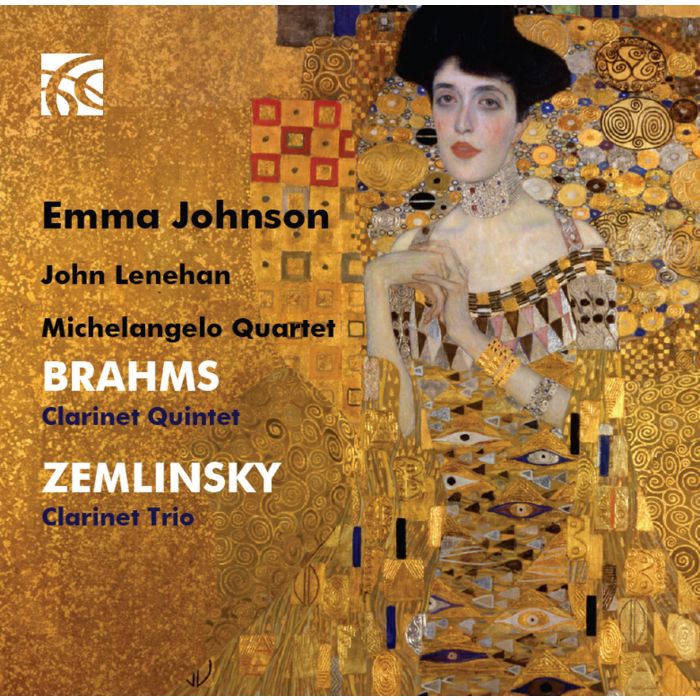
£14.99
In stock
Catalogue Number
NI6310

Emma Johnson is one of few clarinettists to have established a busy solo career which has taken her to major European, American and Asian venues as well as to Africa and Australasia. Emma Johnson's has appeared a soloist with many of the world’s leading orchestras in repertoire which includes all the major clarinet works as well as pieces written especially for her by John Dankworth, Will Todd and Michael Berkeley amongst others. Emma Johnson is also in great demand as a collaborative artist; tours in recent years have included performances with the Takacs and Michelangelo quartets, the pianists Pascal Rogé and John Lill, the cellist Julian Lloyd-Webber and sopranos Lesley Garrett and Elizabeth Watts.
Manufacturer: Wyastone Estate Limited, Wyastone Leys, Monmouth, NP25 3SR
Email: sales@wyastone.co.uk
Reviews:
"In this finely balanced performance [of the Brahms Quintet]; Emma Johnson, when her part is a subsidiary one, blends in easily with the strings, adding a liquid tone to the texture. This is not to say that she doesn't strongly project and characterise the more soloistic episodes, but the whole account is noteable for its feeling of intimate discourse...Zemlinsky's early Trio...is a fascinating, enthralling work, persuasively presented in this strong, confident performance." Gramophone
"This is a lovely work given an impressive performance by these fine artists. The recording made at Wyastone Leys, Monmouth, UK is excellent and there are excellent booklet notes from Emma Johnson." theclassicalreviewer.blogspot.co.uk
"Altogether this is a fine addition to the catalogue, especially given the interesting coupling, and it's very nicely recorded." FRMS Bulletin
"Emma Johnson is a most excellent soloist who has had a highly successful career since winning the BBC Young Musician of the Year competition as long ago as 1984. She has a lovely, mellow tone and blends ideally with the quartet in a perfectly balanced recording which allows the gentle pulsing of the viola and cello to emerge clearly beneath the melodic line in the Adagio. They take that movement a little more briskly than Puddy, perhaps to avoid any connotations of sentimentality which can gather around such familiar and ripely Romantic music. On the other hand, they never abandon the requisite singing quality in their phrasing." Music Web International
"Emma Johnson is a most excellent soloist who has had a highly successful career since winning the BBC Young Musician of the Year competition as long ago as 1984. She has a lovely, mellow tone and blends ideally with the quartet in a perfectly balanced recording which allows the gentle pulsing of the viola and cello to emerge clearly beneath the melodic line in the Adagio. They take that movement a little more briskly than Puddy, perhaps to avoid any connotations of sentimentality which can gather around such familiar and ripely Romantic music. On the other hand, they never abandon the requisite singing quality in their phrasing." Music Web International
"It's surprising that Emma Johnson hadn't tackled this work on disc before, but I'm very glad to have caught up with it eventually, especially as the Zemlinsky is such an under-recorded gem.
…It's worth following Johnson's approach. Nimbus sound can be generous, but this is well-focused to bring out the soft grain already there, the pulsing strings – viola, then cello intertwining with the utmost clarity. It works out particularly in the Adagio-Più lento. You can see here why Johnson's tempi are unhurried yet in fact work out faster than some. The textural interplay is what comes out perhaps in a work where texture is gesture and expression below the gorgeous autumnal-seeming melodies.
…For there is in the higher reaches of the clarinet a soft-grained wail of despair, also afraid to know itself. Even as the entwined solidarity seems to unfold a last benediction, a touch of human warmth. The team here take it about 20 seconds longer than the Oppenheim/Budapests, whilst Kell and the Busch push it to a terse 8:05.
The chamber gradations, the astonishing intimacy and fresh sonority this performance brings make it a natural acquisition to Brahmsians. You won't hear those textures separate and conjoin so revealingly elsewhere.
Whilst it would have been right to have the Brahms Clarinet Trio, Op 114, no-one will complain when they hear this Brahmsian Clarinet Trio which Zemlinsky took in 1895 to Brahms, who immediately pronounced his delight. One can see why. It starts in the Allegro man non troppo – Andante like Brahms' Clarinet Sonata No. 2; its melody, returning several times, is easily good enough to stand comparison as first-rate Brahms. It's memorable and haunting.
And here's another reason Johnson invoked the cimbalom. It's back. The final Allegro, both tuneful and folksy within a Brahms nimbus – particularly the clarinet – is perky and memorable. Though brief, it contains the profundity Zemlinsky discovered in himself and in this work. There's almost a moto perpetuo feel, as the work ends in a whisper.
The final chords try to recall the late 19th century, but we're nudging Mahler territory: clear-cut, off-kilter rhythms and tunes, a folk idiom sharpening itself. Zemlinsky's journey from his early master was beginning as his master's life ended.
There's unlikely to be such a fine performance of the Zemlinsky for years, though it deserves many. It's a great reason to buy this disc for the trio alone. However, though there are recent Brahms Clarinet Quintets out there I've not heard, this is sovereign and a natural successor to the great British clarinet tradition; indeed, to most other clarinetists who've committed this work to disc. Its special qualities demand a hearing." Music Web International

|
| Sample Tracks |
|---|
|
Quintet in B minor, Op. 115: I. Allegro
Quintet in B minor, Op. 115: II. Adagio - Più lento
Quintet in B minor, Op. 115: III. Andantino
Quintet in B minor, Op. 115: IV. Con moto
Trio for clarinet, cello and piano in D minor, Op. 3: I. Allegro ma non troppo
Trio for clarinet, cello and piano in D minor, Op. 3: II. Andante
Trio for clarinet, cello and piano in D minor, Op. 3: III. Allegro
|
0.135 kg