We use cookies to make your experience better. To comply with the new e-Privacy directive, we need to ask for your consent to set the cookies. Learn more.



British Piano Concertos Vol. 2: Jacob, Addison, & Rubbra
£14.99
In stock
Catalogue Number
SRCD416
- available to download and stream from all Digital Platforms
Jacob’s Piano Concerto no.2 in E flat was completed in 1957 and premiered on 11 July of that year at the Winter Gardens, Bournemouth by the soloist Edith Vogel. A Proms performance took place at the Royal Albert Hall on 9 August 1957 with the same soloist. A review in The Times of the 1957 Proms performance of Gordon Jacob’s Piano Concerto No.2 declared that ‘the composer’s masterly understanding of the orchestra enables him to express each idea economically and in the most clean and attractive colours’, while The Sunday Times’ critic wrote that, ‘having taught the craft of orchestration to a whole generation of composers, Dr. Jacob is himself a past master at clear and effective scoring’. Addison’s Variations for Piano and Orchestra was written in 1948 and revised the following year. According to Alan Poulton’s Dictionary-Catalog of Modern British Composers, It was first performed in a BBC broadcast in 1960 by Margaret Kitchin. The work is written for a small orchestra, comprising double woodwind, four horns, a pair each of trumpets and trombones, bass trombone, timpani, modest percussion and strings. Though the piano had played a prominent role in an earlier student piece by Rubbra, his Piano Concerto, Op.30 (1932) is the composer’s first fully-fledged, large-scale work for soloist and orchestra. The score features an elaborate solo part and requires substantial orchestral forces. [Paul Conway]
Manufacturer: Wyastone Estate Limited, Wyastone Leys, Monmouth, NP25 3SR
Email: sales@wyastone.co.uk
Reviews:
"Simon Callaghan's clean, lightweight piano sound, crisply articulate, is ideal for Jacob and Addison, who favor linear figurations over big, splashy chords. Callaghan is responsive to the varying moods, with many lovely moments. In the larger-scaled Rubbra, the quick, rippling scales are limpid, the quiet bits pensive." Stephen Francis Vasta, stereophile.com [read complete review]
“A valuable and absolutely delightful release that rightfully appeared on classical best-seller charts in the late summer of 2023” James Manheim, AllMusic [read complete review]
“Following Lyrita’s similarly titled album of 20th-century British rarities in which only one out of six was actually designated a concerto, we now get two concertos and a variation set, all in first recordings… In every case, Simon Callaghan radiates delight in reviving these neglected items, and his pungent and precise fingering is matched by the spirited attack of the BBC National Orchestra of Wales and their two conductors.” Geoff Brown, BBC Music Magazine [read complete review]
“Lyrita’s second instalment of British Piano Concertos forms another significant addition to the catalogue, providing a valuable spotlight on three rarely performed 20th century works, each receiving their recording premieres. In a collaboration between pianist Simon Callaghan and conductors Stephen Bell and George Vass, the BBC National Orchestra of Wales presents a three-decade traversal of work by Gordan Jacob, John Addison and Edmund Rubbra. As with the previous disc, this is a wonderful tribute to a trio of composers whose work is seldom heard in the concert hall and largely unknown today were it not for the efforts of enterprising record labels.” David Truslove, Wales Arts Review [read complete review]
“Returning to the treasure-trove of mid-Century British piano concertos, Simon Callaghan comes up with three gems, all receiving first recordings… Pianist Simon Callaghan has followed up his disc of British piano concertos from the 1950s [see my review], by returning to the the era for British Piano Concertos on the Lyrita label with a trio of concertante works by Gordon Jacob, John Addison and Edmund Rubbra, accompanied by the BBC National Orchestra of Wales, conductors Stephen Bell and George Vass. All three are first recordings… It seems amazing that, returning for a second disc of British piano concertos, Callaghan should again be able to come up with a trio of fine works which deserve to be better known and which are receiving their first recordings. Performances are excellent, allowing you to simply sit back, enjoy the music and wonder what else is out there!” Robert Hugill, Planet Hugill [read complete review]
"This recording by the BBC National Orchestra of Wales was conducted by Stephen Bell (Jacob and Addison) and George Vass (Rubbra) and, surprisingly, is the first recording of all three works. As a survey of 25 years of British piano concertos, or, more importantly, of their composers’ works, they show how influential the classical music scene in the UK was with the film industry of both the UK and the US. These seem like highly listenable and facile pieces, on one hand, and, on the other, are serious contributions to a very large and distinguished field." Maureen Buja, Interlude [read complete review]
“Gordon Jacob (1895-1984) composed some four hundred works, including two symphonies, several concertos, chamber music, choral works, songs, and film and television music. His Second Piano Concerto of 1957 begins with a playful rhythmic movement, followed by a lyrical, poetic, and in some cases very lively variation movement. A light-hearted virtuoso movement ends the concerto, whose wealth of ideas is impressive and makes it a very attractive work worth hearing. John Addison (1920-98) wrote Variations for Piano and Orchestra in 1948, and it is a very expressive, often somberly coloured work that, although sometimes very virtuosic in the piano part, is most notable for its orchestral writing. Edmund Rubbra (1901-86) composed a highly original piece in his 1930 Piano Concerto, whose richness of colour and ideas make it truly distinctive and attractive. Good and committed interpretations make these three premiere recordings a program worth listening to.” www.pizzicato.lu
"This marvellously enterprising and revelatory disc opens with a work which deserves one’s full attention. Gordon Jacob’s 1957 Piano Concerto No 2, which is on a large canvas of over 30 minutes duration. It opens with a spirited, sonata form Allegro vivace with a gorgeous romantic second subject... These wonderfully idiomatic performances and the recording are outstanding, and Simon Callaghan plays reflectively when needed but also with great power and agility. Snap it up." Gary Higginson, British Music Society [read complete review]
"These three works are far from rugged, rebarbative or unapproachable. They appealingly beckon and entreat listeners who need have no misgivings about performances or Lyrita’s engineering." Rob Barnett, musicweb-international.com [read complete review]
“Ultimately a very well played and engineered disc of music that probably deserves its ‘forgotten’ status. All three works are genuinely enjoyable and worth hearing if – like me – you are interested in British 20th Century music. But none are major works that demand restoration to the active repertoire.” Nick Barnard, musicweb-international.com [read complete review]
This marvellously enterprising and revelatory disc opens with a work which deserves one’s full attention. Gordon Jacob’s 1957 Piano Concerto No 2, which is on a large canvas of over 30 minutes duration. It opens with a spirited, sonata form Allegro vivace with a gorgeous romantic second subject.
We move to a poetic ‘Variations’ movement, in which the theme is not stated immediately, but, after a minute or so, is given to a solo oboe after a brief piano cadenza. The four variations are highly contrasted holding your attention and end in a ‘rowdy’ and rhythmic Allegro con brio. The finale, marked ‘Allegro con brio’, can be summed up as a ‘joyous romp’. As you might expect of this composer, the craftmanship and orchestration never cease but to fascinate.
The shortest work on this disc is by John Addision, a pupil of Gordon Jacob, his Variations for Piano and Orchestra (1948). You may recognise him as the composer of the music to that great film A Bridge Too Far, but here he is working in an abstract format, constructing a perfectly designed structure with a slow introduction and four contrasted variations, but ending with the slow processional idea just as it began. After its initial play-through in the Royal College with Kathleen Long as soloist, for some reason Rubbra rejected this, his first major concerto, and it has not been played again. I am sure that if he had heard this performance, he would have felt quite differently about it. It falls into the fast-slow-fast format of many concertos, but there is a slow introduction, and the central section of the middle movement is quite excitable. The first movement, beginning atmospherically, is in sonata form and, to quote Paul Conway’s excellent notes, develops into a ‘jaunty folk-like march’. The ensuing Larghetto e tranquillo has a reminder of Vaughan Williams in its meditative opening. The finale is in Rubbra’s favoured compound time, but at this period without the trademark three against two. Ronald Stevenson called it a ‘Scottish sounding Jig’. The concerto’s harmonic language is often lush and, along with some of the melodic contours, drew to my mind aspects of the 2nd Violin Sonata, written immediately afterwards. These wonderfully idiomatic performances and the recording are outstanding, and Simon Callaghan plays reflectively when needed but also with great power and agility. Snap it up. - Gary Higginson, British Music Society
Lyrita serve up three British works for piano and orchestra. These are otherwise unrecorded works – one from each of the 1930s, 1940s and 1950s. Two of them are titled ‘Concerto’ with the Addison being a set of Variations. The composers were born in successive decades (as near as damn-it) and they departed the scene during the 1980s and 1990s. The Jacob Second Piano Concerto is on about the same half-hour three-movement scale as the Rubbra, though differing in mood and morphology.
The Gordon Jacob concerto is largely bright and glittering with a touch of Holst’s brass band suites about its bluff and bluster. Remission comes part way through the first movement when the music enters a becalmed phase. Most of the movement squares up to the listener, alert and bushy-tailed and alert. The long (13:00) central Variations movement seriously repents of its predecessor’s teenage heroics. Instead we hear Jacob the poet of meditative stoicism. This seems to speak of moonlit meandering and moth-wings. The dynamics are recessed, timorous even. A couple of minutes before the movement closes it rouses itself for a moment. The heroics resume for pianist and the wider orchestra in the finale which assumes the brilliance of a gambolling jester. Complex cross-cutting rhythms run riot. Its emotions are showy and certainly it lacks the overwhelming emotional surge of the Rhapsody for two pianos and brass band which surfaced in the form of a work for two pianos and orchestra on EMI ASD2612. There are even some recollections of the Ravel G major Concerto.
This Second Concerto was premiered on 11 July 1957 in Bournemouth, where the pianist was also the work’s dedicatee, Edith Vogel (1912-1992). The Bournemouth Orchestra was, on that occasion, conducted by its ‘resident’ of the time, Charles Groves. A month or so later the Concerto – and Vogel – raised their heads at the Royal Albert Hall Proms, but this time with the London Symphony Orchestra conducted by Basil Cameron.
You may well be curious about the First Piano Concerto (1927). This can be heard on Somm with Mark Bebbington as soloist. Jacob wrote a great deal but it’s ironic that it is his orchestral transcriptions that have secured some fame for his name: Vaughan Williams’ English Folk Song Suite, Holst’s Moorside Suite and Elgar’s Organ Sonata.
John Addison was born in Surrey. He joined the staff of the Royal College of Music as Professor in 1950. His Divertimento for brass is among his most celebrated concert works. As a screen music practitioner, his name is linked with the vivacious and swashbuckling A Bridge Too Far (1977) and Murder, She Wrote (1984-1996).
Addison’s Variations for Piano and Small Orchestra was written in 1948. In its small compass – three short movements – it is rather like a scorched and desolate Rachmaninov; a touch of Rawsthorne as well. Addison puts the piano through its paces. The Variations are without studied contrivance and sport a natural reflective flow. The score ends in a jazzy euphoric finale which drifts and drizzles down into dank stability and silence. Hats off to Addison for embracing this self-effacing gesture rather than an explosion of thunder and sparks.
Edmund Rubbra was born in Northampton. He was a distinguished and practical pianist as well as a composer and academic. He performed, broadcast and recorded as part of a Trio alongside violinist Erich Gruenberg and cellist William Pleeth. There are several works of his for piano and orchestra; the present 1932 Concerto is not to be confused with the already well-known Piano Concerto from 1956. The latter has been recorded by Malcolm Binns (BBC Radio Classics), Piers Lane (review; review) and Denis Matthews (review; review). In addition there is a very substantial Sinfonia Concertante which is on CD from Howard Shelley (review) and also from a BBC radio broadcast by the composer and the CBSO/Hugo Rignold (review). His overture-scaled Nature’s Song is on an earlier Lyrita disc (review; review).
The 1932 Concerto, op. 30 was premiered by Kathleen Long and the New Symphony Orchestra conducted by Geoffrey Toye in March 1933. Ultimately, it struggled to find favour with its composer who had misgivings about it, such that the 1956 Concerto was not designated as “No. 2”. The first movement of the op, 30 marries up a true Andante moderato with an Allegro con brio. It starts in self-effacing way and almost surreptitiously. The atmosphere and images are of sun-dappled spinneys, rather like Paul Nash’s Wittenham Clumps. Howells and RVW are kindred spirits here, with the music warm and ecstatic but without the Pan-like supernatural element (so, not Bax). It’s magical stuff, later giving way to “rum-ti-tum” folksy passages. Towards its close there is really splendid work for horn and trombone as well as a seraphic intertwining solo violin. Triumphant Sibelian passages ripple with energy. Marked Larghetto e tranquillo, the central slow movement is slowly tolled out. With its slow sun-struck self-confidence and plangent arpeggiation it recalls the First Piano Concerto of Cyril Scott who was also one of Rubbra’s teachers. The music morphs into the defiant and the bardic in the manner of Bax’s Symphonic Variations but less loquacious, more concise and concentrated. The finale is a jolly Molto vivace in the manner of RVW (Pastoral Symphony and Wasps) and Grainger (Scotch Strathspey and Reel and Green Bushes). The xylophone jangles to sweep the listener along in the action. The work ends abruptly. Even so, there’s a great deal here to like. The keen-edged and eager performances convince you that Callaghan, the BBC NOW (who as a broadcasting ensemble are well used to breathing fresh life into music outside the mainstream) and the two conductors are everything you might cherish for such a project. Paul Conway’s utterly indispensable notes support the listener in first recordings of these works (made in association with BBC Radio 3). His writing is packed with factual context and biographical material as well as analysis. SRCD.416 is effectively Volume 2 to an earlier ‘collation’ of piano concertante pieces that, by and large, eschewed the title ‘Concerto’. Works by Addison and Rubbra were also featured there alongside four unusual others. These three works are far from rugged, rebarbative or unapproachable. They appealingly beckon and entreat listeners who need have no misgivings about performances or Lyrita’s engineering.
Rob Barnett, musicweb international
"These premiere recordings will be of interest to all Britis music lovers. Jacob and Rubbra were near-contemporaries whilst Addison was a generation younger and the 3 works were composer over a quarter-century span between 1932 (Rubbra) and 1957 (Jacob). Each has distinctive features.
Jacob's concerto opens with fanfare orchestral figures before the piano announces himself in a puckish entry spreading light-hearted wit-briefly ruminative in the first movement - alongside suitably pert orchestration...
Addison's 1948 variations for piano and (small) orchestra is a compact quarter-of-an-hour piece subdivided into three clear sections. The theme is both condensed and melancholy though it broadens ecpressibely and the piano is given a romanticised profile which allows some virtuosic and dapper faster sections...
The Piano Concerto, Op.30 of Edmund Rubbra should be distinguished from his much later venture from 1956 which has recieved several recordings. The earlier work was his first essay in large scale - that's to say soloist and orchestral -form but he wasen't satisfied with it and it wasn't to be published during his lifetime...
Fortunately, Simon Callaghan is on hand to deliver the stylish and stylistically savvy performances, supported by the BBC National Orchestra of Wales who are on excellent form under the two fine conductors - Stephen Bell, who directs the Jacob and Addison and George Vass, who conducts Rubbra.
Paul Conway's notes tell us everything we could possibly want to know and this Hoddinott Hall recording, which is splendidly judged acoustically, os ,ade on association with BBC Radio 3." - Jonathan Woolf
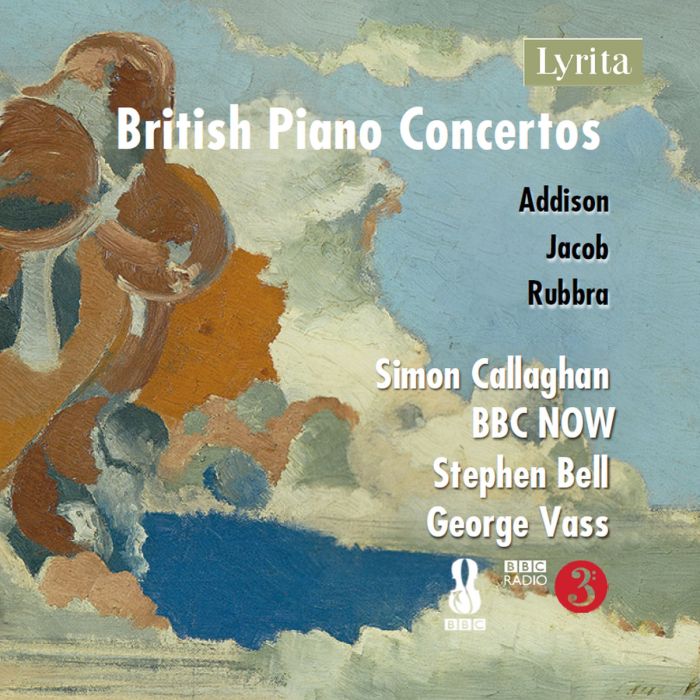
"Aside from the thoughtfully-chosen, sometimes recondite musical material, Lyrita enhances the latter with evocative artwork, lengthy and detailed sleeve notes, containing insightful biographies of the conductors and soloists who have created the Lyrita sound. For this new CD of recordings of British piano concertos, the booklet cover is Cumulus Head, a 1944 painting by Paul Nash, evoking an English downland landscape.
Herewith three piano concertos, by composers John Addison, Gordon Jacob, and Edmund Rubra respectively. Addison’s Variations for Piano and Orchestra of 1948 is an at times quirky, at times impassioned score, designed to test any soloist and draw in an inquisitive audience. In short, a superior ‘divertissement’. Addison was best known for his film music, such as his scores for Reach for the Sky (1956) and Alfred Hitchcock’s Torn Curtain. But he was also an accomplished composer of classical music, as his Concertante for Oboe, Clarinet, and Orchestra (1948) attests.
Gordon Jacob’s Piano Concerto (1957) has a similar style to that of Vaughan Williams. The work begins with an emphatic allegro passage. But in contrast to ‘RVW’s Piano Concerto in C, premiered in February 1933 and conducted by Sir Adrian Boult, Jacob’s concerto does not conclude in peace and seclusion. Now a largely forgotten figure, Jacob was a great teacher and a prolific composer. The concerto is informed by distinct elements of nostalgia. Under the baton of Stephen Bell, the National Orchestra of Wales do justice to Jacob’s bold argument and big sound.
Of the three composers featured in this CD, Edmund Rubra, a devout Roman Catholic, is unquestionably the more mystical and introspective. He composed a large cycle of symphonies. Those familiar with Vernon Handley’s recording for Lyrita of Rubra’s Festival Overture will understand why connoisseurs of British music maintain that Rubra’s oeuvre should be given a more prominent place in our concert and Radio 3 schedules. George Vass, a champion of contemporary British repertoire, exercises admirable control over Rubbra’s concerto, notably in the intensely spiritual opening on woodwind, followed by a violin solo. And credit to pianist Simon Callaghan, whose performances at the English Music Festival have made such a profound impression." - The Quarterly Review, Stuart Milson
Following Lyrita’s similarly titled album of 20th-century British rarities in which only one out of six was actually designated a concerto, we now get two concertos and a variation set, all in first recordings. But given the diverse entertainment and the performers’ panache, I’d listen happily even if one of the works was called Tutti-Frutti Ice Cream. Part of the appeal is that the music doesn’t always behave as the composers’ reputations might suggest. John Addison’s scores for film or concert usually have a jaunty streak, yet his early set of Variations is often thoughtful, even melancholy. Edmund Rubbra’s heavy body of serious symphonies avoid folksy effusions; yet his 1932 concerto, which its composer later tried to forget, ends with a noisy and percussive maypole stampede. The only piece that broadly follows expectations is Gordon Jacob’s 1957 creation: the handiwork, as expected, of a master orchestrator and a skilful juggler of multiple moods – indeed, rather too many for the concerto’s own good, though they don’t stop the results being fun.
In every case, Simon Callaghan radiates delight in reviving these neglected items, and his pungent and precise fingering is matched by the spirited attack of the BBC National Orchestra of Wales and their two conductors. Some harsh brass sounds during the Jacob betray the airless studio acoustic of Cardiff’s Hoddinott Hall, and Rubbra’s percussive quirks tend to get swallowed up. None of this, though, should deter purchasers of this second round-up of British pianistic flights, whatever the pieces are called.- Geoff Brown, BBC Music Magazine
I imagine that for must collectors the primary attraction here will be the first of Rubbra’s three concertante works for piano, composed in 1932 and successfully premiered at the Royal College of Music the following year. It was well received by a tranche of London's musical press, who approved of the concertos luscious -rather than lush -scoring, appealing tunes and organic structure. It makes the composer's decision to withdraw the work all the more baffling. Recognisably Rubbra, it might not be quite as fluently written as the marvellous G major {1956) but shares a common three movement structure: moderate opening movement, Adagio, and jaunty, dancelike finale. Perhaps it was the music's resonances of Vaughan Williams (noted by the critics) that Rubbra felt unhappy with. It is a shame, for this is a strong work, with much to enjoy in this scintillating performance by Simon Callaghan under George Vass's direction.
Just as Rubbra’s piano-and-orchestra works remain nowhere near as well-known as they should be, so Gordon Jacob's pair are largely unknown. Mark Bebbington recorded the First (1927), with strings only, for Somm in 2014, but Callaghan has now recorded its fully orchestrated successor from 30 years later. Edith Vogel premiered the work in 1957, performing it several times: there is a riveting YouTube recording of an early performance under Rudolf Schwartz that is astonishingly vivid and full of an energy that is largely lacking here. The opening Allegro vivace suffers worse, its festive, celebratory note sounding rather trivial in Callaghan's and Stephen Bell's hands, where Vogel and Schwartz swept one away. Of course this new version has far better sound, and the central variations benefit hugely; this is marvellous music-making. The Allegro con brio finale could zip a touch more but rattles along nicely.
In some respects, the absolute peach here is the non-concerto, John Addison's wonderful Variations (1948). Addison may be remembered best as a film composer but he was a fine concert composer, too (there are two other piano-and-orchestra pieces: Conversation Piece, 1958: Concertino, 1959), but these Variations are beguiling, compelling and entrancing. superbly scored and very well performed here. With tip-top sound throughout, this is a fascinating issue. - International Piano, Guy Rickards
"There are still British piano concertos to discover.
Even if you are familiar with the discography of British piano concertos, there are always 'niche works' that are worth exploring. Gordon Jacob is greatly underestimated as a composer, not least because of his modesty, but also because of his musical economy. There is no note too many, there are no unnecessary experiments, he wants to work out of the music itself. One such work is the Second Piano Concerto in E flat from 1957. Jacob went his way quite unimpressed by his contemporaries – you can hear the traditions of British symphonic music as well as influences from Europe and overseas, but if you concentrate on his own work, we can slowly see his personal style a little more clearly – there is still far too much of his work, although long appreciated by the BBC and heard at many festivals, unknown to the musical present. Jacob's concerto sparkles with joy of playing and technical sovereignty, the variation movement at the centre opens up an impressive world of its own. The play with the extended tonality is exciting and exciting at all times, despite all the 'traditionalism'.
Simon Callaghan and the BBC National Orchestra of Wales, currently the most experimental of the BBC orchestras, take the half-hour work seriously and find exactly the right tone for the music – differentiated, transparent, airy and yet full of depth and a contemporary readiness to exacerbate." Dr Jurgen Schaarwachter, Klassik.com

|
| Sample Tracks |
|---|
|
Piano Concerto, No. 2 in E Flat Major: III. Allegro con brio
Variations for Piano and Orchestra: III. L'Istesso Tempo - Lento sostenuto
Piano Concerto, No. 2 in E Flat Major: I. Allegro vivace
|
0.135 kg