We use cookies to make your experience better. To comply with the new e-Privacy directive, we need to ask for your consent to set the cookies. Learn more.



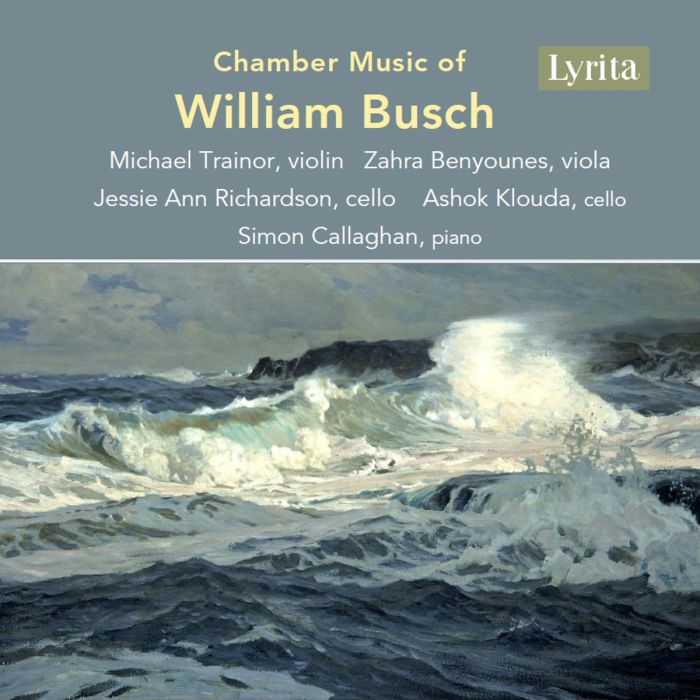
Chamber Music of William Busch
£14.99
In stock
Catalogue Number
SRCD439

Three pieces for violin and piano were written as individual works and, as such, they can be presented separately or, if given collectively as a suite, played in any order. Busch wrote his Passacaglia for violin and viola in 1939, the score takes the form of a decisive, four-bar theme followed by thirty variants upon it. These mini-variations range widely in character, from trenchant and forceful to airy and smooth. A Memory for cello and piano was written for Elizabeth Poston. Busch subtly conveys the idea of a reminiscence suggested by the title with simple, lightly sketched ideas presented with an air of hazy nostalgia. Eventually, the feeling of distance and reserve created in the opening portion of the work is replaced by a more troubled mood. The music ends in sorrow with a heartfelt, steeply descending sequence for unaccompanied cello followed by the merest hint of the opening material. The Quartet for piano and strings is the most substantial of William Busch’s chamber pieces. Although the composer’s lyrical gifts are much in evidence, the four movements are also rigorously concise. Considerable dramatic rewards are gained from the creative tension between the music’s unforced expressivity and the formal rigour with which Busch’s powerful themes are worked out. The Suite for Cello and Piano is among Busch’s most searching and variegated instrumental works. In a postwar assessment of the score, The Times’ critic noted that its four pieces ‘reveal a sensitive and interesting mind’. Elegy for cello and piano exploits fully the stringed instrument’s lyrical qualities and capacity for rich, autumnal colours. The work begins with an extended soliloquy for unaccompanied cello and the cellist continues to preside over the entire opening section, which features only a couple of brief interjections from the piano. © Paul Conway
Manufacturer: Wyastone Estate Limited, Wyastone Leys, Monmouth, NP25 3SR
Email: sales@wyastone.co.uk
Reviews:
"William Busch, who died in his mid-forties, also offers colorful and tempered compositions with an impressionistic touch in his chamber music. After studying piano, Busch increasingly concentrated on composition and found his own creative language. The few compositions are characterized by their quality.
The Quartet for Piano and Strings is his most important contribution to chamber music. Strong expressivity against formal strictness creates a supporting arc of tension. His Passacaglia for violin and viola consists of a decisive, four-bar theme, which is followed by 30 very different variations. The three pieces for violin and piano can be performed individually or as a suite in any order. Several works for cello were written during the Second World War. The Suite, Elegy and A Memory, all for cello and piano, utilize the qualities of the string instrument to produce a sonorous sound and to sing it out in song.
The members of the Piatti Quartet, who could form a string trio, as well as the pianist Simon Callaghan and the cellist Ashok Klouda as guests make up the tableau of performers, with Klouda playing together with the pianist in the Suite and the Elegy.
They develop their greatest breath in the most extensive work, the Quartet. The pianist joins the Piatti Quartet trio here. They succeed in clearly teasing out the lyrical side of the piece and yet also acting in a strictly concise manner in all four movements. From these poles, they create a creative tension and show the powerful themes that Busch worked out. In the other works, too, the symbiosis of expressive, playful line and vivid elaboration of the structures is successful." www.pizzicato.lu [read complete review]
"I was delighted when the opportunity to review this disc of William Busch’s Chamber music came as I have had for some time a soft spot for his wonderfully expressive Cello Concerto (Lyrita SRCD 320)… this is wonderful and original music, superbly performed, and it was clearly a tragedy for English Music that William Busch died before he could fulfil his considerable promise." Gary Higginson, British Music Society
"Three pieces for violin and piano (1943-1944) is a work of overwhelming beauty. The three movements are intimate, warm and delicate. It is a piece to be listened to in solitude, which is a constant in his work as a whole. It is nothing more than a reflection of the composer's soul, which the Piatti Quartet interprets as a round and beautiful piece. It is a true work of art.
In the Quartet for piano and strings, written in 1939, Busch's most important chamber work, the musicians of the Piatti Quartet, together with pianist Simon Callaghan, highlight Busch's psychological penetration and narrative wisdom. The interpretation of the four movements, which is impeccable in style, calls for a listening of cosmic and universal scope.
This album is a revelation for us. The serene music of William Busch, impeccably performed by the Piatti Quartet, leads us to an exciting and challenging outcome." Marçal Borotau, Sonograma Magazine
"...William Busch (1901-45) whose Three Pieces for Violin and Piano (1943-44) and Passacaglia for Violin and Viola (1939) are among the gems of little-known English music on a new disc from Lyrita Records. Busch studied in America and Berlin, but Woolacombe, North Devon, was the landscape and cultural setting of the ‘Three Pieces’ — the final movement Lacrimosa clearly resonating with (although not necessarily inspired by) English music’s famous sense of remote melancholia...." Stuart Milson, The Quarterly Review
"I have been most impressed by the music and performances here, and I live in hope that this composer enjoys the recognition that he truly deserves. His music has been one of the great discoveries on my musical journey. Also to be commended are the accompanying notes and the excellent sound recording. I highly recommend this disc.” Geoffe Pearce, Classical Music Daily
"The performances here are excellent. The members of the Piatti Quartet, violinist Michael Trainor, violist Zahra Benyounes and cellist Jessie Ann Richardson are joined by pianist Simon Callaghan and cellist Ashok Klouda. It’s Klouda who plays the Suite and Elegy, with Callaghan. The recording in the Concert Hall, Wyastone Leys has been well judged and the notes, as mentioned, are in the best of hands – Paul Conway’s. Busch is a composer with a gift for expressive intensity and this valuable disc contains what I assume are premiere recordings." Jonathon Woolf, MusicWeb International
"There is lovely individual playing with warmth and sensitivity, with a few intonation and phrasing miscues. The beauty of the music is sometimes vapid, ephemeral, and there is not quite enough impetus to listen again. But most beautiful moments in life are meant to fade away." Ned Kellenberger, American Record Guide
"The best way to describe the chamber works here might be to say that one should imagine a Bartók who was not specifically Eastern European and who stuck closer to traditional tonality. Consider the Tarantella movement from the Suite for cello and piano of 1943, which is more oriented toward the rhythmic nature of the dance than to any neo–Romantic content. The Passacaglia for violin and viola is a fascinating work, not neo anything and packing, as Bartók did in chamber music, a great deal of counterpoint into a restricted instrumental medium. The small cello pieces — sample A Memory — are arrestingly beautiful. Many of Busch’s works were on a small scale, but the program offered here by members of the fine Piatti Quartet includes a good-sized Piano Quartet that is both lyrical and logically constructed. The sound from the Wyastone Estate Concert Hall is ideal on an album that may well remake the British 20th century chamber music repertory a bit." James Manheim, AllMusic.com

|
| Sample Tracks |
|---|
|
Three pieces for violin and piano: I. Cantilena, Larghetto con molto espressione
Passacaglia for violin and viola: Allegro con brio, energico
Quartet for piano and strings: III. Molto vivace ed energico
Suite for cello and piano: IV. Tarantella, Presto, molto sostenuto
|
0.135 kg