We use cookies to make your experience better. To comply with the new e-Privacy directive, we need to ask for your consent to set the cookies. Learn more.



Charles Villiers Stanford: Te Deum & Elegiac Ode
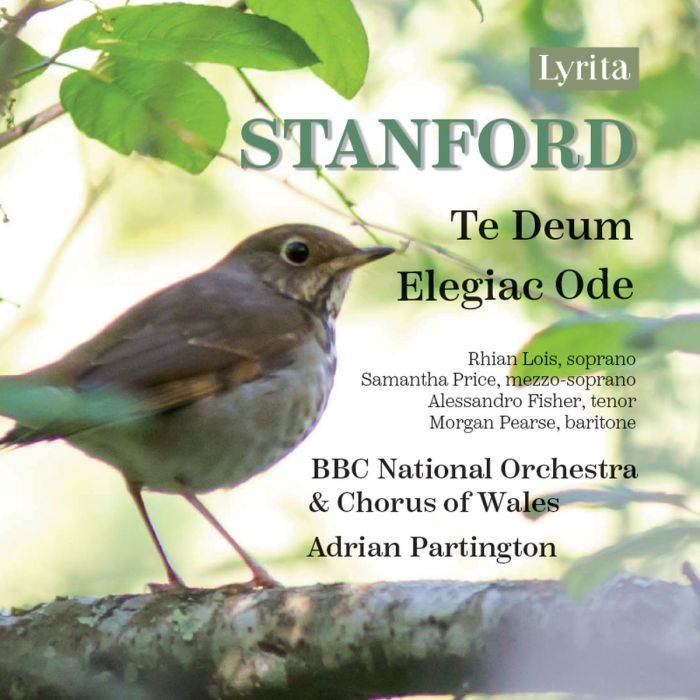
£14.99
In stock
Catalogue Number
SRCD435
- available to download and stream from all Digital Platforms
By the time Stanford had received a commission from the Norfolk and Norwich Festival to write a choral work for them in 1884, he had, at the age of 32, already begun to assert himself as one of Britain’s leading composers. The Elegiac Ode was, however, his first mature foray into the world of major British choral festivals. Some of the Elegiac Ode had in fact been sketched three years earlier in 1881, but after the Norwich commission was received, Stanford evidently grasped the opportunity to complete the work in its entirety in July 1884. The words were taken from the last part of Whitman’s elegy, ‘When lilacs in the dooryard bloom’d’, written in the aftermath of President Lincoln’s assassination in 1865 (it was a text which Stanford’s pupil, Holst, later used for his Ode to Death, composed in the wake of the war in 1919). Taking the seven verses of the burial hymn, Stanford divided his chosen text into four parts, thereby creating a four-movement musical structure more akin to a choral symphony with its substantial (and thematically related) choral outer movements flanking two shorter inner essays.
Stanford’s large-scale setting of the Te Deum Op. 66 was first sung at the Leeds Festival on 6 October 1898 and its ambitious, opulent dimensions were clearly intended to be a fitting commemoration of the accession to the throne of Queen Victoria (its dedicatee) sixty years earlier as well as a tribute to the full-bodied, well-trained Leeds chorus of 350 singers. A particular feature of the Te Deum is the grandeur of much of its choral writing. Though also dramatic in its impact, a dominating feature of the Te Deum is its prominent use of the chorus, and the many fulsome sonorities Stanford was able to draw from the magnificent ‘instrument’ of the Leeds voices. © Jeremy Dibble
Manufacturer: Wyastone Estate Limited, Wyastone Leys, Monmouth, NP25 3SR
Email: sales@wyastone.co.uk
Reviews:
"The performances on the disc have a sophistication and vigour that does full justice to the music. Adrian Partington marshals his large-scale forces admirably, and all concerned make a real case for this music. The disc fills in a valuable gap in the Stanford discography, but more importantly points to a composer whose choral inspirations were a world away from the British tendency to equate large-scale choral works with religion and Biblical texts." www.planethugill.com [read complete review]
“…this is likely to be the most important contribution on disc to the Stanford centenary... An outstanding CD which is likely to be the most important contribution on disc to the Stanford centenary... The present performance is excellent in every respect... the choral singing is very exciting and I also admired the clear diction of the BBC National Chorus of Wales (BBCNCW)... I don’t know how many singers were in the BBC National Chorus of Wales for this assignment, but, my goodness, they make a splendid job of the piece." John Quinn, musicweb-international.com [read complete review]
"Stanford’s major choral works have been lucky on disc recently with the Brabbins/Hyperion Requiem and the Hill/Naxos Stabat Mater prime examples. Lyrita, with the same conductor orchestra and chorus as on this new disc, offered the Mass ‘Via Victrix’…
If you are familiar with Stanford’s style there is nothing greatly to surprise here, but I do feel the sweep of the writing, the grandeur of the setting, and the sheer dynamic energy of the music, impresses more than in some of the other works mentioned.
Conductor Adrian Partington draws playing and singing of great skill and ardour from his BBC Welsh forces – the choral work is extensive and demanding but the Welsh chorus here rise fully to the occasion. The four soloists are likewise well matched and balanced, and they sing Stanford’s Italianate, near operatic lines with theatrical fervour. I enjoyed hearing tenor Alessandro Fisher again after his excellent On Wenlock Edge for Albion Records. Soprano Rhian Lois is fearless in attack although her actual sound is coloured by a noticeable vibrato.
The coupling is an unexpected but rather impressive early work. This is his Elegiac Ode of 1884 – Stanford’s first major offering to a British choral festival, and furthermore one of the first significant settings of the poetry of Walt Whitman. I usually associate Whitman with the generation who came after Stanford – I wonder if Vaughan Williams knew this work when writing his Toward the Unknown Region?
Jeremy Dibble in his predictably fine and illuminating liner notes suggests this is a quasi-choral symphony with the four movements (running for 27:12) playing continuously. Certainly, the structure and form is well handled and impressive with some of the orchestral writing more novel than the grand Te Deum. Baritone and Soprano have significant solos and again all elements of the performance convince." Nick Barnard, British Music Society
Elegiac Ode is an impressive composition. Stanford’s musical response to Whitman’s words is eloquent – and I speak as someone who isn’t the greatest fan of Whitman’s poetry. The present performance is excellent in every respect. However, for all the merits of the Ode, the real prize here is the Te Deum.
Stanford’s setting of the Te Deum was premiered at the 1898 Leeds Triennial Festival. Stanford had taken over as conductor of the Festival that year (succeeding Sir Arthur Sulivan); he was to remain in that post until 1910. The Te Deum was dedicated to Queen Victoria, whose Diamond Jubilee had been celebrated the previous year; it must have been an impressive calling card for the new Festival conductor. The work, which is sung in Latin, is for SATB soloists and chorus with orchestra and organ. It’s a big piece – here, it plays for 45:24 – and it’s emphatically a concert work….
Lyrita have presented the performances in excellent sound; there’s good clarity and a fine dynamic range while the loud passages have all the impact one could desire. This outstanding CD will be self-recommending to all devotees of Stanford’s music; I hope that it will also win new admirers for this fine composer. I think this is likely to be the most important contribution on disc to the Stanford centenary." John Quinn, MusicWeb International
" From its dramatic full-chorus opening, over a dramatic chord and timpani roll, the Te Deum is immediately impressive. The orchestra has its own contrapuntal duties and is a strong reason for the beauty of the elaborate setting..." Maureen Buja, Interlude
"The performances on the disc have a sophistication and vigour that does full justice to the music. Adrian Partington marshals his large-scale forces admirably, and all concerned make a real case for this music. The disc fills in a valuable gap in the Stanford discography, but more importantly points to a composer whose choral inspirations were a world away from the British tendency to equate large-scale choral works with religion and Biblical texts." Planethugil
"God Bless Lyrita. Once again, they have produced a first recording of neglected British music, this time two of Charles Villiers Stanford’s choral/orchestral works... Te Deum, almost twice as long as the Elegiac Ode, is scored for huge forces. Jeremy Dibble, the author of an exhaustive biography of Stanford, wrote the admirably informative booklet… To be frank, I am surprised how well I responded to this work. Clearly, Stanford was inspired to create a combination of the devotional with the triumphant affirmation of faith. The recording is excellent, the singing is fine, the chorus and orchestra are obviously well-prepared. The accompanying booklet is immensely detailed." Jim Westhead, MusicWeb International
"We’re fortunate that on this Lyrita release, the renditions are superb. The BBC National Orchestra and Chorus of Wales, conducted by Adrian Partington, perform with distinction. Both offer gorgeous, full-bodied sonority, taut execution, and sensitivity to dynamic gradations. The chorus’s precise diction, marvelously blended textures, and ease throughout the registers do full justice to Stanford’s writing. The solo quartet—soprano Rhian Lois, mezzo Samantha Price, tenor Alessandro Fisher, and baritone Morgan Pearse—are all more than equal to the challenges imposed by Stanford’s operatic approach. It seems to me that in these world premiere recordings, the participating artists have made the finest case for the pair of choral works. The booklet includes Jeremy Dibble’s liner notes, and full texts and translations. This is a fine choral disc, indeed. Recommended." Ken Meltzer, Fanfare Archive

|
| Sample Tracks |
|---|
|
Te Deum, Op. 66: III. No. 3 Judex crederis - Allegro energico
Te Deum, Op. 66: VI. No. 6 In te, Domine speravi - Allegro maestoso - Tranquillando - Andante Maestoso
Elegiac Ode, Op. 21: II. No. 2 Dark Mother, always gliding near - Allegretto con moto
|
0.135 kg