We use cookies to make your experience better. To comply with the new e-Privacy directive, we need to ask for your consent to set the cookies. Learn more.



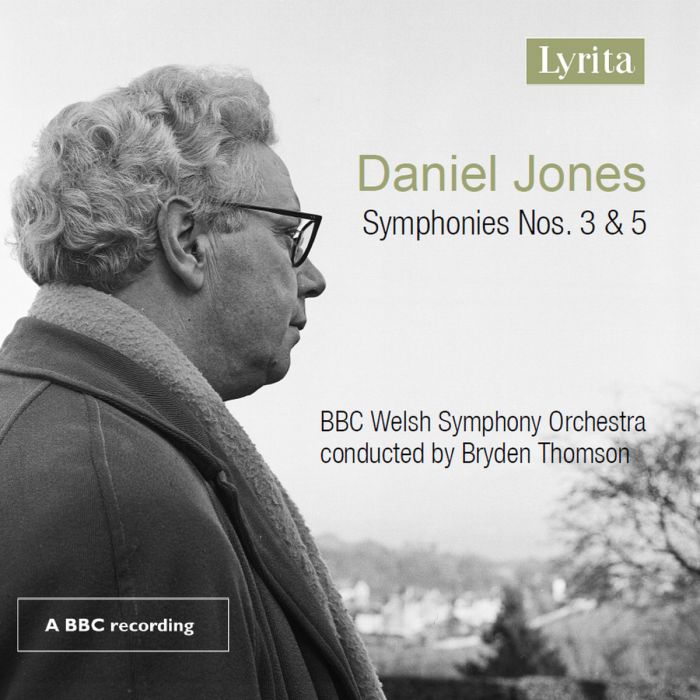
Daniel Jones: Symphonies Nos. 3 & 5
£14.99
In stock
Catalogue Number
SRCD390
‘The process of writing any piece of music really is one of discovery and the feeling I always have is that what I’m setting myself to write already exists and that what I have to do is unveil it, discover it’. This characterisation by Daniel Jones of the creative process as one of exploration and excavation seems appropriate for a composer whose scores have a powerful sense of rightness and inevitability. His lifelong dedication to music meant that he was unwilling to compromise by diluting it with other work, such as teaching. When he was mischievously accused of never having had a proper job, his response was to tap his manuscript and reply, ‘This is a proper job’.
Manufacturer: Wyastone Estate Limited, Wyastone Leys, Monmouth, NP25 3SR
Email: sales@wyastone.co.uk
Reviews:
EDITORIAL REVIEWS
I am going to make an assumption, at the outset of this review, that those who already know and love Daniel Jones' music (and who have been collecting Lyrita's series of releases of his music) need only hear that this latest release is well up to standard with good BBC sound buffed up for release and fine committed performances. For everybody else (which included myself before preparing this review), it might be helpful to provide some kind of introduction to this fascinating but neglected composer. So brace yourself for a distinctly novice guide to the music of Daniel Jones!
…I do not believe any music is wholly abstract and Jones, based on public statements, clearly believed that the most important aspects of his symphonies were the feelings they enshrined… Jones' music is not elemental in the way Sibelius' can be but it does have its own quiet grandeur. As I listened, I imagined myself exploring the hidden coves of the Gower. This is music that most definitely requires repeated and careful listening before it reveals its particular pleasures. On the surface, these are sturdy, well-made orchestral works of a mostly tonal nature. The reader is, however, encouraged to go further…
The paradox here is that without adequate rehearsal time and sufficient numbers of performances, performers are going to struggle to really grab the listener, but unless they do grab the listener, adequate rehearsal time and sufficient numbers of performances will not be forthcoming. Recordings like this are a crucial way of breaking out of that paradox and Lyrita and ultimately the BBC are to be thanked wholeheartedly for taking a risk on this music. As for the listener, there is no risk – this music is a real treat!
Music Web International – Classical Review
It's cast in three movements. The first has a short, slightly mysterious introduction which gives way to a strongly rhythmical Allegro moderato. Here, the music is taut and purposeful and the BBC Welsh SO plays it incisively and confidently… This section is quite turbulent at times; the tone of the music is serious and there's plenty of energy in the writing. The music rarely seems to rest, even when the dynamics are soft. Jones brings the movement to a conclusion that is quiet and, to my ears, somewhat uneasy.
…One thing's for sure: the beauty is certainly not just skin deep. The concluding Allegro is characterised by what seems like indefatigable rhythmic propulsion. Energy levels are high and the music is often spiky in nature. Bryden Thomson and his players give a committed and assured account of the music.
The music is vigorous and determined from the outset, although the oboe introduces a contrasting second theme (1:18) which other instruments then take up and develop. I admire the variety of orchestral textures and colours that Jones deploys in this movement as he develops his material; all sections of the orchestra are fully engaged though, as I said, he is self-disciplined when it comes to the percussion. This is a busy and interesting movement.
…The (second) movement contains a number of sections and one interesting little feature is that the start of each of these sections is denoted by a small contribution from the glockenspiel. The music is almost always fast, dynamic and rhythmically alert; the BBC Welsh make a very good job of it. This is attractive and inventive music.
The movement that follows features a considerable amount of contrapuntal music and of all the four movements I found it the hardest to get to grips with, whilst admiring the compositional skills. The music is very confident and purposeful from start to finish. The conclusion is strong and emphatic; one has the distinct impression that Jones has said all he wants or needs to say and so brings the symphony to a definite but unfussy end, and that's an admirable quality.
…The music and the performances were done proper justice by the BBC engineers and Lyrita's transfers are very good indeed. As ever, Paul Conway's notes are thorough in terms of the background and insightful and persuasive when it comes to describing the music. He certainly made it a lot easier for me to appreciate what I was hearing.
…Those who are collecting these CDs can add this latest one to their shopping list with confidence. I do hope Lyrita will be able to issue the final instalment in the series before long.
Music Web International – Classical Review

|
| Sample Tracks |
|---|
|
Symphony No. 3: III. Allegro
Symphony No. 5: I. Allegro moderato
|
0.135 kg