We use cookies to make your experience better. To comply with the new e-Privacy directive, we need to ask for your consent to set the cookies. Learn more.



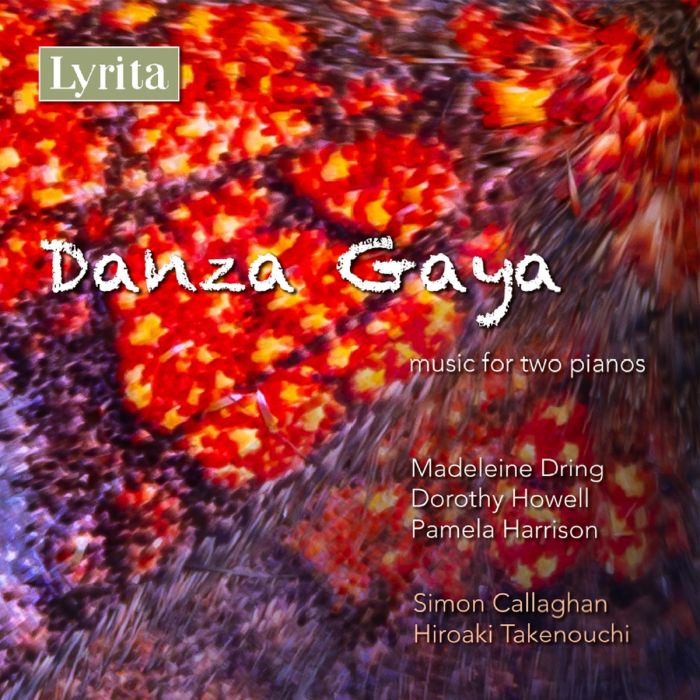
Danza Gaya: Music for Two Pianos
£14.99
In stock
Catalogue Number
SRCD433


This CD brings together three prolific but little-known British composers: Dorothy Howell (1898-1982), Pamela Harrison (1915-90), and Madeleine Dring (1923-77). Working in the same country at the same time, these composers had much in common. All studied at either the Royal Academy or Royal College of Music, and went on to have dual careers as composer-performers. They wrote tonal music in a style that would fall out of fashion in the later twentieth century, which has certainly contributed to their disappearance from concert halls. And above all, they composed with a great sense of humour. The music on this disc sparkles with wit and energy. In the mid-twentieth century the two piano combination was popular both in the concert hall and for light entertainment. It proved a perfect medium for composers who liked to bring a lightness of touch to their work, allowing them to write pieces that were fun both to play and to watch.
Manufacturer: Wyastone Estate Limited, Wyastone Leys, Monmouth, NP25 3SR
Email: sales@wyastone.co.uk
Reviews:
"The works presented here are all her works for piano duet or two pianos, all played here on two pianos. Danza Gaya (1965) gives the work its title and gets the CD off to a rousing start, but of the short works my favourite is the Tarantelle (1947) which really has the feel of a devil’s dance, and a naughty devil at that. Caribbean Dance (Tempo Tobago) from 1959 was clearly written with Benjamin’s Jamaican Rumba in mind and is great fun.
The two sizeable works are the Fantastic Variations on Lilliburlero for Two Pianos (1945), and the Sonata for two pianos (1951). The three-movement variations take the well-known tune and put it through all sorts of hoops. Abrupt, jokey key changes in number one, a night club blues in number two, and a madcap chase in the finale, before disappearing into the ether. She admired Milhaud’s Scaramouche and we can hear it here. The Sonata is seldom played, and the liner notes indicate it was poorly reviewed at its première. This is unfortunate as it is a good work. The first movement perhaps overdoes the dramatic dotted rhythms too much, but the second elegy, and the final toccata, never outstay their welcome. The finale has all the bustle and energy of Martinu about it and ends far too soon. The shorter works by Dorothy Howell and the little-known Pamela Harrison are performed with aplomb.
Simon Callaghan and Hiroaki Takenouchi are an expert piano duo, and the works could not wish for better interpreters. The sound is as exemplary as we have come to expect from Lyrita. Spring seems to be late this year so If you want to bring a little sunshine into life, buy this disc." Paul RW Jackson, British Music Society
"Some recordings arrive at exactly the right time, and Danza Gaya turned up after a long, stressful day and some inclement early spring weather. Madeleine Dring’s two-minute title track is better-known as a piece for oboe and piano, the composer noting that it “can be played with a slightly lazy feel or a little faster.” Simon Callaghan and Hiroaki Takenouchi’s effervescent two-piano version wins extra points by doing the latter, and will satisfy a craving you didn’t think you had. The bouncy bossa nova rhythms are synchronised to perfection, and you’ll be compelled to listen to it on a loop – on its own terms, “Danza Gaya” is a pocket-sized masterpiece. Callaghan and Takenouchi follow it with three more frothy dances, though the most substantial work here is an impressive 1951 Sonata for Two Pianos. Concise and serious-minded, it was received with bafflement by critics. We get two enjoyable sets of pieces for learners, Dring relishing the need “to try to write music that was attractive within a limited technical range.”
Also on the disc are works by Dorothy Howell (1898-1982) and Pamela Harrison (1915-90). Howell’s impressionistic, evocative Recuerdos Preciosos was composed in 1934 after a trip to Barcelona, its two movements inspired the stillness of the city’s gothic cathedral and the amusements at Tibidabo. 1920’s short, virtuosic “Spindrift” was Howell’s signature piece, brilliantly played here. Harrison’s Dance Little Lady dates from 1976, an entertaining sequence of six quirky dances. The closing “Tempo Giusto” sounds like pealing bells, the clangourous final chords brilliantly caught by producer Adrian Farmer. Excellent, detailed sleeve notes by Leah Broad seal the deal. Trust me: you NEED this album." Graham Rickson, theartsdesk.com
"It’s really wonderful to hear new music by composers who have fallen out of favour, and this recording of three women composers’ music for two pianos is inspirational in its effect. You could imagine some of this music being used today and sounding just as modern as when it was composed." Maureen Buja, Interlude [read complete review]
"Three 20th-century English women composers, thirteen pieces all virtually unknown; Simon Callaghan & Hiroaki Takenouchi take us on an engagingly enjoyable exploration Callaghan and Takenouchi begin with the captivating, Danza Gaya, then the deceptively frothy Valse française, a lively Italian Dance that evokes Arthur Benjamin and as does the altogether delightful Caribbean Dance.
Next comes Dorothy Howell… First of we hear her 1934 piece, Recuerdos Preciosos (Precious Memories), written after a trip to Barcelona, the first movement all laid-back heat and the quiet cool of the cloister in the cathedral, the second a lively evocation of a busy amusement park. The first response to these engaging pieces is why has it taken so long for pianists to bring them to our attention.
This disc brings together music by three women composers whose output has been somewhat side-lined because their music did not fit with post-war musical orthodoxies. They had the misfortune to be women, writing music that was tonal, approachable and, in some cases, with a distinct whiff of light music. We are learning to better know. Callaghan and Takenouchi play with wonderful elan and relish, clearing enjoying the sound-worlds and having a great deal of fun. And they must be thanked for digging up these treasures." Planet Hugill [read complete review]
"Danza Gaya rewards as both a terrific example of their artistry as piano partners (see their dazzling rendering of Dring's Tarantelle as an illustration) and as a testament to the thoroughly appealing music Howell, Harrison, and Dring produced during their lifetimes. The variety and sheer abundance of music featured is alone worth the price of admission, but one also repeatedly marvels at the razor-sharp synchronicity of the piano partners' playing." Textura [read complete review]
'Callaghan and Takenouchi play with wonderful elan and relish, clearing enjoying the sound-worlds and having a great deal of fun. And they must be thanked for digging up these treasures.' Planet Hugill
"The material the pianists chose for the release, recorded in August 2023, charms with melodic richness and warmth, and it's easy to imagine the music winning over audiences either as a full concert programme or as encore selections designed to end an evening on a lighter note. With nine of the thirteen works by her, Dring is the greatest beneficiary of the recording; Howell has three pieces appear, and Harrison a single work only. While some of Dring's works are presented on disc for the first time, the ones by her colleagues have never been recorded until now.
Leah Broad's detailed liner notes help flesh out the portraits of the composers. First attracting attention as a violin prodigy, Dring went on to establish herself as a composer, singer, pianist, and actress. She wrote incidental music for stage, radio, and television, endeavours that no doubt influenced the accessible style she favoured. The Birmingham-born Howell likewise played the violin and piano and knew early on she wanted to become a professional musician. After studying at the Royal Academy of Music, Howell went on to enjoy success with orchestral works during the 1920s and was often programmed alongside her contemporary Dame Ethel Smyth. Harrison, who, like Dring, studied at the Royal College of Music in London, had her first success with a 1938 quintet for flute, oboe and strings and after WWII (during which time she worked as a school teacher) produced a significant body of chamber, vocal, and orchestral music….
Don't let the somewhat disparaging “light music” term deter you from investigating what Callaghan and Takenouchi have done here. Danza Gaya rewards as both a terrific example of their artistry as piano partners (see their dazzling rendering of Dring's Tarantelle as an illustration) and as a testament to the thoroughly appealing music Howell, Harrison, and Dring produced during their lifetimes. The variety and sheer abundance of music featured is alone worth the price of admission, but one also repeatedly marvels at the razor-sharp synchronicity of the piano partners' playing." Textura, Full review here
“…this is a very attractive recital from which all involved parties; composers, performers and production team all emerge with their individual statures further enhanced….what’s not to enjoy!” Nick Barnard, MusicWeb International Full review here
"It’s really wonderful to hear new music by composers who have fallen out of favour, and this recording of three women composers’ music for two pianos is inspirational in its effect. You could imagine some of this music being used today and sounding just as modern as when it was composed." Maureen Buja, Interlude
Pamela Harrison’s Dance Little Lady was written for a friend who had taken up the piano rather late in life. The best of the six pieces are the scherzo and the rather Holstian lento. The set fits this disc’s brief, but those interested in her larger works might look at her chamber and vocal music.
Dorothy Howell’s four work here cover a range of styles. The Mazurka is an enjoyable teaching piece. Spindrift, perhaps her best-known work, used to be a popular concert number in its solo version. To describe it as a whirlwind of sound is to not do it justice… Madeleine Dring’s takes up about two-thirds of the programme. She is also better represented on disc. The four “geographical” pieces that come first were not written as a set, but they are a good overview of her lighter but distinctive style. Three for Two and the Four Duets are teaching pieces. They show that Dring had no difficulty injecting variety and interest into her works for this type of repertoire. More substantial is the clever Tarantelle, reminiscent of the film music of the late 1940s; she too wrote music for radio and television, as well as a good deal of incidental music, including for a 1945 play Apple-Pie Order. She revised the latter and published as Three Fantastic Variations on “Lilliburlero”. The variations are imaginative, with real sadness in the second and a lot of humor in the third. The pieces could have made a good short orchestral work if Dring had been inclined to orchestrate it.
The Sonata for Two Pianos was not well received at its premiere in 1951, I cannot see why. This is a major work for the medium with a striking, almost sinister opening movement, contrasted with a wistful central one and a stirring close in the final allegro vigoroso. It is hard to believe that this is the first recording.
Simon Callaghan and Hiroaki Takenouchi have recorded much repertoire for two pianos. Especially interesting is a recording of Saint-Saëns’s arrangements of Chopin’s and Liszt’s piano sonatas. They bring the same insight and clarity to this music. Delightful from start to finish." William Kreindler, MusicWeb International

|
| Sample Tracks |
|---|
|
Danza Gaya
Dance Little Lady: II. Moderato
Spindrift
Three Fantastic Variations on 'Lilliburlero': II. Andante
|
0.135 kg