We use cookies to make your experience better. To comply with the new e-Privacy directive, we need to ask for your consent to set the cookies. Learn more.


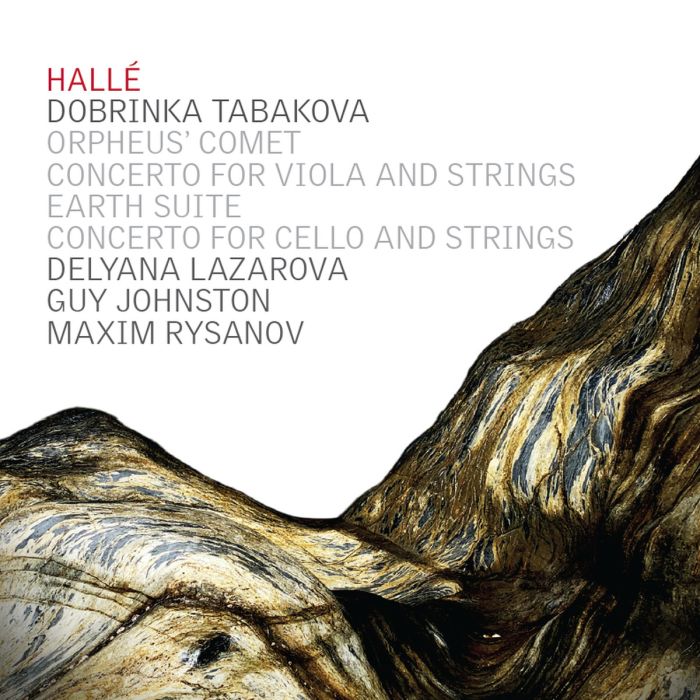
Dobrinka Tabakova: Orchestral Works & Concerti
£12.99
In stock
Catalogue Number
CDHLL7562
This album contains two of Tabakova’s major orchestral works. The three-part Earth Suite, which the composer says was inspired by ‘the overwhelming force of Nature’, recently drew ‘exquisite playing’ from the Hallé (Bachtrack, April 2023). Orpheus Comet features fast rhythmic material combined with atmospheric transparent orchestrations and a glorious climax featuring quotations from Monteverdi. The two significant concertos for strings and soloists included on this album solidified Tabakova’s reputation as an outstanding contemporary voice and display the composer’s close affinity with string instruments. Ukrainian-British Maxim Rysanov, is one of Tabakova’s longest collaborators who premiered the Concerto for Viola and Strings in 2004, a piece described as being ’saturated with an inner, captivating and natural energy’ (Culture Magazine, Nov 2004). The Concerto for Cello and Strings (whose score was described as ‘gorgeous’ by the Daily Telegraph, Australia) is here performed by Guy Johnson, one of the most exciting British cellists of his generation.
Manufacturer: Wyastone Estate Limited, Wyastone Leys, Monmouth, NP25 3SR
Email: sales@wyastone.co.uk
Reviews:
Bulgarian composer Dobrinka Tabakova—a graduate of the Guildhall School of Music and Drama and a PhD in composition from King's College London—has been the artist-in-residence at the Hallé (2022–2023) and has just recorded two of her main orchestral pieces and two concertos, for violin and cello, with the Hallé Orchestra.
Tabakova's creative work is intimately linked to the human experience, and this recording is an important chapter in the production of these years. We remember that she made her debut with String Paths (see the review), for ECM Records, that in 2014 she was nominated for a Grammy and that in 2017 she was composer-in-residence at the BBC Concert Orchestra.
One of the most remarkable characteristics of his work - for those who do not know it - is the beauty of the harmonic constructions. Her orchestral music is a party, as in the first piece on the album, Orpheus' Comet ('El cometa d'Orfeu', 2017), written during his residency at the BBC. This five-minute orchestral piece is based on the myth of Orpheus, found in the fourth book of Virgil's Georgics. The preeminence of metal, with bright and jovial themes, evidence the author's attention to detail. The exchange of impressions between two women, between two levels of communication—the composition and the direction—is fundamental in this recording. Dobrinka Tabakova and Delyana Lazarova, at the head of the Hallé Orchestra, give an immediate outlet to the expressiveness and rigor of the score in a receptive orchestra formed by the excellent Hallé musicians, who have captured the compositional essence of the pieces and have embodied through music the freedom and originality of the two professionals. Both the Concerto for Violin and Strings (2004) and the Concerto for Cello and Strings, and the symphonic movements of the Earth Suite ('Earth Suite'), link us to emotional states or experiences lived with passion. The two soloists, Guy Johnston (on cello) and Maxim Rysanov (on violin), are brilliant, striking and original in the corresponding concerts. Tabakova, who has explored various aesthetic paths, has been able to develop different compositional techniques, which move within the realm of melody, modality, dissonances and the rhythm of accentuated contours. This results in a mastery of consciousness in the elaboration of each of the works. Maria Ivanova, Sonograma Magazine
“Having fought against pressures inherent in her field, she has an unwavering reverence for melody and clarity” Hattie Butterworth.
“For several months I’ve had the numerous recordings of Dobrinka Tabakova’s Nocturne for solo piano on repeat. She wrote it in her twenties, in 2008; and now perhaps considered ‘in vogue’, this style of solo piano work feels at home in panoramic drone footage of Norwegian fjords on YouTube. But I added it to a playlist I have named ‘Cry’. It ignites something deeply emotional within me, and, indeed, much of Tabakova’s music engages with a rawness of human experience. Can we call it accessible? It’s a term that appears to be used in criticism of contemporary music – ‘accessible’ is perhaps the antithesis of the richly encouraged ‘academic’. Tabakova tells me about the pressure, deeply embedded in her education, to discard or disguise melody and its roots: ‘There was always and expectation of how your score should look in college. It had to have beams across bars and be visually really overwhelming. But that felt more like an exercise to me. I was striving to find the most direct route to expression and notation’.” Valerie Barber
"All this suggests ambiguous mood, but it is quickly dispelled: around one minute in, the melody emerges without asserting itself right away. A solemn chorale slowly appears, soon to be surrounded by variants of the initial buzzing. From then on, the music unfolds, and gains considerable impetus through a powerful build-up. That leads to an assertive statement of the melody but “with a modern twist”, as Tabakova has it. All in all, this is an all-around fine concert opener...Earth Suite has (so far) three independent movements, which may be performed in any order, or even separately. Tectonic was written in 2018, Timber & Steel in 2019, Pacific in 2020. Tectonic appeared in a BBC Music Magazine cover CD, so it may be somewhat better known. In this substantial piece, Tabakova shows her remarkable orchestral flair and ability to build in long paragraphs. There are echoes of, say, John Adams or Michael Torke: suggestions to speed up by juxtaposing short, nervous phrases and longer melodies. (This, it seems to me, is a frequent trait in her music.)...This splendid work deserves wider exposure. It had been recorded on an ECM disc which I have yet to hear, so I cannot compare the readings. In any case, Guy Johnston’s performance of this superb, demanding work is as assured and committed as one may hope for. All in all, this is a great release on all counts, with committed readings and in good sound. One can hear that both soloists are attuned to the music. They play with impeccable technique and, one assumes, with deep understanding. The Hallé led by Delyana Lazarova give a remarkably assured and convincing support." Hubert Culot