We use cookies to make your experience better. To comply with the new e-Privacy directive, we need to ask for your consent to set the cookies. Learn more.



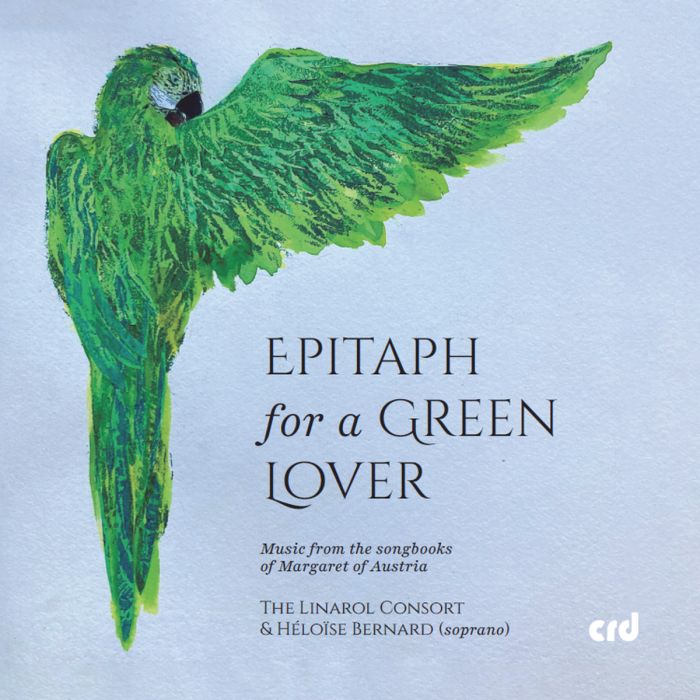
Epitaph for a Green Lover: Music from the songbooks of Margaret of Austria
£10.99
In stock
Catalogue Number
CRD3561
During our 2022 Continuo Foundation supported tour of music from the manuscripts of Margaret of Austria (1480-1530), which we entitled Epitaph for a Green Lover, it became clear that there was keen demand for the programme. After every performance of this beautiful and unrepresented music, the audience asked if we had made a recording; in the end, we took heed. Margaret of Austria, Duchess of Savoy, Governor of the Habsburg Netherlands, was a great patron of the arts who loved to dance and sing. But, above all, she loved her green parrot. Our programme’s title comes from the remarkable chanson Soubz ce tumbel with its tragic text by Margaret’s court poet, Jean Lemaire de Belges. In this song, we find a text drawn from de Belges’s Epitaphe de l’Amant Vert in which the amant vert (‘green lover’) refers to the beloved green parrot. This chanson, along with all the songs featured on this album, come from the two extant songbooks or chansonniers of Margaret of Austria, which are now housed in the Brussels Royal Library. Alongside the songbooks, Margaret’s library consisted of over 350 treasures, including the Très Riches Heures de duc de Berry, the Sforza Hours and an exquisitely decorated book of basse dances on black-stained vellum with silver and gold calligraphy. Such a collection gives a sense of how Margaret was a linchpin in Renaissance culture. Our aim is to transport the modern-day listener to Margaret of Austria’s court through music. Our programme even allows us to give insight into her character since some of her own poetry was set to music by her favourite musicians; we have featured a selection on this album. We have had such pleasure exploring this music and sharing it with audiences in concert, and are thrilled to now bring this stunning repertoire to listeners through this recording. © The Linarol Consort
Manufacturer: Wyastone Estate Limited, Wyastone Leys, Monmouth, NP25 3SR
Email: sales@wyastone.co.uk
Reviews:
"...Some of the music consists of instrumental performances of polyphonic chansons (played exquisitely by the Linarol viol consort on reproductions of 16th-century instruments), while on other tracks the group accompanies the singing of Héloïse Bernard, a soprano whose astonishingly lovely voice manages to be both luminous and dark-hued. It would be hard to overstate both the charm and the mystery of this music, which partakes of the unique melodic strangeness of the late medieval/early Renaissance period; any library with a collecting interest in early music should jump at the chance to add this disc to its collection." Rick Anderson, CD Hotlist
"The violas of the Linarol Consort —recreated from historical instruments of the sixteenth century— offer a warm, velvety and extraordinarily homogeneous sound. David Hatcher, Claire Horáček, Timothy Lin and Alison Kinder build a polyphonic fabric of great subtlety, always attentive to the phrasing and breathing of the text. The ensemble approaches these chansons with an exceptional timbral sensitivity, fleeing both rhetorical excess and a purely documentary reading. The violas create a dense but transparent sound space, of an almost hypnotic warmth, which sustains the entire recording with a very natural musical breath.
The instrumentalists show an admirable cohesion in the way they model the contrapuntal lines. The discourse flows with flexibility and elegance, and the group knows how to constantly preserve that very delicate balance between courtly refinement and intimate expressiveness that this repertoire demands. In the midst of this instrumental fabric, the soprano Héloïse Bernard emerges with admirable naturalness. His luminous voice avoids any excessive declamatory gesture and emphasizes above all the value of the text and the fusion with the violas.
Bernard sings with a very elegant line, a clear diction and a great ability to convey emotion without unnecessary underlining. It is precisely in this relationship between voice and instrument that the album finds much of its uniqueness. As the soprano herself explains in the libretto, she does not sing "accompanied by the violas, but with the violas", and this idea is constantly perceived throughout the recording: the voice does not dominate the whole, but is integrated into it as one more texture, emerging and disappearing within the polyphonic tapestry with extraordinary delicacy. An exemplary musicological recovery and, above all, an album of serene and persistent beauty." Marçal Borotau, Sonogram Magazine