We use cookies to make your experience better. To comply with the new e-Privacy directive, we need to ask for your consent to set the cookies. Learn more.



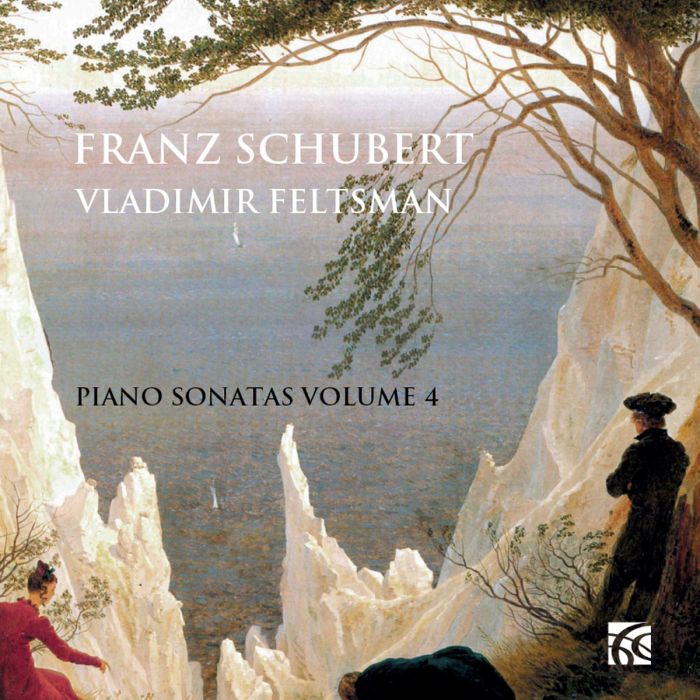
Franz Schubert: Piano Music Volume 4
£14.99
In stock
Catalogue Number
NI6345

Schubert wrote eleven complete sonatas between 1817 and 1828. He also composed movements for several sonatas which he left unfinished. Sonata in A minor D784 is one of the most important singular works in Schubert’s output that stays apart from his previous and later sonatas. It is an austere, almost minimalistic work that achieves a profound and lasting impact. It is one of the darkest and most unsettling pieces he ever wrote and one of the most confessional. This relatively short sonata, by Schubert’s standards, is one of the most authentic, prophetic and enigmatic works ever written. Sonata in A major D959 was written in 1828, the last year of Schubert’s life, very rapidly alongside the sonatas in C minor and B-flat major, just a few month before his death. The speed, quality and quantity of Schubert’s output in the last year of his life are a marvel. In his last year, Schubert wrote some of the most important work that sums up his ideas, inspiration and ambitions as a composer. These incredible works were written by the artist at the peak of his creative powers with clarity and precision. In these works, including the last three sonatas, Schubert points the ways to resolving the perennial conflicts of existence: his final message seems to be that of acceptance and reconciliation. Towards the end of his life, Schubert was learning to accept death as a promise, as a blessing…Vladimir Feltsman
Manufacturer: Wyastone Estate Limited, Wyastone Leys, Monmouth, NP25 3SR
Email: sales@wyastone.co.uk
Reviews:
"This is the fourth in a series of six CDs of Schubert piano sonatas, whose issue is scheduled to be completed this year. I warmly received the first three in my previous reviews and this latest instalment maintains their quality.
This recital consists of two great sonatas, starting with the typically grand and imposing middle period work, D 784. Feltsman employs a very strong, direct tone, the bass-line sonorities emphasised to enhance the sombre, weighty character of the sonata. Feltsman underlines the gravitas to serve as a contrast to the relative calm of the second half of the development and encompass that paradoxical Schubertian amalgam of lonely despair and essential lyricism within one movement. The three carefully weighted concluding chords provide a sense of resignation and acceptance. The deceptively simple little Andante gradually takes on a disturbing note as its syncopated figure gains prominence and Feltsman gauges that transition in mood perfectly. The rushing finale is played with great vehemence but in tempo, if not affect, is rather more measured than Richter’s headlong attack; it ends on four, repeated, brutally absolute chords.
That uneasy yet immensely fecund combination of dark despair and burgeoning hope is immediately apparent in the opening of D 959, the second component of this volume. The rhythmic precision and clarity of exposition of Feltsman’s playing are compelling; the listener is swept along on the melodic tide. This is assertive yet extraordinarily sensitive and fluid pianism. The Andantino begins like a Lied, plainly, almost stolidly, then the fantasia element takes over, yet, as so often in Feltsman’s interpretation, there is something of repressed violence to be heard. Nonetheless, he is able to relax into the waltzing insouciance of the Scherzo. That mood spills over into the long finale, which is similarly released and Feltsman articulates the cascading arpeggios with no strain; we are worlds away from the conflicted opening.
Feltsman’s accounts of these two Schubertian masterpieces are by no means the only recommendable versions, but this is masterly playing by a foremost exponent of Schubert extant today and another valuable step on the road to completion of the series" Ralph Moore, MusicWeb-International
"Vladimir Feltsman, whose Bach recordings impressed me so greatly more than a decade ago, is now embarking on the complete piano sonatas of Schubert. This is Vol. 4 in the series, and it is indeed an extremely interesting approach to the music. The very opening of the sonata D. 784 is quiet, introspective, even mysterious in mood, but as soon as the volume increases Feltsman pounces on the keyboard like a tiger. Another interesting feature of his performance is that, despite the introspective passages, he takes this echt-Romantic music in strict tempo, using touches of rubato in the soft moments but a full-speed-ahead approach in the louder, faster moments.
This gives the music a more cohesive feeling than is often the case in Schubert, whose piano sonatas are more like extended fantasias. Each movement is a peculiar and self-contained psychological trek, while at the same time the separate movements never quite seem to relate to one another the way they do in Beethoven. Thus, to a point, I found Feltsman’s approach both bracing and musically logical.
By and large, I find Feltsman’s approach more appropriate in the Sonata D. 959, but this is a work where the phrases seem to follow one another with greater logic and less contrasts of mood. I was mesmerized by the opening movement of this sonata, where the tumblers all fall into place and everything makes perfect sense, and his performance of the second movement is particularly fiery, even a bit edgy, which I liked. I also liked the introspection he brought to the final section of that movement, and taken on its own merits, this was quite fascinating." Lynn René Bayley
"My overall impression, so far, is of a strong individual, perhaps following the Russian tradition of Sviatoslav Richter…
My overriding impression of Feltsman's D784, composed when Schubert was just 26, is that he perceives this very much as a serious work. There is an overriding darkness which anticipates deep works such as the song cycle "Winterreise" (Winter Journey) and the final String Quartet No.15 in G major D887… All in all, this Sonata deserves recognition and is worth several listens before its qualities come through. The engineers deserve congratulations on perfectly capturing those final chords.
The second piece here is the penultimate Sonata No.20 D959 and as in his performance of D960 from Volume 2 I find Feltsman absolutely absorbing. The first movement is contrasts outward melody with darker introspection but Feltsman moves effortlessly through the various twists and turns… The listener will know from listening to this opening movement Feltsman's preferred approach. I relate to it highly and feel he is conveying all the qualities of Schubert that I find so intriguing and appealing. He sweeps us along by a force that sometimes seems out of control. There is a liquid nature to Feltsman's playing in the Andantino and he calls to mind the First of the Impromptus D899, which are all from the same pianistic joinery. Schubert's pent-up frustration, sexual or knowledge of impending death, I don't know, but it's certainly conveyed in a very individual manner… I enjoyed it enormously. Feltsman so clearly loves this music but avoids any unnecessary ornamentation. It ends another highly satisfactory recital.
This fourth volume continues the very high standard in interpretation and recording reflected in the other discs. The notes by Feltsman are excellent and informative. If you haven't ventured into this series yet, then this entry point is as good as any. I look forward to hearing and evaluating Volume 5) very soon." Music Web International – Classical Review

|
| Sample Tracks |
|---|
|
Sonata in A Minor, D. 784: I. Allegro giusto
Sonata in A Major, D. 959: I. Allegro
Sonata in A Major, D. 959: IV. Rondo Allegretto
|
0.135 kg