We use cookies to make your experience better. To comply with the new e-Privacy directive, we need to ask for your consent to set the cookies. Learn more.


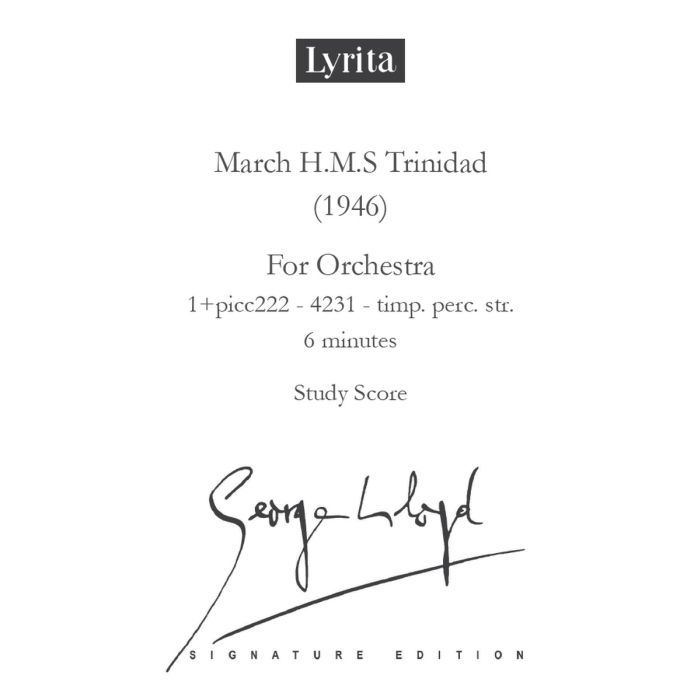
George Lloyd: March H.M.S. Trinidad for Orchestra - Study Score [Printed Music]
£19.99
In stock
Catalogue Number
SRMP0039
For Orchestra
24-page A4 saddle-stitched Score
c.6 mins
The HMS Trinidad March was composed for the ship on which George Lloyd served during the Second World War and became, in his words, “the official ship’s march”. When HMS Trinidad was commissioned on 14 October 1941, bandmaster Harold A Davis asked George to write the ship’s official march. Unbeknown to Harold, a friend of the ship’s captain, the composer Ralph Vaughan Williams, had also been invited to write a march. The captain agreed to listen to both men’s marches and decide which was to be used. Vaughan Williams’ march was not popular with the bandsmen and when both pieces were premiered in the ship’s aircraft hangar, the captain announced that George’s music would be adopted as the HMS Trinidad’s official march. George’s rousing march echoes the role of the Fantasia on British Sea Songs traditionally played at the Last Night of the Proms, with its links to the Navy and its catchy tunes and up tempo rhythms, which encourage audience participation.
A PDF Version of this score is available upon request. Please contact publishing@wyastone.co.uk
FULL SCORE AND PARTS ALSO AVAILABLE FOR HIRE [SRMP0040] FOR DETAILS PLEASE CONTACT NIMBUS MUSIC PUBLISHING
Tel: (+44) 1600 890 007 Email: publishing@wyastone.co.uk
A recording of this work is available on CD [SRCD425] or to Download and Stream
Manufacturer: Wyastone Estate Limited, Wyastone Leys, Monmouth, NP25 3SR
Email: sales@wyastone.co.uk
Reviews:
"In Lloyd's music, one can experience the existential, traumatic experiences and the longing for redemption and transcendence at every turn. And one immediately understands that he must have been a born opera composer (his three operas will be released in the Lyrita edition): melodically as catchy as they are distinctive, rhythmically extremely vibrant, and consistently captivating in its events characterized by strong contrasts. While these events do not unfold in contradiction to purely musical laws, they follow an almost tangible plot that, in its surprising and extremely effective twists and turns, enthralls the listener like a thrilling film. The expressive range extends from capriciously lively scherzos (flirting with "light music") to the most intimate lyricism and on to the catastrophic.
Lloyd has amalgamated the entire tradition and transformed the simple and the complex into something unmistakably his own. He constructs his large-scale forms with a sure hand, and except in the first symphony, there is no schematic approach and no dullness. The orchestration is of magnificent power, delicacy, and versatility (one has to invoke names like Tchaikovsky or Rachmaninoff to make suitable comparisons). For beginners, I would recommend works such as the vehement first piano concerto, the transfigured cello concerto, the profoundly visionary John Donne cantata "A Litany," and, of course, all the mature symphonies. The second violin concerto (with strings) and the piano and chamber music are also wonderful. There are no shortcomings, even though around 1970 he went through a phase that tended more towards factual brevity! As a symphonist, Lloyd reaches a solitary peak in the tragic Seventh Symphony (1957-59). With "H. M. S. Trinidad," he wrote one of the most magnificent marches in history. And when, at the end of the monumental "Symphonic Mass," the solo trumpet, in an improvisationally liberating manner, winds its farewell around the vocal line, we are all simply moved. George Lloyd is a great discovery!” Christoph Schlüren, Fono Forum