We use cookies to make your experience better. To comply with the new e-Privacy directive, we need to ask for your consent to set the cookies. Learn more.


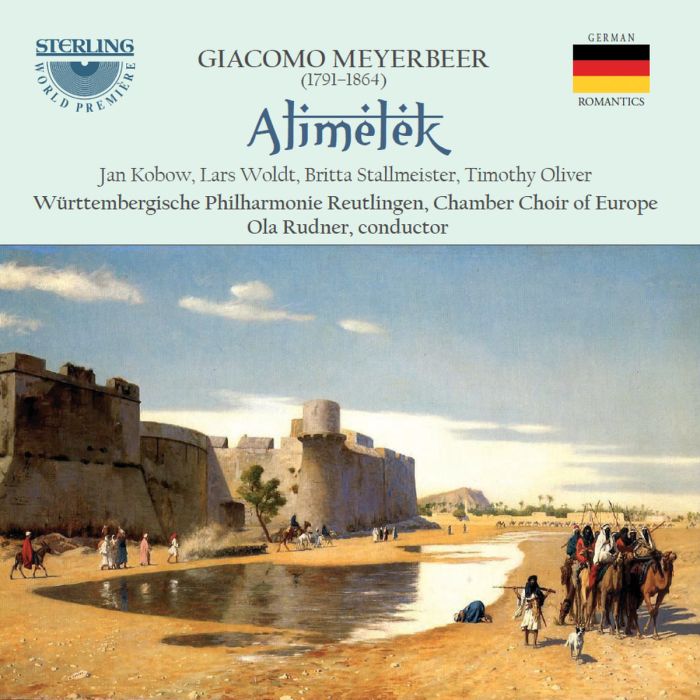
Giacomo Meyerbeer: Alimelek - an Opera in Two Acts
£19.99
In stock
Catalogue Number
CDO1125
The story takes place in Baghdad at the time of the reign of Caliph Harun-al-Rashid, which is best imagined at the distance of a fairy tale. It is about two young people, the rich merchant’s son Alimelek and Irene, the caliph’s niece. Both grow up in prosperity and idleness. After the death of her parents, Irene was received by the caliph and brought up with paternal love and an uncommon freedom.
Eventually she also takes the liberty to refuse Prince Selim, the caliph’s choice of husband, which considerably troubles her relationship with the caliph. She is considering fleeing the palace. The opportunity comes when a pleasure boat gets into a storm and capsizes. Only Irene is rescued from the tragedy, by the hand of Alimelek, who, wanting for anything better to do, happens to be at sea. When Irene opens her eyes, it is love at first sight and the two decide to live together as man and wife in Alimelek’s grandiose home. Of course, Alimelek must hide his young wife, because the caliph has people all over the town looking for her. His previous drinking companions – on whom he has already wasted half of the fortune he inherited from his father, and whom he less and less regards as his friends – he quite easily breaks with, in favour of a more secluded life. His hospitality is only shown to strangers, for whom he does not have to fear that Irene’s identity will be recognized.
Manufacturer: Wyastone Estate Limited, Wyastone Leys, Monmouth, NP25 3SR
Email: sales@wyastone.co.uk
Reviews:
Giacomo Meyerbeer is the only composer that I can think of who composed for three different and equally important eras of 19th century music. His works straddle the German Romantic school, Italian bel-canto and French grand opera. Alimelek, to use the shortened title, is the first opera that he composed and received its world premiere in Stuttgart in January of 1813. The libretto was based on The Tale of the Sleeper and the Waker from Volume One of Burton’s translations of “One Thousand and One Nights”. The plot concerns the wealthy young muslim Alimelek, who lives a somewhat reckless life with his runaway love Irene. He is saddled with a group of freeloading friends who are flouting the muslim laws enough to have the Caliph of Bagdad arrive incognito to investigate him. The Caliph happens to be the very person whom Irene ran away from. The Caliph forms a plan to drug Alimelek with some forbidden wine and remove him to his own palace, where after waking him up, he arranges an elaborate deception to convince Alimelek that he is now the Caliph. All of this is in order to determine how much punishment is warranted for stealing his intended, Irene. In the end all ends happily as the Caliph forgives both Irene and Alimelek.
For a first opera, Meyerbeer’s compositional style shows a remarkable level of maturity and craft. The music shows a strong influence of Turkish mania, which was beginning to wane by 1812. Meyerbeer’s opera is a singspiel which puts it in direct comparison with Mozart’s Die Entführing aus dem Serail. The Turkish aspects of the overture and elsewhere are certainly influenced by Mozart but I must ask why there is so much Istanbul and Janissary-like percussive effects to the music when we are actually in Bagdad? Presumably there was no European musical language available to depict other Middle Eastern cultures until Rimsky-Korsakov got around to composing Shehérezade; as Félicien David’s disappointingly banal symphonic ode, Le désert gives ample proof of. Even so, Meybeer shows a fully developed plasticity of form, particularly in regards to his innovative use of the orchestra, a gift which would serve him well throughout his career. The musical numbers are quite well integrated with the story as the opening double chorus of the Freeloaders demonstrates. Act Two opens with another chorus, this time for a group of slaves, which is even more germane to the action, and it has some delightful Schubertian qualities about it before evolving into a Beethoven-like conclusion. Interestingly, there is a wonderful drinking song for the title character, which aside from being strictly forbidden for Muslims, incorporates some really delightful scoring for the woodwind section.
The live concert performance,e that was recorded here by the German Südwestrundfunk is a decently produced achievement in no small part due to the care and attention of Conductor Ola Rudner who paces things with style and verve. The Württemberg orchestra do full justice to the lovely scoring job that Meyerbeer gave them.
In a time when good documentation for a recording seems like ancient history, Sterling has led the way with not one, but two booklets. The first is an informative history of the opera, and the second is the complete libretto including all of the dialogue with full English translation. There is a great deal of dialogue in this singspiel, and much of it has been recorded. Sterling is really to be commended for printing the dialogue in its complete form with clear indications of the sections that were unperformed.
While Alimelek will never be considered Meyerbeer’s masterpiece, it certainly has enough of interest in it to deserve an occasional airing. This recording has been long in preparation but fills an important gap in the Meyerbeer canon. I would suggest snapping up a copy while one is able to. Mike Parr, MusicWeb-International

|
| Sample Tracks |
|---|
|
Alimelek, Act 1: II. Freund es hilft kein Widerstreben; Dialogue: Meister Ibrahim
Alimelek, Act 2: VII. Welch böser Zauber; Dialogue: Frau aus bester Quelle
|
0.235 kg