We use cookies to make your experience better. To comply with the new e-Privacy directive, we need to ask for your consent to set the cookies. Learn more.


Igor Stravinsky: The Soldier's Tale
£12.99
In stock
Catalogue Number
CDHLL7560
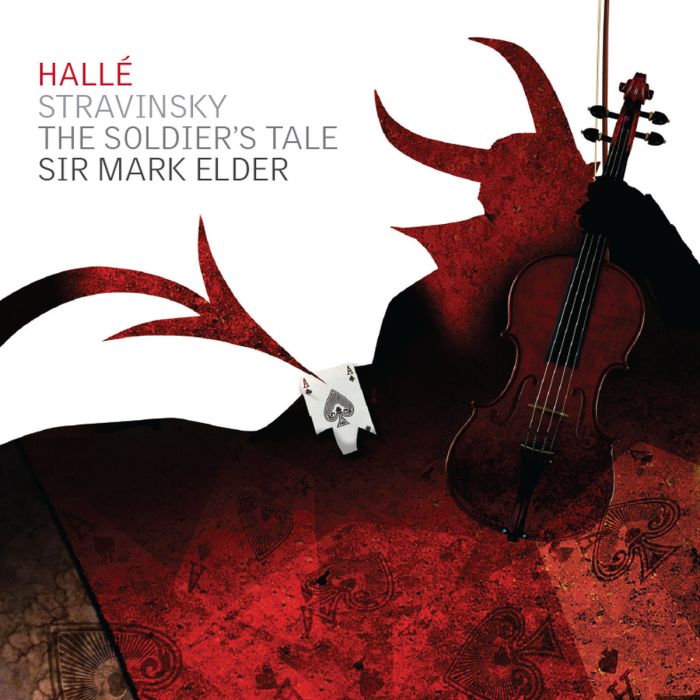
In 2021 Hallé marked the 50th anniversary of Stravinsky’s death with a ground-breaking film of The Soldier’s Tale, subsequently shown on BBC Four on Remembrance Sunday 2022. This album features specially remastered audio of the highly acclaimed soundtrack, featuring principal players of the Hallé under Music Director Sir Mark Elder.
At the height of the First World War, when Stravinsky and collaborators needed to generate funds, they devised this landmark piece of music theatre, which would be suitable for touring due to its small scale. Based on Russian folk songs, the score sees Stravinsky at his unique and evocative best, in music featuring great rhythmic interest, lyrical beauty, humour, jazz and popular dances. Hallé principals under Music Director Sir Mark Elder deliver an acclaimed performance of great skill and colour.
This modern morality tale feels as relevant today as when it was written, and Jeremy Sams’ witty and engaging translation of Ramuz’s French text provides the perfect backdrop to an ensemble of actors who brilliantly display the story’s characters.
Manufacturer: Wyastone Estate Limited, Wyastone Leys, Monmouth, NP25 3SR
Email: sales@wyastone.co.uk
Reviews:
"The 50th anniversary of Stravinsky's death in 2021 took a bit of a hammering due to Covid, so this opportunity by the Halle Orchestra to issue a remastered version on the soundtrack its musicians recorded for a film version of The Soldier's Tale. Broadcast by the BBC on Remembrance Day 2022, is welcome reparation. The seven piece ensemble, with actors Richard Katz (narrator), Martin Imhangbe (soldier) and Mark Lockyer (devil), perform Stravinsky's caustic Faustian parable with magnetic precision and pathos under the poised and purposeful direction of Sir Mark Elder. In a world born of necessity - Stravinsky was cash-strapped in Switzerland at the start of the first World War- the result is a musical toy box filled with fruity playthings and sparky characterisations, from its devilish signature March to such sardonic parodies as the gauche Tango and burlesque Ragtime. There's never a dull moment."
Ken Walton
“…Stravinsky’s The Soldier’s Tale is based on a Faustian yarn from Russian folklore and was created in collaboration with his friend the Swiss writer Charles-Ferdinand Ramus. He and Stravinsky were both short of money owing to the disruptions of the 1914-18 war, and Ramus came up with the idea of an inexpensive piece intended to be “read, played and danced” by a small troupe of travelling performers, using a stage on a trestle so that it could be given even in smaller places with no theatre… At several points, Stravinsky’s brilliantly inventive score – as revolutionary in its way as The Rite of Spring of five years earlier – gains extra poignancy from being heard in its narrative context… The musicians of the Hallé demonstrates exquisite playing for Sir Mark Elder. Just one example is the wailing woodwind phrases of the Pastorale when the soldier begins to realize the pickle he is in. Similarly, Sir Mark brings out Austro-Hungarian associations of the cleverly inverted Royal March. Throughout the recording quality is excellent and the musicians are perfectly placed within the sound field." - Mike Parr, musicweb international Full review here
"This new translation by Jeremy Sams (who did such brilliant work translating Winterreise into English as Winter Journey) does add a brio and fresh punch, and is well delivered By Richard Katz (Narrator), channelling Brian Cant from vintage BBC Children’s series Playaway, Martins Imhangbe as a likeable Soldier and Mark Lockyer, a perky, rustic Devil…The playing of the small band taken from the Hallé is great, from Peter Lang’s gusty violin to Emily Hultmark’s quizzical bassoon, and it’s all led briskly by Sir Mark Elder. There are lots of recordings of The Solider’s Tale…and this Hallé version is better than most." - Bernard Hughes
"For this fiftieth anniversary performance, a contemporary English translation prepared by Jeremy Sams is used. The three actors convey their text with proficiency and clarity, making it straightforward to hear or follow the text in the booklet. The work is modestly scored; Stravinsky uses a septet of violin, double bass, clarinet, bassoon, cornet (or trumpet as used here), trombone and percussion, played here by Hallé orchestra principals. Sir Mark Elder obviously takes this Hallé project seriously and the playing of Stravinsky’s score is first class, stylish with no shortage of colour. " - Michael Cookson