We use cookies to make your experience better. To comply with the new e-Privacy directive, we need to ask for your consent to set the cookies. Learn more.



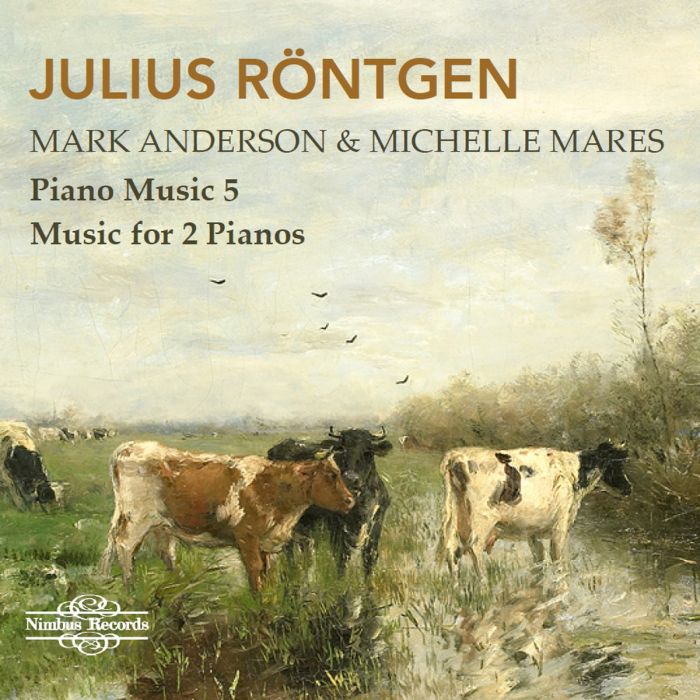
Julius Röntgen: Piano Music Vol. 5 - Music for 2 Pianos
£14.99
In stock
Catalogue Number
NI5996

This recording offers the listener an interconnected view of romantic and postromantic repertoire for two pianos, much of it unknown and even unpublished, until now. The best-known work here is Brahms’ Variations on a Theme by Haydn, Op.56b but there are other works included that deserve wider circulation and exposure. The two sets of variations by Carl Reinecke (1824-1910) are exquisite examples of 2-piano writing and exhibit attractive traits of the Leipzig School, at times providing strong echoes of Schumann and J.S. Bach, quite overtly in his Variations on a Sarabande by J.S. Bach. Likewise, the two sets of previously unpublished works by Julius Rontgen (1855-1932), whose early works are well-rooted in that same Leipzig School, reveal a mastery of composition in the 2-piano genre, an area in which he is currently unknown. Chamber music, concerti and even symphonies, alongside the growing popularity of his solo piano music, are well known genres for Rontgen. However, this recording presents Röntgen’s debut as a composer in the 2-piano medium. In our opinion, his success is as astounding as the obscurity of these works is bewildering.
Manufacturer: Wyastone Estate Limited, Wyastone Leys, Monmouth, NP25 3SR
Email: sales@wyastone.co.uk
Reviews:
"In the latest volume of this fascinating series Mark Anderson and Nimbus Records have taken a slight detour to explore the music for two pianos, bringing pianist Michelle Mares into the fold. They have chosen to contrast two of his variation sets with two piano repertoire by Carl Reinecke and Johannes Brahms that, to be fair, is in a similar vein. I can see the appeal and it is good to hear the Reinecke in fine performances. Scores, of course, are not always easy to come by and it is worth noting that Nimbus have published the scores of both of the Röntgen variation sets that appear on this disc.
The disc opens with the almost heart-rending strains of the theme by César Franck...except it isn't by Franck. The theme, Chant de la Creuse, is a folksong that art critic Paul Poujard, who came from the Creuse region of France, introduced to Franck in 1888 and who then turned it into the second of his 18 Pièces brèves for harmonium. Röntgen is masterful in his treatment of this theme.
If we sense the spirit of Brahms at times in Röntgen's music then it is the spirit of Robert Schumann that infuses the Andante and variations by Carl Reinecke. This may be an early work but it is wonderfully constructed with a lovely, lyrical theme that I imagine Schumann would have been proud of. There is also creative use of the medium; the interplay in the early variations, playfully passed triplet figures between the pianos or the heroic chords of the following variation. We have a madly galloping allegretto and a delicious presto waltz that suddenly takes a detour into baroque inspired counterpoint full of treacherous octaves, handled fearlessly by the team of Anderson and Mares. This is the finale and it suggests a grand conclusion is just around the corner but instead Reinecke chooses to recapitulate the heart warming andante and bring the work to a satisfyingly calm close.
The final work on the disc needs no introduction or description from me. Quite apart from the fact that Brahms' Variations on a theme by Joseph Haydn are famously not on a theme by Haydn in the same way that Röntgen's Variations on a theme by César Franck aren't on a theme by Franck this work fits very well into the programme alongside the heavily Brahms-influenced variations by Röntgen. I am impressed with the performances throughout and delighted to be introduced to these wonderfully crafted and appealing works. The Röntgen are first recordings as, I believe, are the Reinecke Sarabande variations. This new recording, in excellent sound, is well worth exploring. I look forward to further volumes in this enterprising series – perhaps we will get to hear the Passacaglia on a theme by Donald Francis Tovey before too long?" Rob Challinor, MusicWebInternational
"First, are Röntgen's 1903 variations on a theme by Franck… The following variation is rather lovely and builds on the melody found in the main theme with some splendid added harmonies... There is a little postlude which provides a very apt and harmonically clever ending to the work.
Reinecke's Op.24 variations follow, using Bach's Sarabande from the First French Suite as a basis for seven variations and a finale. I think this is a magnificent work and here it is played superbly… his is another superb piece and is given a great performance.
Track 3 is Röntgen's Variations on a theme by Beethoven, with the theme from the finale of Beethoven's string quartet no.13, Op.130. This starts in a very dark place, full of menacing rhythms and strange harmonies in a minor key but resolves itself to the major key theme at about 1'30'' and it sounds utterly charming... The notes give a detailed breakdown of the structure of the closing variations of the work in which Röntgen quotes part of the opening movement of the quartet… The playing of both pianists is exemplary throughout.
Carl Reinecke's early Op.6 variations follow… There are many clever pieces of writing here; for example, the abrupt change from fast to slow at 4'14'' is marvellously handled, coming as quite a surprise, and the proceeding bouncy variation is brilliant… The last few moments are a delightful baroque-inspired, virtuoso showpiece for both pianists and is splendidly played. The ending is suitably florid and complex writing with plenty of virtuoso flourishes...Whatever you call them, this is a superb work and it is magnificently played throughout…
The longest work on the disc is Brahms' marvellous Variations on a Theme of (not actually by) Haydn. Here, the tempo is swift but not too swift and the interplay between the soloists is absolutely magnificent. The opening 'Andante' is perfectly judged and the proceeding variations are marvellously played so that they gradually build intelligently towards the finale… The final statement of the theme, with all its added octave runs, is celebratory in feel and is brilliant. I have several recordings of this work in this version and I have to say that this is my new favourite of them all.
This is another superb addition to the series - the playing is excellent throughout and the two pianists clearly work extremely well together… I should say that listening on headphones to this is impressive, as you can tell which piano is playing which notes. Added to the fact that four of the works on the CD are in my opinion of a very high quality and had been totally forgotten, this is a marvellous CD all round. The cover notes are well written and provide a lot of detail about the music and some interesting thoughts about the works…" MusicWeb International

|
| Sample Tracks |
|---|
|
Variations on a Theme by César Franck (arr. Julius Röntgen)
Variations on a Sarabande by J.S. Bach. Op. 24
|
0.135 kg