We use cookies to make your experience better. To comply with the new e-Privacy directive, we need to ask for your consent to set the cookies. Learn more.



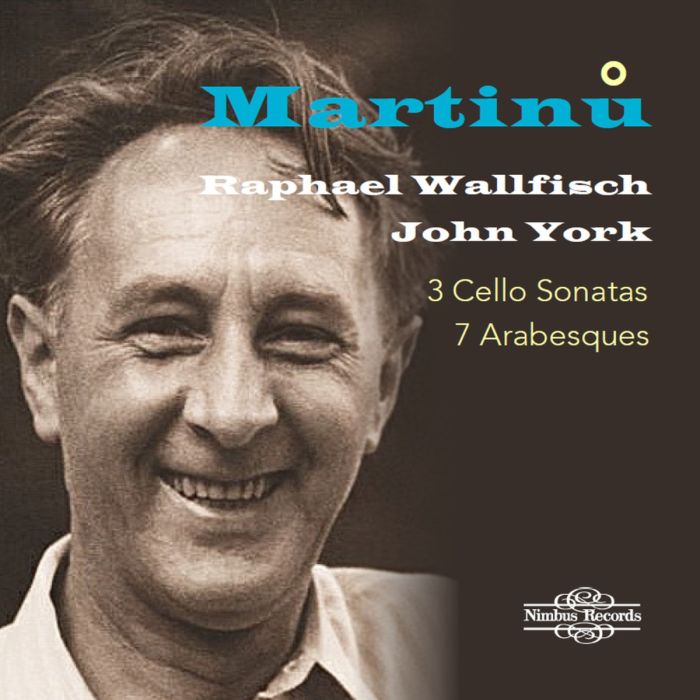
Martinů: 3 Cello Sonatas & 7 Arabesques
£14.99
In stock
Catalogue Number
NI8105

The mid-20th century has a tragic and many-faceted story to tell where musicians from Europe, both Jewish and non-Jewish, are concerned. So many were either blacklisted, dismissed from their positions and forced into exile or transported to the camps and simply eliminated. Some, like Martinů, seemed unsettled wherever they were. He was blown hither and yon by events beyond his control but he managed to stay just one step ahead of the invaders, seeking a place where he and his wife could live well despite the war – and where he could work freely. This peripatetic existence was not eased by his difficult, possibly autistic, personality – but that did not prevent him from composing a vast and very successful amount of music in all genres, including an unusually large number of pieces for the cello. Some early sets of short pieces for cello and piano certainly helped him to gain an enormous confidence and facility in that combination so that, when he came to compose his three sonatas, all written for specific cellists, the music could be filled with technical, idiomatic brilliance.
Seven Arabesques of 1931 display rhythmic quirkiness and repetition, an attractively dissonant colour and an entertaining individuality while generally adopting a straightforward ABA design. Melody, mechanical quasi-minimalist repetition, complicated syncopation, jazz and bravura – they’re all here in generous helpings.
Manufacturer: Wyastone Estate Limited, Wyastone Leys, Monmouth, NP25 3SR
Email: sales@wyastone.co.uk
Reviews:
"I was very impressed with Raphael Wallfisch’s earlier disc of Martinů’s Cello Concertos and Concertino with the Czech Philharmonic under Jiří Bělohlávek (review) and also am pleased with this new recording of the sonatas, especially since it includes the composer’s delightful Arabesques. The works on this disc cover a broad spectrum of Martinů’s career, as do the concerted pieces on the other disc. Thus, this is a suitable companion to that one, and with these two CDs one can enjoy Martinů’s major compositions for cello. These works contain in abundance the composer’s key modulations and syncopation that make his style so distinctive.
All three sonatas are masterpieces that deserve far greater advocacy on concert programs than they have received. Wallfisch/York provide plenty of power and energy to the outer movements of the First Sonata and excel in the sparseness and bleakness of the second movement before the mood changes, the lyrical theme emerging which the duo express with all the warmth desired. The same is true for the Second Sonata, where Wallfisch/York capture well in the middle movement the feeling of sadness that the composer apparently experienced, having recently left his homeland. Yet, they do not shortchange the lighter, even jazzy atmosphere of the finale. This brighter mood comes to the fore in the Sonata No. 3, where the influence of American jazz is apparent throughout the outer movements that contrast with the more somber slow movement. The duo seem especially well attuned to the happier spirit and humour of this sonata and revel in the work’s syncopations. Theirs is a wonderful performance, indeed.
What really makes this programme competitive with its rivals, though, is the bonus of the Seven Arabesques. There is a world of variety in these short pieces from the dancing liveliness of the first arabesque and the jazzy, bluesy second one to the more pensive third and lyrical fifth arabesque. The fourth in this series is like a Czech hoedown, a rustic, stomping dance. The last two are also lively with the seventh an exuberant folk dance. For me, these are worth the price of the disc alone. Combined with fine performances of the cello sonatas and excellent sound, what’s not to like. In addition, pianist John York contributes worthwhile notes on the music." MusicWeb International
"Martinu's three cello sonatas are masterpieces of the repertoire that have been gratefully taken up by many players... The cello and piano are equally important in this music, though the piano carries a particular burden in the rhythmically mobile Third Sonata, perhaps the most overtly Czech of them all… But Wallfisch and York do bring their own sense of clarity to the music, with the cellist finding the lyrical impulse and using his strongly projected tone to sustain long lines. The earlier Arabesques, more straightforwardly entertaining, are added to make a generously full programme." BBC Music Magazine
"There is lovely lyrical Adagio, and with the relative brevity of each movement there is plenty of inner contrast. The First Cello Sonata was composed under the shadow of the early months of World War II, and Martinů's bittersweet major/minor harmonic stresses are in evidence in the angular first movement but relatively absent in the remarkable central Lento, described by John York in his booklet notes as "bleak, chilly, despairing and dissonant... surely the composer's personal reaction to the betrayal, loss and destruction in his country." The final Allegro con brio is intense and rhythmically forceful but by no means filled with joy.
The Second Cello Sonata was composed in the USA to where Martinů had fled after the Nazi invasion of France. This is another work filled with wartime stress and lament in the central Largo. With moments of cadenza in the second and third movements, the breadth and range of expression and often spectacular material in the piano in the first movement this sonata has the feel that it could have as easily have become a concerto. Yearning for home can be heard in references to folk music idioms, most clearly in a Bohemian dance in the finale, but also in the open intervals of the mournful central movement.
The Third Cello Sonata was dedicated to cellist Hans Kindler, whose apparently "inveterately and delightfully upbeat" personality translated itself into a work that gives a more positive impression than the first two. John York points towards eccentricities and enigmatic musical messages in this work, and its contrasts of mood are indeed mercurial. There are however some truly beautiful passages in the work, and the final Allegro (ma non presto) is a fittingly rousing conclusion to the entire programme.
These performances are all excellent, and the recording is good… Raphael Wallfisch and John York can certainly stand comparison with the best." Music Web International
"They rate warmly, to be blunt. Wallfisch phrases with richness and York is a most attentive partner and they tend to avoid extremes of tempo and declamation, such as can prove somewhat wearying in other hands – Isserlis and Mustonen, for example. Taking a kind of Golden Mean works well in these sonatas yet when one listens to Starker and Firkušný one feels a deeper and more visceral, lively sense of music-making, and Starker's tonal qualities bring more core of the note leanness than Wallfisch's.
The one movement in the recording that strikes me as somewhat fast is the opening of the Second Sonata, though Wallfisch and York manage to prove engaging interpreters and avoid any sense of syntactical gabble. Rather, they are astute with rubati where the Julietta motto theme is well brought out, but not needlessly paraded, and they prove correspondingly to relax in the central slow movement. In the Third Sonata the sprung rhythms are perhaps better realised by Firkušný and Starker whose interpretation of an initial Poco andante is more athletic than Wallfisch and York. This is certainly better though than the frenetic motoric approach of Isserlis and Mustonen. The slow movement is again beautifully textured but in the finale the music's sheer vitality is better conveyed by a slightly more pressing tempo. I will say that Wallfisch and York find the music's humour; not all duos manage that.
Some discs leave it there, with just the sonatas, but Nimbus has added a welcome and under-recorded collection of Seven Arabesques composed in 1931. These are studies in rhythm, syncopation and character. The third is the most obviously dissonant, with lashings of colour, whilst the fourth is the most jazz-influenced and the fifth the most expressive. They are excellently played here.
Recommendations? It's clear that Starker-Firkušný represents the most idiomatic approach and I have long harboured admiration for the famous Supraphon recording with Josef Chuchro and Josef Hála, though Chuchro is a more reserved performer than some others mentioned earlier. Wallfisch and York represent a warmly expressive view of the sonatas, commendable but perhaps lacking the last ounce in rhythmic brio." Music Web International

|
| Sample Tracks |
|---|
|
Seven Arabesques, H.201: V. Adagio
Sonata No. 1, H.277: III. Allegro con brio
Sonata No. 2, H.286: II. Largo
Sonata No. 3, H.340: I. Poco andante - Moderato - Allegro vivo
|
0.135 kg