We use cookies to make your experience better. To comply with the new e-Privacy directive, we need to ask for your consent to set the cookies. Learn more.



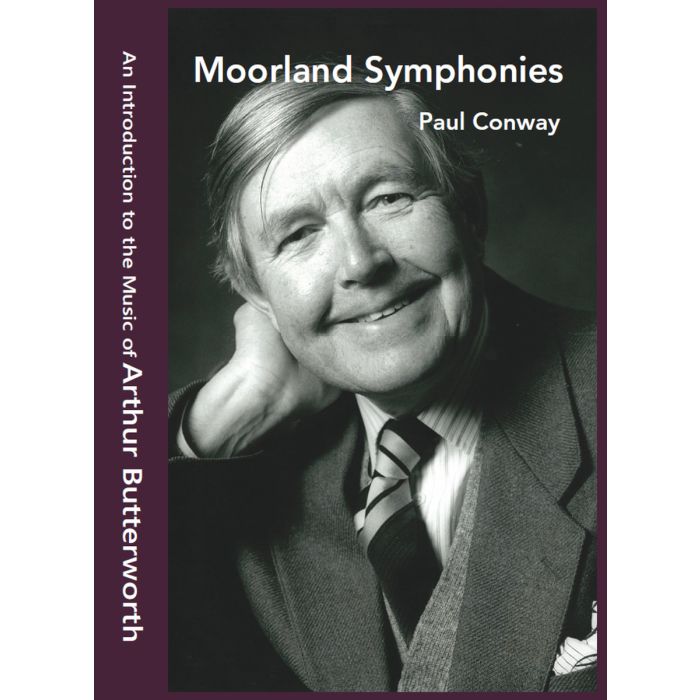
Moorland Symphonies: An introduction to the Music of Arthur Butterworth by Paul Conway [Paperback Book]
£29.99
In stock
Catalogue Number
SRCD9415
Arthur Butterworth (1923-2014) wrote over one hundred and fifty compositions including seven symphonies, chamber and instrumental pieces and a significant body of work for brass band. Many of his scores were inspired by the Yorkshire moorlands near his home in Skipton, North Yorkshire. His experience playing second trumpet in the Hallé Orchestra under Sir John Barbirolli helped to make him an intensely practical musician. Most of his pieces were commissioned by soloists or performing bodies confident he would provide something idiomatic and challenging. This book offers a starting-point for an exploration of Arthur Butterworth’s music. If the reader is thereby encouraged to explore further, it will have served its purpose.
Manufacturer: Wyastone Estate Limited, Wyastone Leys, Monmouth, NP25 3SR
Email: sales@wyastone.co.uk
Reviews:
"No comparisons diminish the stature of the Fourth Symphony, energetically captured in its premiere performance in 1986, and a triumphant success in its own right. The conflicting keys, hovering note oscillations and disruptive percussion might point in Nielsen's direction, yet we're still securely in Butterworth's north, where turbulence and exuberance walk side by side, slow movements ache, and growling dark sonorities, like peat bogs on the Yorkshire Moors, are never far away. This is a musical country well worth a visit." BBC Music Magazine
"Here is a composer who knows what he is doing, and why – causing listeners to respond in the most positive fashion. These three performances are splendid, and the sound of 2 and 4 is very good. The five stars awarded this issue reflects the quality of the music." Robert Matthew-Walker, Classicalsource
"Conway offers pertinent explanations – from the vagaries of fashion and a loyalty to his musical inspirations of Sibelius, Elgar and Vaughan Williams to his own personal unforced humility and reticence for self-promotion. There is also perceptive insight – his analysis providing a cool, dispassionate reference of detailed appreciation to the hallmark compositions as well as the secondary works...Ten chapters span the identifiable periods of his principal works (two cover his early musical life, a further two, an appreciation of his writing style and a pointed mini interview he gave in 1963). The appendices include Butterworth's own views on the brass band movement – a ‘paradox’ of ‘utter disdain’ (from its discipline to its ignorance of playing Elgar) to ‘a stimulating challenge, both technically and more importantly in the sense of pure musical invention and inspiration’...Almost 100 years to the date of his birth, Paul Conway has helped shine a light on a composer long overdue his true acclaim. - Iwan Fox, 4Barsrest
Over 10 chapters the author explores Butterworth’s life and works in tandem. He describes his upbringing and schooling, his army years, his somewhat piecemeal musical education (interesting that while at the Northern College he wrote an experimental serial piece) and his early years as a trumpeter, principally in Scotland and Manchester. It was surprising to learn just how successful the 1st Symphony was in its day – a triumph sadly never quite repeated. We learn how the composer juggled composing with performing, conducting, and eventually teaching music, and how bedding himself down in a largely amateur/semi-pro world provided a secure and nourishing habitat, but also isolated him from the metropolitan world of ‘new music’, leading to a perception of him as a regional and even minor figure.
Highlighting some of the neglected works makes clear how wide a range they encompass – this is not just a painter of melancholy moorscapes. The Organ Concerto turns out to be alarmingly wild, and even malevolent. Ancient Sorceries has an eerie atmosphere far removed from the composer’s now-familiar pipe and cardigan image. Nor does the music concern itself entirely with things Northern. There are evocations of Maori culture, Italian landscape, and a Venetian influence. If the sinister Guitar Concerto evokes a Spanish feel, it is the cruel history of the Spanish Inquisition – which as we all know Nobody Expects! …
Over 164 pages (in a large format paperback) Paul Conway’s vivid and highly readable descriptions, precise and analytical, yet not overburdened with detail, do much to bring many unknown pieces to life. Like Malcolm MacDonald on Brian, he has the gift of leaving the reader impatient to hear the music he has evoked so vividly. A few years back Dutton Epoch made a handful of recordings with Butterworth conducting; since then, there’s been very little except a Lyrita CD of broadcasts, seemingly a one-off. So, there is still much to do in terms of recordings alone, in particular modern readings of the marvellous Second Symphony, as well as the unrecorded Sixth, not to mention a host of smaller works. (Fortunately, Butterworth’s works for brass are reasonably well represented on record.) I sincerely hope this frankly overdue, and very welcome study may finally do something to spur new interest in this overlooked and richly characterful master. An indispensable issue – and hopefully the first of many! Full review here - Kevin Mandry, British Music Society
"Lyrita’s name is synonymous with many of the finest recordings of 20th Century British music. I was not aware that their commitment to this corner of the repertoire extended to the printed word as well. In some ways this new book reminds me of publications from Thames Publishing where relatively short books focussed on the life and work of composers otherwise neglected. Author Paul Conway’s avowed intent is; “[to] offer a starting-point for an exploration of Arthur Butterworth’s music. If the reader is thereby encouraged to explore further, it will have served its purpose”. Certainly on that front, Conway succeeds although that success will be thwarted for many readers – as the included discography shows – by the relative lack of commercial recordings of this music…
After the main biographical text which covers 119 pages and ten chapters, this book includes useful brief descriptions of Butterworth's use of style, instrumentation, form and tonality. Butterworth's answers to questions for possible inclusion in the 1963 "British Composers in Interview" is reprinted here (it was not used in the original book). Then there are a series of appendixes which include a chronological list of works with dates of first performances but no indication of scoring. The discography highlights how much of Butterworth's work still remains to be more widely known. Appendix E offers some of the most interesting insights. It consists of edited transcrips of conversations between Butterworth and Conway with sub-headings including "Butterworth on Barbirolli..." or "Butterworth on Elgar" and a couple of others. The opinions offered are cearly fascinating but perhaps more so is the sense of getting an insight into the process and thought or motivation behind the word." Full review here - Nick Barnard, musicweb international
It's a welcome and wlcoming book, not forbidding in any way. The composer's music occupies a distinctive place alongside the works of Simpson, Wordsworth, Lloyd, Arnell and Rubbra. In what is, avowedly, "An Introduction" rather than anything grander or more lumbering, it does extremely well to introduce the man and the music. The author, paul Conway has a nae familiar for his finely probing and urgently communicative notes for many Lyrita and other CDs issued since 2010. He continues to make his contribution - advocacy and criticism - in the media, specialising in twentieth-century and contemporary British music...
Butterworth, was a saffable - but not bland - in life as his cover portrait suggests. Here is a man radiating a warmly smiling character, even at age 76. He suffuses intelligence and bonhomie in equal measure and there is no subterfuge about his. If he has controversial views thay are stated rather than diplomatised. Paul Conway confers on us quite ab it of detail enough to satisfy most appetites and to raise the questing beast of exploration. On that front the discography at pages 146-7 plays its facilitating role. There is a sparing spatter of music examples and these form part and parcel of the text. There's no cloyingly academic analysis, something with which some of Lyrita's original LP-sleeve-writers saddled records of superb music. The book uses the occasional footnote...
As handbook and introduction, it is no stranger to depth of information. Its functions are enhanced by two pages of a winged chronology. These are placed usefully at the start. There is no overarching index (which is a pity) but two pages of selective personalia include lists of page numbers and chapters. Each of the chapters starts with a year range/title abd recounts salient events during particular years e.g. 1923-42, 1947-55 and so on until 2001-2014. The chapter titles list the principle works for those years. Chapters 1-10 methodically cover the passage of the years and are followed by chapters 11 and 12. These include a reflective survey, "Style and Characteristics", which bridges the years. " Full review here - Rob Barnett, musicweb international
Despite current concerns regarding public support for performing bodies and the like, there remains in Britain a level of demand for music by our serious composers. Music once highly thought of, and reasonably often heard, tends to suffer relative oblivion following the composer’s passing… Butterworth was principal trumpet of the Hallé, his music always conceived from practicality in performance: unlike Malcolm Arnold, Butterworth’s musical language (like his spoken voice) was less ‘public’, but no less expressive. Drawing upon timeless natural pro-fundities, the ‘Moorland Symphonies’ inspiration of Butterworth’s original and surprisingly wide-ranging art is fully explained in Conway’s well-written and eminently valuable book, beautifully presented and very much needed at this present time. A masterly study. - Robert Matthew-Walker, Musical Opinion Magazine
Classical recording labels don’t often turn publishers. All the more reason, then, to welcome a book designed to encourage exploration of Arthur Butterworth (1923-2014), a neglected, independent-minded British composer whose output often reflects bleak northern landscapes (the spirit of Sibelius too)... Conway’s description in most cases are vivid, exact and encouraging, though he doesn’t shirk from critical comments when required. Given the music’s gritty nature and unshowy colouring, it’s pleasing to find that Butterworth was interested in synaesthesia, and considered E flat major a ‘maroon red’ colour, akin, he said, to the late Queen’s ‘official Daimler car’. No index; but we’re usefully given a work list, pages of interview quotes and a list of CDs. Geoff Brown, BBC Music Magazine
Conway offers pertinent explanations – from the vagaries of fashion and a loyalty to his musical inspirations of Sibelius, Elgar and Vaughan Williams to his own personal unforced humility and reticence for self-promotion. There is also perceptive insight – his analysis providing a cool, dispassionate reference of detailed appreciation to the hallmark compositions as well as the secondary works. There is also perceptive insight – his analysis providing a cool, dispassionate reference of detailed appreciation to the hallmark compositions as well as the secondary works of each period. A conscious consideration underpins his framing - the biographical strands (Butterworth’s own autobiography is noted) kept precise and pertinent to those which he considers ‘of special interest and note’. It brings a welcome focus to what is an exhaustively extensive catalogue of output...Almost 100 years to the date of his birth, Paul Conway has helped shine a light on a composer long overdue his true acclaim. Ten chapters span the identifiable periods of his principal works (two cover his early musical life, a further two, an appreciation of his writing style and a pointed mini interview he gave in 1963)...These have richly enhanced the brass band movement, yet they are also accompanied by the little gems of brass ensembles and solo work, each written with a clarity of thoughtfulness and deeply ingrained idiomatic purpose. Almost 100 years to the date of his birth, Paul Conway has helped shine a light on a composer long overdue his true acclaim. - Iwan Fox, 4barsrest
Lloyd had been a prodigy of a composer, with two operas staged in London before the Second World War – one at Covent Garden, when he was still in his 20s. However, thanks to the savage effect of war, and to a radical change in the tastes of those who influenced opinions in classical music, Lloyd disappeared for more than a quarter of a century, only to enjoy a remarkable revival in his old age, his determination in the face of critical contempt a tribute to his greatness… In 1981, I heard a relay of his gigantic Fourth Symphony – the work he wrote while convalescing – on Radio 3, and was astonished that it was the first performance of this very unmodern work by a composer of whom I had never heard. I toured the record shops the next day to find more music by him, but none had been recorded. Several years later, Lyrita issued his Fourth, Fifth and Eighth symphonies, conducted by one of the few notable musicians who had believed in him, Edward Downes. Thanks to Alan Blyth, the chief music critic of the Telegraph, I tracked Lloyd down, interviewed him, and we became friends. By 1986, when I met Lloyd, his revival was taking off. An American businessman set up a record company and recorded all 12 of Lloyd’s symphonies and much other music, mostly written during his wilderness years while he earned a living growing carnations and mushrooms in Dorset. There were performances in London concert halls again. Some who worked with him say he could be difficult and headstrong, which also helps explain his difficulties after the war. But he was a composer who merits far more attention than he has had, and I do not doubt he will get it. - Simon Heffer