We use cookies to make your experience better. To comply with the new e-Privacy directive, we need to ask for your consent to set the cookies. Learn more.



Nicholas Maw: Spring Music, Voice of Memory & Sonata For Solo Violin
£14.99
In stock
Catalogue Number
SRCD385
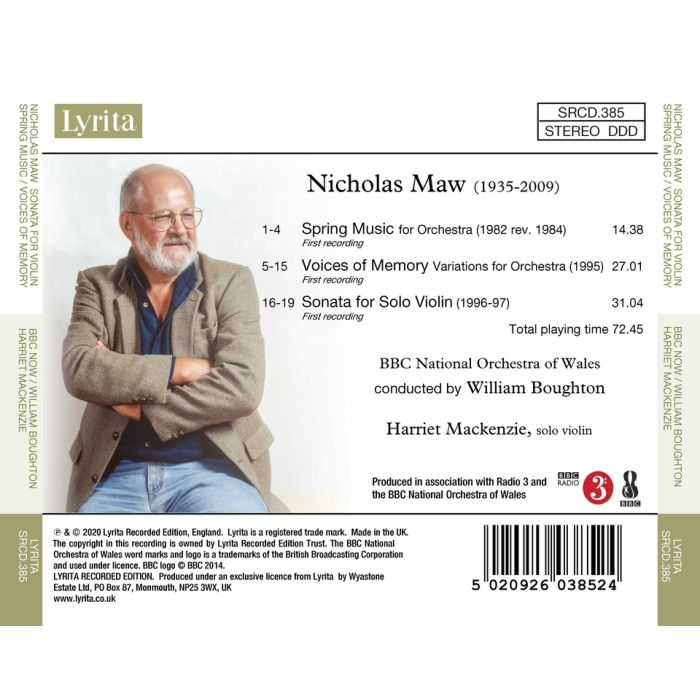
Maw’s most fervent desire was to communicate directly with his audiences and produce material which performers would enjoy playing and Spring Music, written with the express purpose of diverting and entertaining an audience, finds the composer at his most uninhibited and freely expressive. Fresh, colourful and vibrant, this score has the exotic, open-hearted spirit of a curtain-raiser by William Walton or Alan Rawsthorne. In its final, slimmed-down version, it rapidly became one of Maw’s favourite pieces among his own output and he once described the long-breathed cello-led melody as ‘one of the best tunes I think I’ve actually ever written’.
In 1995 Maw was commissioned by the BBC to write a work commemorating the 300th anniversary that year of the death of Purcell. Maw soon came to the conclusion that he wanted to round off his tribute piece with an example of a chaconne, a form in which Purcell was pre-eminent. The theme which Maw chose to embellish is derived from the first of his Life Studies for 15 solo strings. Taking his lead from Tchaikovsky, Maw decided that the main title should reflect precisely the reference vocabulary of the piece and so the piece became known for a while as Romantic Variations. Later still the title was altered to its definitive form of Voices of Memory: Variations for Orchestra.
Described by Andrew Burn as ‘a major contribution to the genre’, the Sonata for Solo Violin was requested by Jorja Fleezanis, to whom the work is dedicated. In Maw’s Sonata for Solo Violin, the constraints of writing for a single stringed instrument in a four-movement, large-scale work are deftly surmounted by the composer’s gift for melodic lines and rhythmic invention. Each movement has a vivid sense of colour, formal logic and onward momentum so that the writing, however demanding it may be, never suggests an arid study or a shallow technical exercise.
Manufacturer: Wyastone Estate Limited, Wyastone Leys, Monmouth, NP25 3SR
Email: sales@wyastone.co.uk
Reviews:
EDITORIAL REVIEWS
This is a terrific disc… The three works, all recorded for the first time, are presented in chronological
sequence and date from either side of Odyssey's completion. Indeed, the exuberant concert-opener Spring Music (1982, rev 1983-84) sounds like its smaller cousin, sharing the mightier work's manner of
expression but not thematic material – or searchingly inward quality. As with Odyssey, the cellos are crucial in stating the key melodic material, and this section of the BBC National Orchestra of Wales open out the music to ravishing effect. Voices of Memory (1995) is one of the hidden gems in Maw's output, a variation set written to celebrate the tercentenary of Purcell's death. The sheer brilliance of the compositional ingenuity (on a theme from his own Life Studies rather than Purcell) and acuity of orchestration should place it in every British orchestra's repertoire, as this coruscating performance under William Boughton trumpets loud and clear. It is matched by a most unlikely successor,
the Sonata for solo violin (1996-97), written for and premiered by Jorja Fleezanis in Minnesota. Harriet Mackenzie has the measure of the music, which nods towards Baroque models but is never
pastiche, fleet and finger-perfect in the swift scherzo 'March-Burlesque' and final 'Flight', intense in the opening 'Scena' but most moving in the longest movement, 'Tombeau', dedicated to the memory of his friend, Jacob Druckman. Wonderful.
GRAMAPHONE
Nicholas Maw always stood slightly aside from Birtwistle, Maxwell Davies and others from the remarkable cluster of British composers born in the mid-1930s. Essentially a post Romantic, he developed a musical language mindful of contemporary developments, but still in touch with the harmonic world associated with the beginning of the 20th century. Nothing on this welcome album can top his breakthrough piece of1962, Scenes and Arias, till a knockout today; even so, if you aren't stirred by the panache This half-hour Sonata for Solo violin (1997) I'd suggest a visit to the doctor. Harriet Mackenzie is a most earless and eloquent executant of his wonderfully expressive array of contrasting textures, colours and violin techniques, fully worth placing alongside the 20th century masterworks of Ysaye and Bart6k.On the orchestral front, the variation set Voices of Memory (1995) offers another of Maw's impressively deft juggling displays within a large-span structure, well serviced by William Boughton and the BBC National Orchestra of Wales…
BBC MUSIC MAGAZINE
Anyway, Spring Music is quite captivating, at one moment burgeoning with life and ecstasy, almost akin to Tippett and the next wondrously melodic as in the gorgeous cello tune, which constitutes what one might call the second subject. One should also understand two things as quoted in the unusually detailed and useful booklet notes by Paul Conway: first, quoting Maw, “Music has got to be able to sing. You’ve got to write melodic material which can be perceived immediately and is memorable” and secondly, the quotation from a poem by Dylan Thomas as inscribed at the head of the score, “The force that through the green fuse drives the flower”.
Composers have always written unaccompanied Violin Sonatas, but one which lasts thirty minutes? It’s a tall order for performer and listener alike. Maw’s sonata was written for Jorja Fleezanis and it received its first outings in America where Maw was then living and working and where he died. Having heard it, I felt so pleased that Lyrita had recorded it, as it is such a major work, so extraordinary in its variety of expression, imagination and clarity of formal design and direction. It makes demands on all, not least on the powers of concentration required by the performer, but Harriet Mackenzie never falters either technically or musically.
The piece is in four movements: ‘Scena’ that begins arrestingly with pianissimo high harmonics and then moves into several contrasting and dramatic idea, a ‘March-Burlesque’, which oscillates between those two styles, thirdly, a ‘Tombeau’ which is over ten minutes of rapt intimacy with occasional passionate outbursts and finally a wild and virtuosic ‘Flight’ which holds the attention throughout - quite extraordinary.
The last work, which is almost as long so clearly also on a large canvas, is Voices of Memory, a superbly structured set of variations on a theme by the composer himself, taken from a section of his Life Studies for 15 solo strings completed in 1976. He was asked to write something in honour of the 300th anniversary of the death of Henry Purcell which fell in 1995. The form most associated with that great composer is the Passacaglia or Chaconne or Ground bass over which the composer will add melodic and harmonic variants, so in Voices of Memory Maw writes a set of nine contrasting variations culminating in a Passacaglia which then uses the theme twenty-one times before concluding gloriously and with satisfying power. The language is largely diatonic and it ends in the major key. It is also no coincidence that the title under which it was first performed at a royal concert in 1995 was ‘Variations in Old Style’, curiously also known later as ‘Romantic Variations’ before its final name was established. Those titles should give you a major clue, if I haven’t done so already, as to what to expect.
This, then, is another enterprising Lyrita release of premiere recordings, all superbly played and recorded, William Boughton being a great advocate for British music and a man who is not frightened to learn new and demanding scores. The booklet notes by Paul Conway are, as ever, ideal.
MusicWeb

|
| Sample Tracks |
|---|
|
SRCD385 Spring Music for Orchestra: II. Moderato con moto, sempre grazioso
SRCD385 Voices of Memory: Variations for Orchestra: VII. Variation VI Andante molto sostenuto
SRCD385 Voices of Memory: Variations for Orchestra: XI. Variation X Finale. Molto moderato
SRCD385 Sonata for Solo Violin: III. Tombeau
|
0.135 kg