We use cookies to make your experience better. To comply with the new e-Privacy directive, we need to ask for your consent to set the cookies. Learn more.


Ole Hjellemo: Orchestral Works
£14.99
In stock
Catalogue Number
CDS1128
After the critic’s failure with his first symphony in 1912, Hjellemo took his time before presenting his second work in this genre – symphony no. 2 in B minor, which was premiered in 1926. The 2nd Symphony is even more extensive and advanced than the 1st, and requires an even larger orchestra. This suggests well that Hjellemo had more confidence in his own abilities than in the critics’ judgment. The symphony is a large, epic work almost unparalleled in Norwegian music history. The symphony was, as critics reported, very well received by the audience – the composer had to come forward three times to receive applause.
There are no sources mentioning anything about this concerto when it suddenly appeared on a concert program with the Philharmonic Company Orchestra in May 1934, where Hjellemo himself was conducting three of his works. The violin concerto received a good reception, and in the reviews, the soloist was particularly noticed. The entire programme was also broadcast live on radio in several European countries.
This piece has been performed on several occasions, also after the composer’s death. The premiere took place on 17 June 1936, and the soloist was Ernst Glaser. Hugo Kramm conducted the Radio Orchestra in Oslo, and also this time the concert was broadcast live in several European countries. At the premiere, the work had the title Rondo for violin and orchestra, but later Hjellemo changed it to Norsk Caprice. The piece consists of a short orchestral opening, introducing the soloist. What follows is a traditional Norwegian Halling (a folk dance in 2/4 or 6/8 meter typical for Norway), virtuoso written for the violin.
Manufacturer: Wyastone Estate Limited, Wyastone Leys, Monmouth, NP25 3SR
Email: sales@wyastone.co.uk
Reviews:
“…Hjellemo hailed from Dovre in the centre of Norway... From early on he was exposed to the country’s rich folk music tradition. Musical talent manifested itself early and he learned to play the violin. Aged 20 he relocated to Kristiania, now Oslo. The only door open to him at the time was to join the army as a way of learning music. Eventually he could play several instruments including wind, percussion and piano. He directed the Dombås Music Society from 1895 to 1906. As time passed he was able to study under Gudbrand Bøhn and Iver Holter. He played the violin in orchestras, and retired from the army in 1930. From 1919 to 1932 he taught violin, harmony, and composition at the Oslo Conservatory. He died in Oslo in 1938.
The earliest work here in the Second Symphony in B minor, written between 1922-1926. Hjellemo’s First Symphony of 1912 had been disparaged by the critics, hence the lapse of some ten years… Scored for large orchestra, it was premiered in 1926. It’s an epic and ambitious work which struts out with confidence and depicts a mountain climb in Norway. The opening movement seems inspired by the mountainous landscapes that surrounded him, and some of the brass sections remind me of Wagner. Everything appears writ large. A much less grandiose slow movement follows. The composer described it as “mist and emerging sunshine through skies”. The disposition is mysterious, lyrical and elemental, with some glorious pastoral whispers from the woodwind. The third movement… which contrasts moments of invigorating freshness with more solemn moments....
The first mention of the Violin Concerto is on a concert programme in May 1934...The opening movement… inhabits sunny pastures and exudes a comforting warmth. The Andante has a melancholic introspection. I find it the most interesting and finest of the three movements. It employs some vivid colourful orchestration, around which Christopher Tun Andersen weaves a luminous web of sound. The finale follows without a break…
The Norsk Caprice was premiered in June 1936 and was graced with several performances after the composer’s death… It’s based on a traditional Norwegian Halling, which is a folk dance. The fact that Hjellemo was a violinist himself is reflected in the virtuoso writing of the solo part… It’s an attractive score of catchy rhythms, with plenty of swirl and swing.
All three of these rare works are superbly recorded and receive excellent and persuasive performances. As is the norm with Sterling, they are spectacularly well documented. The liner notes are written by the conductor of these works, Jørn Fossheim. Don’t miss this disc if you are well disposed to tonally pleasing late Romantic music."Full review here
Stephen Greenbank
"…The Violin Concerto (1933)…At 18 minutes it’s compact in the extreme and formally odd with a first movement longer than the other two combined. The violin pitches in from the start and begins a rather peripatetic journey…Dating from a couple of years after the Violin Concerto, the Norwegian Caprice is an essay in folkoric charm for solo violin and orchestra. There is much pirouetting over a somewhat generic orchestral wash…that manages to generate an open-air warmth…His… Second Symphony which was premiered in 1926…opens with misty evocations and herd-girl chants in the winds, before the strings take over with their own song. Rich lower brass appear as the music develops. The second movement is another nature study, focusing on sunlight….the music softens to Alpine verdancy and horn calls proliferate sinking to a contented close…
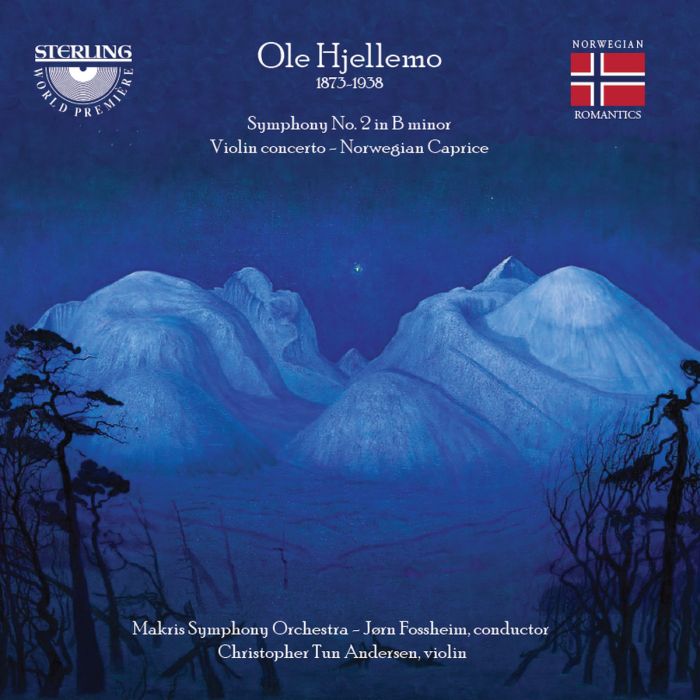
The booklet art is an appropriate and attractive painting by Harald Sohlberg (1869-1935)."
Jonathan Woolf

|
| Sample Tracks |
|---|
|
Violin Concerto: III. Allegro con brio
Symphony No. 2 in B minor: III. Allegro con spirito
|
0.135 kg