We use cookies to make your experience better. To comply with the new e-Privacy directive, we need to ask for your consent to set the cookies. Learn more.



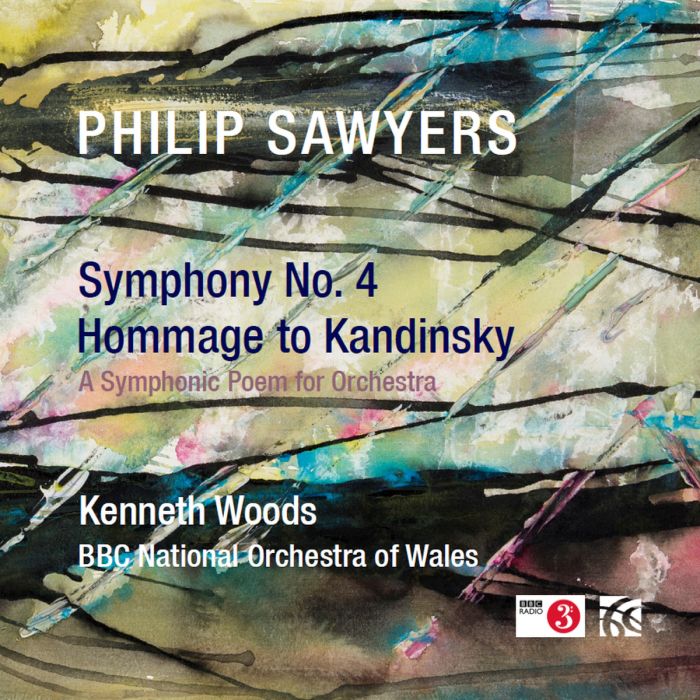
Philip Sawyers: Symphony No. 4 & Hommage to Kandinsky
£14.99
In stock
Catalogue Number
NI6405

Sawyers’s Fourth Symphony is scored for an orchestra of two flutes, two oboes, two clarinets, two bassoons, four horns, two trumpets, three trombones, tuba, timpani, bass drum, cymbals and strings. Structurally, it marks a departure from his First and Third Symphonies, which are both in the traditional four-movement form, and the one-movement Second. Sawyers says of the somewhat unusual structure that: My Fourth symphony is in three movements. “Why?” might be a reasonable question. The answer is that simply that by the time the third movement was complete, there was nothing more to say.
The large-scale symphonic poem Hommage to Kandinsky was commissioned by the Grand Rapids Symphony in celebration of the tenure of their longstanding Music Director, David Lockington, who premiered the work in September 2014. Given the celebratory nature of the occasion, the orchestra encouraged Sawyers to employ the largest orchestra he had yet written for: 2 flutes and piccolo, 2 oboes and cor anglais, 2 clarinets and bass clarinet, 2 bassoons and contra bassoon, 4 horns, 3 trumpets, 3 trombones, tuba, timpani and percussion, harp and a large string section. The work’s subject matter had its origins in Sawyers’s attendance at an exhibition “Kandinsky: The Road to Abstraction” at the Tate Modern in London in 2006. Although Sawyers took particular inspiration from several paintings in the exhibition, the resulting tone poem represents primarily an emotional response to Kandinsky’s work rather than an attempt to respond literally to Kandinsky’s images in music.
Manufacturer: Wyastone Estate Limited, Wyastone Leys, Monmouth, NP25 3SR
Email: sales@wyastone.co.uk
Reviews:
"Arcana.FM who have chosen this recording of Philip's Fourth Symphony and Hommage to Kandinsky as one of the Best Recordings of 2020: "One of the most striking contemporary releases this year capped a fine showing from Kenneth Woods, both with the English Symphony Orchestra and – as here – with the BBC National Orchestra of Wales. Philip Sawyers’ Symphony no.4 and Hommage to Kandinsky are captured by Richard Whitehouse in this review of two exceptional pieces of new music, given great performances under conductor Kenneth Woods." Arcana.FM [read complete review]
"Philip Sawyers' oratorio Mayflower on the Sea of Time, to have been premiered at Worcester Cathedral, has been cancelled due to the Coronavirus pandemic. So this latest release in conductor Kenneth Woods' survey of his orchestral music, is thus doubly welcome. The former violinist's big break as a composer came when his student work Symphonic Music for Strings and Brass (1972) was championed by the Grand Rapids Symphony Orchestra in America. They commissioned Hommage to Kandinsky (2014) asking him not to spare the orchestral forces. He obliged and the result is an exciting, vibrant symphonic poem as colourful as the Russian painter's abstract art with the orchestra and Woods revelling in its rich textures and intense emotional sweep. Sawyers' three-movement Symphony No.4 (2018) employs smaller forces and has a tense, dramatic and densely-argued first movement and ends with a serenely beautiful Adagio. Excellent playing and recording quality to match." Birmingham Post
"From the pen of Philip Sawyers (a Londoner born in 1951), these are quite the best two pieces this composer has yet given us, in my opinion, and of those I have heard. Symphony No.4 (2018) opens in arresting style, a bold summons that bids our involvement in some very strong symphonic argument and varied emotions. It might be thought a Very British piece (with, to my mind, shades of Alan Rawsthorne) but its pent-up passions, and a light and shade that prevents sameness, means that it travels well in terms of its design and length (thirty-six minutes) and also with regard to future performances. Placed second is a buoyant Scherzo, as shadowy as it is fleet, that works well to counteract the cut-short (my impression) opening Moderato. Placed last is an expansive Adagio, with motivic connections to what has gone before, of haunting intimate expressivity countered by waves of intense fortissimo, and the soaring conclusion wraps the whole convincingly. I was hoping for a loud ending! The half-hour Hommage to Kandinsky (2014), written for the Grand Rapids Symphony, is equally impressive. Originating from a Kandinsky exhibition at Tate Modern that Sawyers attended, his Hommage to the Russian painter plays continuously and enjoys twelve distinct tempo markings and judicious diversions – from misty opening to a troubled ending; listener-interest never flags. Like the Symphony, Hommage to Kandinsky is scored with consummate skill (and is for larger forces) to which the BBC National Orchestra of Wales responds with relish and sensitivity, led by Kenneth Woods with typical flair and compassion. He and the composer have collaborated on an informative booklet note. Nimbus Alliance NI 6405, to be released on June 5." Colin Anderson
"…The booklet contains an excellent and detailed essay about the music by Kenneth Woods, which incorporates extensive quotes from the composer himself. I have found these invaluable and I've draw upon them in describing these two works, both of which were new to me… I believe, because the two scores on this CD and the other four discs of his orchestral music that I’ve heard demonstrate that this is a composer with a fine understanding of the modern orchestra. Couple that with a genuine melodic voice, a gift for expressing and developing his ideas, and a flair for orchestral colouring and you have a composer whose work demands to be taken very seriously.
…Here we have two significant and eloquent new works. Both display command of the orchestra and an imaginative mind at work. Both of these compositions require concentrated listening but they will reward the listener for his or her efforts. The more I hear of Philip Sawyers’ music, the more impressed I am. Here, he receives ideal advocacy from the BBC National Orchestra of Wales, whose playing is expert and committed. In Kenneth Woods this composer clearly has a formidable champion; under his direction the performances exude conviction.
The recordings, made in the orchestra’s home hall in Cardiff, are excellent. The orchestral sound has impact and presence, and the engineers have achieved an impressive dynamic range and allow the details of Sawyers’ scoring to come through very well.
The musicians involved and Nimbus are to be congratulated on letting us hear these accessible and rewarding works which are the work of a composer who definitely has something worthwhile to say." Music Web International

|
| Sample Tracks |
|---|
|
Symphony No. 4: II. Presto - Moderato - Presto
Hommage to Kandinsky
|
0.135 kg