We use cookies to make your experience better. To comply with the new e-Privacy directive, we need to ask for your consent to set the cookies. Learn more.



Richard Blackford: La Sagrada Familia Symphony & Babel, A Cantata
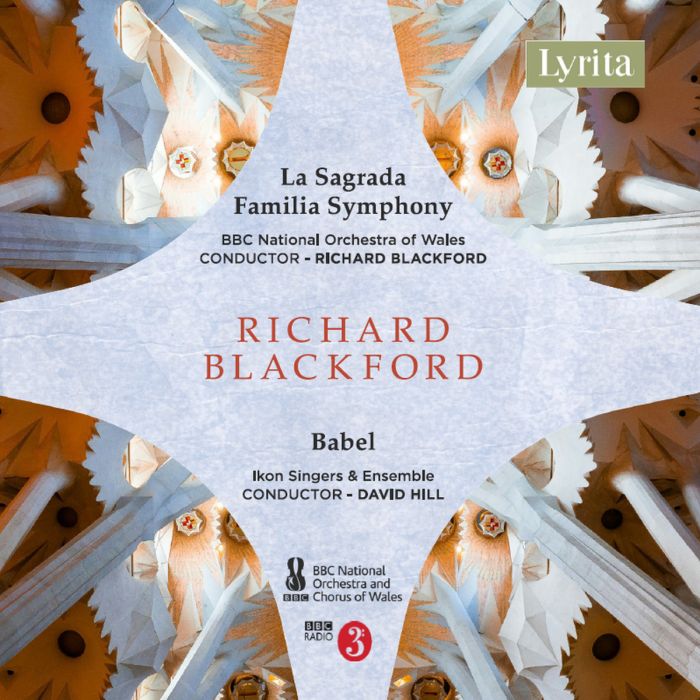
£14.99
In stock
Catalogue Number
SRCD432


Richard Blackford’s music, which includes three operas, two ballets and many works for orchestra, chorus and chamber ensembles, has been performed and broadcast all over the world. In 2022 he conducted his second symphony La Sagrada Família with BBC National Orchestra of Wales for Lyrita Records and has directed a film to accompany live performances. In 2023 his song cycle Songs of Nadia Anjuman, a Britten Sinfonia commission, with soloist Elizabeth Watts received 5-star reviews from The Times and The Guardian. He was awarded Best Creator at the 2023 National Federation For Music Societies Awards for his cantata Babel.
Manufacturer: Wyastone Estate Limited, Wyastone Leys, Monmouth, NP25 3SR
Email: sales@wyastone.co.uk
Reviews:
"These two works, the first an orchestral work with the BBC Symphony Orchestra, and the second with the Ikon Singers, 3 soloists, 2 pianists, an organist, and 2 percussionists. As new compositions, they are imaginative and creative additions to long-established genres yet stand in their own right as strong modern works." Maureen Buja, Interlude [read complete review]
"Titled after Antoni Gaudí's mesmerizing architectural structure, La Sagrada Familia Symphony represents Blackford's attempt to render into sound the visual splendour of the temple, its impact bolstered by the light streaming through its stained glass windows. In structuring the work, he fashioned the movements in accordance with the building's three facades, Nativity, Passion, and Glory, each, he says, “a visual world unto itself, stylistically apart yet united by Gaudí's grandiose vision.” Consistent with images of Biblical figures, saints, musicians, animals, and nature that dot the “Nativity” facade, the dramatic, sonata-styled movement exudes affirmation, hope, and celebration. That tone's established by glorious trumpet fanfares that punctuate the movement and complemented by pastoral tone painting generated by woodwinds, harp, and oft-sweeping strings. In keeping with a title alluding to struggle, “Passion” is marked by grief and turmoil, the musical tone complementary to the drama of Christ's Passion. An arresting six-note figure catches the ear, as do ominous string glissandos, muted horns, and whip lashes that reinforce the impression of instability and violence. An anguished episode evokes the crucifixion of Jesus, after which the music accelerates to bring the movement to a feverish close. “Gloria,” by comparison, expresses time-suspending awe and majesty in its opening horn solo and the swirling orchestral textures and lyrical plainsong melody that follow. As La Sagrada Familia Symphony reaches its climactic end, the conclusion's drawn that it deserves a place on any of today's symphony concert stages and would be rapturously received were it so presented...
The work's already arresting character is enhanced by Blackford's decision to not simply alternate between chorus and soloists but to instead combine them in places (see the blending of the tenor with the chorus in the first part's “God gave the signal and it began to rain” episode) as well as feature the soloists together as vocal conduits for God. The insertion of solo passages into the design also creates welcome contrast between the robust choral sections and the less declamatory solo parts. Three interludes—for the storm and flood, the building of the tower, and its destruction—add evocative instrumental interjections to the design. There are moments of disarming beauty, from the gentle chorus that follows the first interlude and the soprano's luminous rendering of the “Do not fear the largeness of the showers” text." Ron Scheper, Textura
"Richard Blackford … is a very fine composer of the type of music, we need in the present day. Accessible, extraordinarily well crafted, and communicative. It is no surprise that he has written over 200 scores for the small and large screen. The composer notes that Britten’s Noyes’s Fludde was a favourite work as a youth. The influence is clear, it is cleanly and economically scored, with a clear narrative divided between the soloists and the chorus. There is even space, as in Britten’s Noye, and St Nicholas, for audience participation, here in the form of the hymn Praise My Soul the King of Heaven. Via the writings of Flavius Josephus the cantata unites the stories of Babel and Noah’s Flood. There is some wonderful writing notably part-way into ‘The rain has ceased’ where there is a beautiful close imitative section. In the ‘And He confounded’ section there is a magical duet which reminded me of Abraham and Isaac from the War Requiem. The singers have wonderfully clear diction throughout which makes the narrative clear throughout. This is a major addition to the genre.
The La Sagrada Familia Symphony is based on Gaudi’s extraordinary cathedral in Barcelona, only now nearing completion after more than a century. Each movement is not inspired by the structure but by the facades at the entrances, ‘Nativity’, ‘Passion’ and ‘Glory’. ‘Nativity’ is coloured by brilliant fanfares for the brass and rich writing for the full orchestra. The ‘Passion’ is violent with much use of the percussion; it is probably the most cinematic of the three movements, but all the more rewarding for that. Think more Mel Gibson than Cecil B. de Mille. ‘Glory’ builds effectively in a Bernstein-like way from a quiet opening to a rapturous end with gongs and bells. The composer shows himself to be a very skilled conductor and the orchestra plays magnificently. This is a work that cries out to be heard in the concert hall. I live in hope." Paul RW Jackson, British Music Society
"It is surprising that it is an Englishman who has composed a symphony dedicated to Antoni Gaudí's Sagrada Familia, the majestic Catalan temple that represents a metaphor for Catalonia. Recall that the colossal structure is supported by large pillars in the form of tree trunks that reinforce the impression of a spiritual forest. The main entrances to the basilica are three large façades: Nativity, Passion and Glory. These façades have inspired Blackford to compose the three movements that make up this original symphony. The composer explains in the album notes that his work is a tribute to the Catalan architect Antoni Gaudí.
The score establishes many metaphorical relationships, such as six-note themes to represent the six columns, or for example, the fact that in the score the orchestral writing evokes a blurry effect, with smooth chord cycles constantly changing thanks to a complex range of sound dynamics. The album is completed by Babel... The voices of the Ikon Singers and Ensemble, directed by David Hill, tell two stories; the two parts of the cantata, which begin similarly, presenting first Seth's children and then, in the second part, Noah's children. The piano and percussion part instrumentally illustrate the dense textures of the choir, which demonstrate its full potential." Josep Bosch – Sonogram magazine
"These two works, the first an orchestral work with the BBC Symphony Orchestra, and the second with the Ikon Singers, 3 soloists, 2 pianists, an organist, and 2 percussionists. As new compositions, they are imaginative and creative additions to long-established genres yet stand in their own right as strong modern works." Maureen Buja, Interlude
“As La Sagrada Familia Symphony reaches its climactic end, the conclusion's drawn that it deserves a place on any of today's symphony concert stages and would be rapturously received were it so presented."
Whereas Blackford conducts the BBC National Orchestra of Wales in the performance of the three-prt La Sagrada Familia Symphony, David Hill guides the Ikon Singers and Ensemble through their paces on the towering Babel… Titled after Antoni Gaudí's mesmerizing architectural structure, La Sagrada Familia Symphony represents Blackford's attempt to render into sound the visual splendour of the temple, its impact bolstered by the light streaming through its stained glass windows. In structuring the work, he fashioned the movements in accordance with the building's three facades, Nativity, Passion, and Glory, each, he says, “a visual world unto itself, stylistically apart yet united by Gaudí's grandiose vision.” Consistent with images of Biblical figures, saints, musicians, animals, and nature that dot the “Nativity” facade, the dramatic, sonata-styled movement exudes affirmation, hope, and celebration. That tone's established by glorious trumpet fanfares that punctuate the movement and complemented by pastoral tone painting generated by woodwinds, harp, and oft-sweeping strings…
While the vocal resources for the performance—a twenty-member chorus and three soloists, soprano Rebecca Bottone, tenor Alessandro Fisher, and baritone Stephen Gadd—are plentiful, instrumentally they're modest, with only two pianists, an organist, and three percussionists deployed." TEXTURA, Feburary 2024
"Right from the start, David Hill and the BBC National Orchestra of Wales place us in front of this mighty architectural monument with a majestic sound and a strong inner radiance. It is a solemn, jubilant sound, carved in stone, which in the second movement merges into a touching cello lament. This song of mourning contrasts beautifully with the sharpness of the orchestral writing, which makes us aware of inner turmoil, fear and pain. The symphony culminates in a colourful Gloria, an inspiring orchestral setting of Gregorian chant that soars unerringly upward to the enthroned spires of the Sagrada Familia and far beyond.
Shortly after this symphony, the world premiere of the cantata Babel, a work commissioned by the Camden Choir, took place in London in March 2022.
Here, too, Richard Blackford uses powerful musical imagery to describe God’s wrath, the great flood, and the confusion of languages at Babel – until God makes peace with humanity.
We also experience this work in a vital, energetic and dynamic interpretation, with a final hymn that does credit to the English choral tradition." Starke Builder, Pizzicato
"This CD brings together two recent and quite different works by Richard Blackford. One is a symphony – his second – written for what sounds like a large orchestra while the other is scored for voices and a much more modest instrumental ensemble.
The symphony is inspired by the truly remarkable La Sagrada Familia basilica in Barcelona designed by the Catalan architect Antoni Gaudí (1852–1926)... Having experienced this truly unique building, I was more than intrigued to hear Richard Blackford’s musical response to it. In the booklet he says this: “Whereas my symphony is inspired by that monumental building, I hope that my musical structure can stand alone as an homage to Gaudi in its own right”.
Wisely, Blackford has not sought to paint a musical picture of the entire building; that would be an impossible and probably self-defeating task. Instead, he has focused on a crucial aspect of Gaudi’s design: the three great façades which encompass the access points to the basilica. These façades depict Nativity, Passion and Glory and each of Blackford’s three movements is inspired by one of them. The symphony lasts for 26:22 in this performance…
The BBC National Orchestra of Wales plays excellently under the composer’s direction.
In discussing the scoring of the cantata (Babel), Blackford comments that “[t]his sound world is redolent of those Britten masterpieces for amateur choirs, ensembles and audiences….to which I too am greatly indebted”. It seems to me that the Britten indebtedness is well absorbed and Babel sits firmly in that tradition, not least in concluding with a hymn (in which I presume the audience can join); in that respect, I was especially put in mind of Saint Nicholas and in particular the wonderfully effective use of ‘God moves in a mysterious way’ right at the end.
The choir (here a group of 20, who are professionals, I think) carry much of the narrative thread in the cantata. The soloists have a lesser narrative function; their principal responsibility is to voice the words of God and to comment on the story in a small number of short solos. The music is attractive and speaks directly to the listener; at all times, the story is clearly and concisely communicated. All three soloists are excellent; though it may be unfair to single out one of them, I especially enjoyed Rebecca Bottone’s singing of the calm, reassuring solo in Part I, ‘Do not fear the largeness of the showers’. The choir is also very good; their singing is consistently clear and animated. All the singers, both solo and choral, offer very clear diction; I had little need to refer to the libretto.
The playing of the instrumental ensemble is crisp and incisive; one would expect nothing less when artists of the calibre of the pianists Anna Tilbrook and Iain Farrington are involved. David Hill, who has already conducted recordings of other compositions by Richard Blackford, directs the performance with energy and an evident sense of dramatic pacing…
This CD presents two very different, attractive recent works by Richard Blackford; both are given excellent performances. The same technical team of producer Andrew Walton and engineer Deborah Spanton were responsible for both recordings. The symphony was set down in the BBC’s purpose-built studio-cum-hall in Cardiff and the venue for the cantata sessions was a church; in these two very different acoustics, excellent, clear results have been achieved." John Quinn, MusicWeb International
"The inspiration for his Sagrada Familia Symphony (2022) was the literally towering masterpiece of the great Spanish architect Antonio Gaudi. It’s sometimes considered a landmark of Art Nouveau, but no single move[1]ment could hope to contain Gaudi’s genius. Each of the symphony’s three movements is named for a facade of Gaudi’s fantastic structure. I, `Nativity’, has a broad introduction of tangy fanfares for the muted brass leading to arching string figures. The movement ends quietly with interweaving woodwind melismas. II, `Passion’, has a jagged 6-note motif, reflecting the 6 angled columns supporting that entrance. The movement is a rondo, generally reflecting the torment embodied in Josep Subirachs’s sculpture included in the facade. Four thunderous chords represent `The Torn Veil’. The ensuing passage of downward-rushing strings is an hommage to that episode in the St Matthew Passion of Bach. The close has rapid string passages, ending unresolved. III, `Gloria’, uses a pair of Gregorian chants, one a Credo first sounded on a solo horn. The development includes fragrant string passages, then chimes and high woodwinds over a pizzicato bass ostinato. The music, over a lengthy crescendo with organ support, moves to an ending of great fervor. Despite some acerbic harmonies, the symphony gives listeners the feeling of exaltation they’d get from the best of Alan Hovhaness’s work, though Blackford uses western rather than eastern modes. Babel (2022) was commissioned by the Camden Choir for its 50th anniversary. Blackford conflates the Biblical narratives of the Great Flood and the Tower of Babel. He continues the tradition of musical parables set out by Benjamin Britten in Noye’s Fludde. The modest accompaniment uses 2 pianos, 2 percussionists, and an organ. From these the composer draws a good variety of colors. Some of the choral writing reflects Stravinsky’s Symphony of Psalms… The composer himself leads the symphony with gusto, and the cantata is skillfully directed by David Hill. The Ikon Singers are only 20 strong, but sound like legions." O'Connor, American Record Guide

|
| Sample Tracks |
|---|
|
La Sagrada Familia Symphony: II. Passion
Babel, A Cantata, Part I - The Flood: I. The children of Seth praised God
Babel, A Cantata, Part I - The Flood: IV. Do not fear the largeness of the showers
|
0.135 kg