We use cookies to make your experience better. To comply with the new e-Privacy directive, we need to ask for your consent to set the cookies. Learn more.



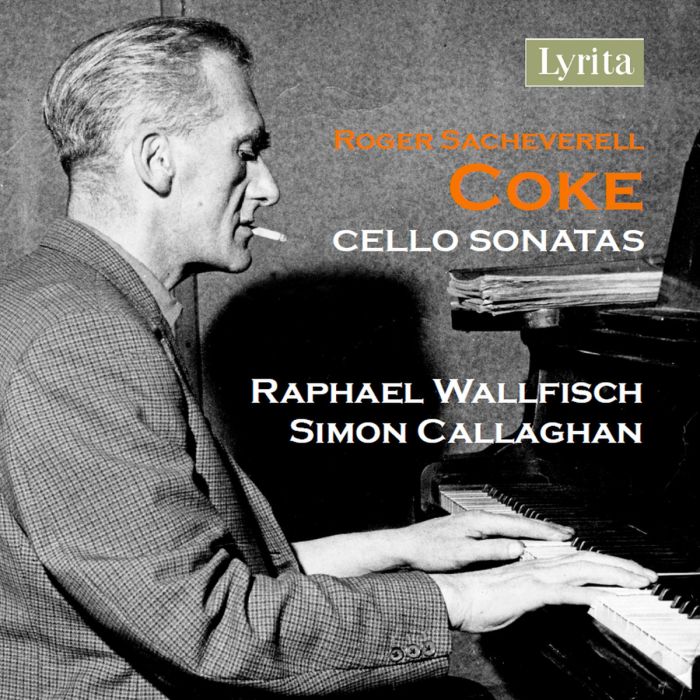
Roger Sacheverell Coke: Cello Sonatas
£14.99
In stock
Catalogue Number
SRCD384


Thanks to the tireless advocacy of the pianist Simon Callaghan, the music of the Derbyshire-born Roger Sacheverell Coke has started to emerge from the obscurity in which it has languished since the composer’s death in 1972. Despite showing considerable early promise, Coke remained an outsider in British musical life. Following studies at Eton (until 1931), he took private lessons with Mabel Lander (piano) and Alan Bush (composition) rather than attending university or music college. Coke credited Bush for helping him to find his musical voice, and cited Arnold Bax as a major influence, but his musical sympathies also extended to Bruckner, Mahler and Rachmaninoff at a time when all three were deeply unfashionable among musical cognoscenti. The three cello sonatas featuring on this disc frame the years 1936 to 1941, a very productive period in Coke’s life. It is a measure of Coke’s confidence in the cello sonatas that he programmed them all in a single concert at the Wigmore in London on 6 October 1951, with the cellist Sela Trau, and invited critics from several of the major broadsheets.
Manufacturer: Wyastone Estate Limited, Wyastone Leys, Monmouth, NP25 3SR
Email: sales@wyastone.co.uk
Reviews:
"All three sonatas on this typically enterprising Lyrita anthology date from the years 1936 to 1941 - an especially fecund period for the composer, which also saw the completion of his Second Symphony (which bears a dedication to Rachmaninov), two piano concertos (Nos 3 and 4 - recorded by Hyperion on Vol 73 of its Romantic Piano Concerto series, 11/17), as well as the 24 Preludes and powerfully taut 15 Variations and Finale (both for piano). I enthused about these last two when assessing Simon Callaghan's exemplary premiere recordings (Somm, 8/15), and if none of the works here rises to the same level of inspiration, there's still plenty to reward the patient listener. Take the First Sonata's absorbing opening Allegro moderate with its frequently bony textures and adventurous harmonic reach; or the two sets of sparkling theme and variations that comprise the finales of the Second and Third Sonatas (in the former there's a quotation from the first movement of Rachmaninov's Fourth Piano Concerto). Elsewhere, a generously lyrical impulse comes to the fore in the slow movements and No 1 's concluding 'Quasi una fantasia', where Lyrita's excellent annotator, Rupert Ridgewell, is surely not mistaken in detecting strong stylistic and even thematic links with Frank Bridge (namely his glorious Cello Sonata) and Bloch (From Jewish Life}.No lost masterpieces, then, but a thoughtful, quietly individual voice does emerge with repeated hearings. Inquisitive readers can rest assured that Callaghan and the admirable Raphael Wallfisch strain every sinew in their passionate advocacy of Roger Sacheverell Coke. First-rate sound and expert balance, too." Andrew Achenbach, Gramophone
"In the last few years recordings of the music of Roger Sacheverell Coke have introduced an almost unknown composer to the discography. In the vanguard has been Simon Callaghan who recorded piano concertos three, four and five (a surviving movement) for Hyperion’s ‘Romantic Piano’ series, solo piano works for Somm and returns for a thorough exploration of the three Cello sonatas, of which these are the first commercial recordings (there’s a non-commercial recording of No.2)...
Everything I’ve heard of Coke’s music, which is admittedly not a huge amount – and only includes that which has been recorded – sounds equivocal and hard to read. Structures are not always easy to follow and it’s the case here that the Third Cello Sonata has a more explicitly clear structure than the first two sonatas. Moods too are difficult to interpret. This is uneasy music.
Yet it’s certainly not without interest, notwithstanding its often more austere profile. It possesses a bittersweet lyricism and explores the higher and lower registers of the cello, in the First Sonata, that generates a creative tension. There are ruminative elements as well as ardour in cello lines that ultimate withdraw from the kind of late-Romantic eloquence that one might have expected. The droller elements of Coke can be sampled in the Scherzo of this sonata, a kind of Pink Pantheresque movement, if you will, puckish and laced with pizzicati. If the finale reminds one of anyone it’s not, say Bartók, but more Bloch.
Coke was known to have revered Rachmaninov and some of the powerful piano chording in these works owes its place to the Russian composer, and there are plenty of opportunities for melancholy and thwarted dance drama, even in the elegy-rich lines of the slow movement of the Second Sonata of 1938. The finale here is unusually extrovert for Coke, and he can’t help slipping in a quotation from Rachmaninov’s Fourth Piano Concerto. In both finales of the Second and Third Sonatas he constructs a compact series of variations; indeed, the last sonata ends very quietly - as well as nostalgic-melancholic central movements.
I can’t imagine greater advocates than the Wallfisch-Callaghan team. The duo explores every facet of Coke’s music and that includes passages of ambiguity, and of unresolved, indeed seemingly irresolvable emotive dilemmas. This is not music of efficiency and fluency. It is somewhat crabbed, and unwilling to let the listener in, or to provide conventional answers. Coke may have cited Alan Bush and Arnold Bax as major influences – the former was his teacher – and he may have toured widely with pianist Charles Lynch, a major Bax and Rachmaninov interpreter, but he offers up few stable or unequivocal answers in his music." Jonathan Woolf, MusicWeb
Everything I’ve heard of Coke’s music, which is admittedly not a huge amount – and only includes that which has been recorded – sounds equivocal and hard to read. Structures are not always easy to follow and it’s the case here that the Third Cello Sonata has a more explicitly clear structure than the first two sonatas. Moods too are difficult to interpret. This is uneasy music.
Yet it’s certainly not without interest, notwithstanding its often more austere profile. It possesses a bittersweet lyricism and explores the higher and lower registers of the cello, in the First Sonata, that generates a creative tension. There are ruminative elements as well as ardour in cello lines that ultimate withdraw from the kind of late-Romantic eloquence that one might have expected. The droller elements of Coke can be sampled in the Scherzo of this sonata, a kind of Pink Pantheresque movement, if you will, puckish and laced with pizzicati. If the finale reminds one of anyone it’s not, say Bartók, but more Bloch.
Coke was known to have revered Rachmaninov and some of the powerful piano chording in these works owes its place to the Russian composer, and there are plenty of opportunities for melancholy and thwarted dance drama, even in the elegy-rich lines of the slow movement of the Second Sonata of 1938. The finale here is unusually extrovert for Coke, and he can’t help slipping in a quotation from Rachmaninov’s Fourth Piano Concerto. In both finales of the Second and Third Sonatas he constructs a compact series of variations; indeed, the last sonata ends very quietly - as well as nostalgic-melancholic central movements.
I can’t imagine greater advocates than the Wallfisch-Callaghan team. The duo explores every facet of Coke’s music and that includes passages of ambiguity, and of unresolved, indeed seemingly irresolvable emotive dilemmas. This is not music of efficiency and fluency. It is somewhat crabbed, and unwilling to let the listener in, or to provide conventional answers. Coke may have cited Alan Bush and Arnold Bax as major influences – the former was his teacher – and he may have toured widely with pianist Charles Lynch, a major Bax and Rachmaninov interpreter, but he offers up few stable or unequivocal answers in his music." Jonathan Woolf, MusicWeb
"The singing melodic lines are richly harmonised in idiomatic piano writing and cover the full range of cello emotions, from elegiac poignancy to dance- like exuberance. Perhaps, for a composer who often suffered from bouts of depression there is much darkly expressive music here. The First Sonata of 1936 is the shortest at 20 minutes and is perhaps the most successful as the material is unpretentious, and finally balanced between playful and heartfelt.
The Second Sonata of 1938 was a significant work for Coke as it was written at the time he destroyed many of his early ‘immature’ works, and so can be seen as coming of age of the composer. The slow movement begins straight out of Ivor Novello, says hello to Rachmaninoff, and is absolutely ravishing. The very Russian sounding finale even includes an obvious quote from Rachmaninoff’s 4th Piano Concerto.
Mr. Callaghan is a fine pianist, who sounds better with every new release and who is completely in tune with the music, while Mr. Wallfisch plays this unfamiliar repertoire with tremendous musicality." British Music Society
The Second Sonata of 1938 was a significant work for Coke as it was written at the time he destroyed many of his early ‘immature’ works, and so can be seen as coming of age of the composer. The slow movement begins straight out of Ivor Novello, says hello to Rachmaninoff, and is absolutely ravishing. The very Russian sounding finale even includes an obvious quote from Rachmaninoff’s 4th Piano Concerto.
Mr. Callaghan is a fine pianist, who sounds better with every new release and who is completely in tune with the music, while Mr. Wallfisch plays this unfamiliar repertoire with tremendous musicality." British Music Society

|
| Sample Tracks |
|---|
|
First Cello Sonata in D Minor, Op. 24: II. Adagio, largo assai, mesto
Second Cello Sonata in C Major, Op. 29: I. Moderato maestoso - Allegro appassionato
Third Cello Sonata in A Minor, Op. 44: I. Andantino - Allegro
|
0.135 kg