We use cookies to make your experience better. To comply with the new e-Privacy directive, we need to ask for your consent to set the cookies. Learn more.



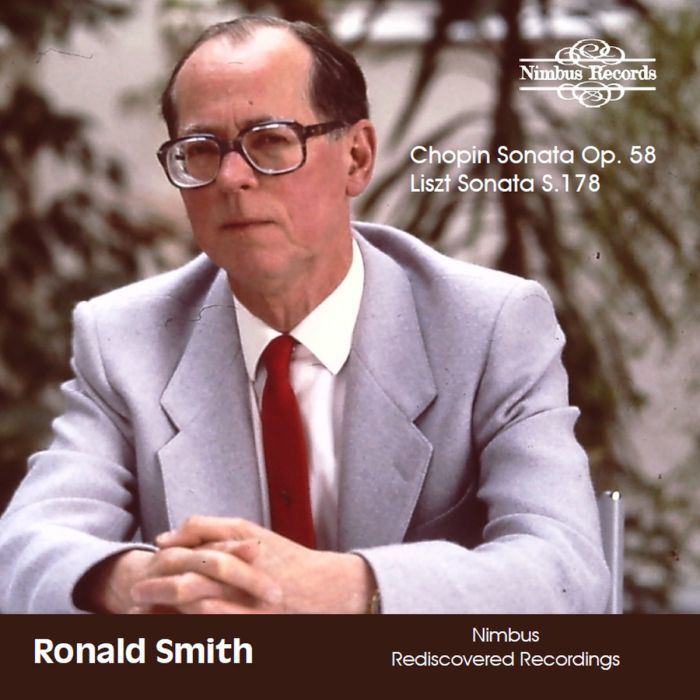
Ronald Smith plays Chopin & Liszt: Nimbus Rediscovered Recordings
£10.99
In stock
Catalogue Number
NI7115

Ronald Smith approached Nimbus at a turbulent time in the industry. His long-time recording partnership was in transition, and he would make six visits to the Nimbus studio, a peaceful space in the ballroom of the Victorian mansion at Wyastone Leys just outside Monmouth. His initial visits in February and August 1980 were concerned with really core repertoire: Chopin’s Etudes Op. 10 and Op. 25, his Sonata Op. 58, and the Liszt Sonata. He returned in 1983 to record Liszt’s transcription of Beethoven’s Seventh Symphony and Busoni’s transcription of Bach’s ‘Chaconne’. In 1985 there were two visits, in May to record an album of popular Beethoven Sonatas, then in September to deliver Balakirev’s B-flat minor Sonata and Scriabin’s ‘Black Mass’ Sonata No. 9. A final visit in June 1986 was devoted to Mussorgsky’s ‘Pictures at an Exhibition’. The sessions in 1980 were both ‘analogue’, being made on reel-to-reel tape machines. We had little idea how quickly such Industry wide state-of-the-art technology would be brutally swept aside by the arrival of digital recording, and its market counterpart the Compact Disc. Ronald’s Chopin Etudes were released on LP the following year. The LP sleeve went as far as announcing the catalogue number of the upcoming Chopin/Liszt Sonata pairing. The master was approved and ready to go. But all things ‘digital’ upended all sense: the record world, its media and followers clamoured for digital recordings of standard works. Labels rushed to satisfy the demand (Nimbus was no exception) and unreleased ‘analogue’ masters fell into a dark hole. Ronald Smith’s later digital recordings enjoyed immediate release, but not so the Chopin/Liszt Sonatas, until now, 45 year on. © Adrian Farmer
Nimbus ‘Rediscovered Recordings’
Nimbus is pleased to present the first two titles of a short series of recordings sitting on the shelves of the Nimbus archive that were ‘rediscovered’ during the 2020 COVID shutdowns. In those quiet days idle hands and minds posed the question: ‘So, do we have anything unissued that we can use to construct a release programme?’ This casual enquiry initiated a full investigation that has continued for five years and revealed more than fifty recording projects that, for one reason or another, never made it into the world. Some of these recordings go back to the founding of Nimbus in the late 1960s. There is no single reason to account for their neglect, and in every case we have found no justification for holding them back any longer.
The original analogue tapes, typically one-inch, four track, 30ips, transferred to a digital medium with no problem. We decided to archive them at 192k, thus preserving them for next generation use. Early digital tapes, from 1981/82, using U-matic cassettes, sometimes required surgical intervention to repair passages of lost signal, but having been stored in the same warm, dark room for their entire lives also transferred reliably for the most part.
Manufacturer: Wyastone Estate Limited, Wyastone Leys, Monmouth, NP25 3SR
Email: sales@wyastone.co.uk
Reviews:
"Then, after the opening riff, Liszt offers the fugato announcing the third, demonic progression. Serving as a kind of development section, the expansive fugue injects a fury into the textural mass that defies classical categories. Each articulation of the impulse intensifies the staggering effect, so no wonder the orchestral version often appeared in Universal horror films! The consolation of the D major theme arises out of the emotional rubble, devoutly delivered and beatific in visionary power. Smith then mounts to a grueling, cataclysmic moment, furioso, since it is better to rule in Hell than to serve in Heaven, the ultimate expression of individualistic pride. Yet, Liszt resists the apotheosis of the Abyss and reintroduces his grand anodyne, the Andante sostenuto theme after a pregnant silence. The snake bites its own tail; the ouroboros, the eternal circle, is complete." Gary Lemco, Audiophile Audition (Click here for full review)
“…In general character the music is more benign than in the First Symphony and the Second has an ingenious way of moving forwards in successive waves of intricately related material so that a satisfying architectural continuity emerges naturally over the entire half-hour span. The Concerto is similarly coherent but freer in its facture with an appropriate air of flamboyance to the textures. Both works are irresistibly performed, and they breathe an air of outer enchantment entirely rare in music of such inner sophistication. Watkins is assuredly a modern master, and this is an album to relish.” Geraint Lewis, Gramophone

|
| Sample Tracks |
|---|
|
Sonata in B Major, Op. 58: II. Scherzo. Molto vivace
Sonata in B Minor: II. Andante sostenuto
|
0.135 kg