We use cookies to make your experience better. To comply with the new e-Privacy directive, we need to ask for your consent to set the cookies. Learn more.



Saint-Saëns Piano Duo & Duet Volume 1
£14.99
In stock
Catalogue Number
NI5940
Saint-Saëns' favourite pupil, Gabriel Fauré, wrote in his obituary of his teacher of the ‘serene regions’ his music often inhabited, ‘where violence and paroxysms are unknown, where gravity, wit, charm and smiling tenderness rule side by side.’ In this he was echoing his teacher’s own response to the world around him: ‘Are smiles and graces to be ignored by all?... Happiness is disapproved of in the music of our time... Long live sadness! Long live boredom!’ To which I respond, ‘Long live keys, tunes, clarity and playfulness! Long live the music of Camille le Grand!’ Roger Nichols.
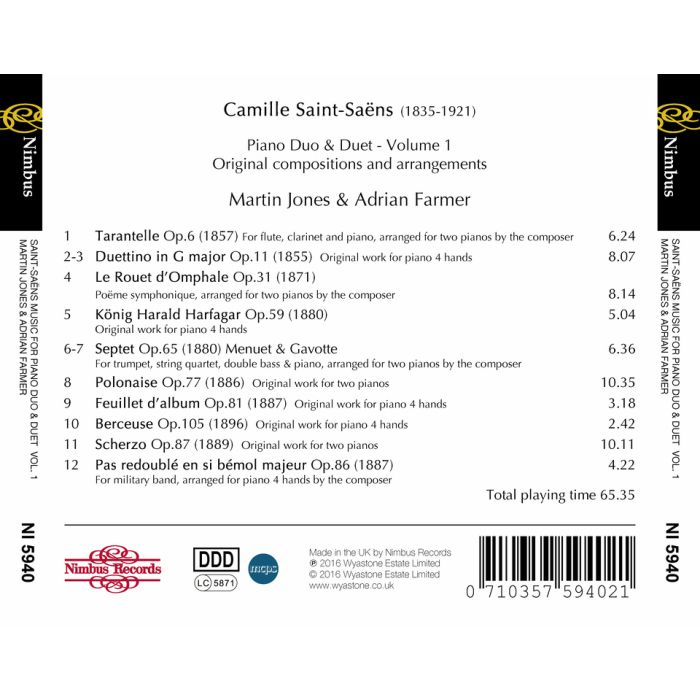
This recording is the first of two volumes of original compositions and arrangements for piano duo and duet by Camille Saint-Saëns. This programme presents the substantial Scherzo, Op. 87 and Polonaise, Op. 77 for two pianos alongside a number of smaller works for two pianos and piano four hands.
Manufacturer: Wyastone Estate Limited, Wyastone Leys, Monmouth, NP25 3SR
Email: sales@wyastone.co.uk
Reviews:
EDITORIAL REVIEWS
"This collection of original compositions and arrangements is a delight from start to finish...The clarity four hands bring to every note is most rewarding as is the fact that a second volume has already been announced."
Classical Music Magazine
"... the two pianists are perfectly in tune with one another at all times. This is thoroughly enjoyable and well recorded with some interesting cover notes. I really look forward to hearing volume 2 … with volumes 3 and 4 to follow, I hope."
Music Web International - Classical Review
Here is one of the byways of that output, a disc of both original compositions and arrangements for piano duo and duet. This first of two volumes opens with a piquant Tarantelle arranged for two pianos, first heard anonymously at Rossini's famous Parisian salon, when its quality led to the assumption it was written by the host. Not all this music escapes the atmosphere of the salon it must be said, for domestic qualities dominate over those associated with the concert hall. Roger Nichols's booklet note places the two-movement Duettino in that category, which "aims at young girls" and their "traditional occupation of the piano stool after dinner". Which does not mean it is short on charm, and the same could be said of the light entertainment of the Feuillet d'album, which nonetheless offers skilful contrapuntal writing in its middle section.
But some works here have more substance. A keen follower of Liszt (the admiration was mutual), Saint-Saëns produced a series of symphonic poems on Liszt's model, of which the first was Le Rouet d'Omphale. This tale of Hercules features a spinning wheel, the rhythmical rotation of which can be heard from the outset but which also generates some of the attractive melodic material of this work. (If you want to hear the composer's two piano arrangement of his best known symphonic poem, Danse macabre, that can be found on Nimbus's second volume). König Harald Harfagar, (King Harold Fairhair) is a tale of the monarch who first united Norway, and another more serious endeavour, this time an original work for the piano 4 hands medium. But the craftsmanship in all these pieces would make it difficult to know which are arrangements and which originals without consulting the programme listing.
…In the Polonaise, Saint-Saëns seems to have found his inner Slav, with writing that almost matches the examples of Chopin or even Tchaikovsky's Polonaise in Eugene Onegin. This is the piece I shall return to most often.
Nimbus regulars Martin Jones (piano) and Adrian Farmer (piano) are expert and adroit players, but also highly sympathetic to the medium, whether at two keyboards or one. They treat each piece on its merits, and always sound spontaneous. With the very last item, the Pas redoublé arranged from a military band original, the duettists set off at a very quick march ("at the double" indeed) and sound as if they are having a great deal of sheer fun – not a quality that is unwelcome in such repertoire of course. The recorded sound is good, avoiding any of the clatter than can occur when two modern pianos are both required to play loudly.
Music Web International – Classical Review

|
| Sample Tracks |
|---|
|
Tarantelle, Op. 6
Duettino in G major, Op. 11: II. Allegretto
Le Rouet d'Omphale, Op. 31
Septet, Op. 65: I. Menuet
Polonaise, Op. 77
Feuillet d'album, Op. 81
Scherzo, Op. 87
|
0.135 kg