We use cookies to make your experience better. To comply with the new e-Privacy directive, we need to ask for your consent to set the cookies. Learn more.



Soulima Stravinsky: Nimbus Rediscovered Recordings [2CDs]
£14.99
In stock
Catalogue Number
NI7110

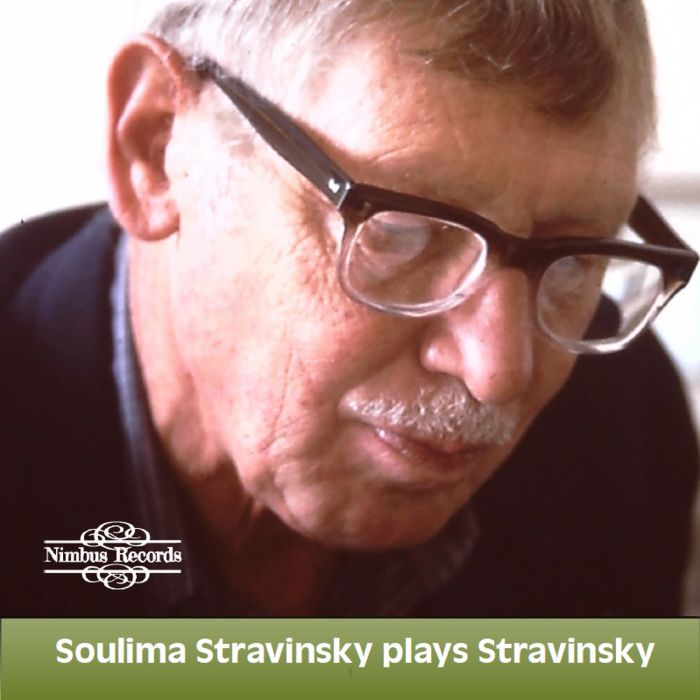
Soulima Stravinsky was the third child of Igor and Yekaterina Stravinsky. His career in music encompassed performing as a recitalist and concerto soloist, particularly noted for interpretations of his father’s music, musicology, education, and composition. Soulima’s performing career was slowly expanded with achievements as a transcriber, editor, author, and composer. Although in the later endeavour his work was inevitably over-shadowed by his father’s towering reputation. Soulima had a particular gift for composing music for children. He made two visits to the Nimbus Studios, in 1975 to record these performances of his father’s music, and in 1977 to record his own music for children. This is the first release of these fine performances, facsinating not least for their specific historic significance. © Adrian Farmer
Nimbus ‘Rediscovered Recordings’
Nimbus is pleased to present the first two titles of a short series of recordings sitting on the shelves of the Nimbus archive that were ‘rediscovered’ during the 2020 COVID shutdowns. In those quiet days idle hands and minds posed the question: ‘So, do we have anything unissued that we can use to construct a release programme?’ This casual enquiry initiated a full investigation that has continued for five years and revealed more than fifty recording projects that, for one reason or another, never made it into the world. Some of these recordings go back to the founding of Nimbus in the late 1960s. There is no single reason to account for their neglect, and in every case we have found no justification for holding them back any longer.
The original analogue tapes, typically one-inch, four track, 30ips, transferred to a digital medium with no problem. We decided to archive them at 192k, thus preserving them for next generation use. Early digital tapes, from 1981/82, using U-matic cassettes, sometimes required surgical intervention to repair passages of lost signal, but having been stored in the same warm, dark room for their entire lives also transferred reliably for the most part.
Manufacturer: Wyastone Estate Limited, Wyastone Leys, Monmouth, NP25 3SR
Email: sales@wyastone.co.uk
Reviews:
"The restoration from the original analogue tapes offers a balanced result, with a natural piano image and a dynamic range that respects the character of the original recordings. The fact that many interpretations are published with minimal editing interventions reinforces the perception of controlled spontaneity and technical soundness. All this makes this album a document of serene authority that enriches Stravinsky's interpretative reception. In this sense, the value of the album is twofold: as an object of study and as a fully convincing musical experience." Carme Miró, Sonogram Magazine (Read full review here)
"Here is a fascinating find. Soulima Stravinsky was the third child of Igor and Yekaterina Stravinsky and had his own career as pianist, composer, author, and educator, often playing his father’s music. One of his specialties in his own compositions was music for children, which as this album illustrates, he had a special gift for: the music is both disarmingly simple and highly sophisticated. He recorded these performances of his own and his father’s music for Nimbus in 1975 and 77, but this is the first release, making this an illuminating and historically important album. Soulima plays his father’s music with skill and authority, from the early, Scriabi-nesque Etudes through the more familiar neo-classical pieces. I especially like his rendering of The 5 Fingers, simple but striking miniatures. He articulates the austere lines of the sonata, Serenade, and Tango with tart, lively precision. Soulima’s own music on CD2 is full of color and charm, especially the 3 Fairy Tales. `The Fairy Appears’ has a simple magic; `Cinderella’s Flight’, `The Magic Harp’, and `The Spindle’ are skillful pieces of tone painting; the bitonal `Wedding Bells’ are playful and joyous. The spare, inventive Sonatina 6 is Soulima’s version of neo-classicism. His Piano Variations are a bit more modernist, especially `11 Tones’ and `12 Tones’. The well-recorded album ends with the last Variation, a lyrical, bittersweet Pavana." SULLIVAN, American Record Guide

|
| Sample Tracks |
|---|
|
Quatre Etudes, Op. 7, K. 9: I. Con moto
Sérénade en la, K.44: II. Romanza
Three Fairy Tales, Cinderella: V. Cinderella Dances With The Prince
Three Fairy Tales, Jack And The Beanstalk: IV. The Enchanted Castle And The Wicked Giant
Three Fairy Tales, The Sleeping Beauty: IV. The Prince's Hunt
Piano Variations, First Series: VI. Les Vales
|
0.145 kg