We use cookies to make your experience better. To comply with the new e-Privacy directive, we need to ask for your consent to set the cookies. Learn more.



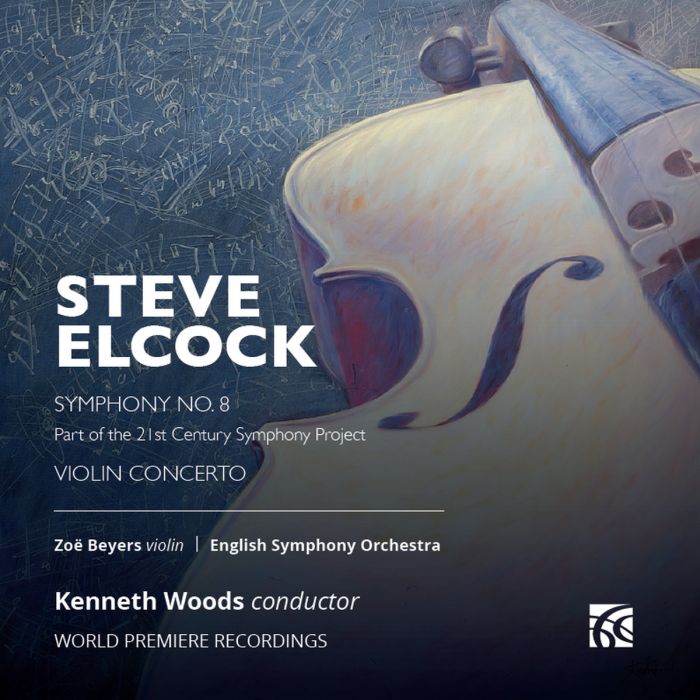
Steve Elcock: Symphony No. 8 & Violin Concerto
£14.99
In stock
Catalogue Number
NI6446

World Premiere Recordings
Steve Elcock, born in Chesterfield, Derbyshire in 1957, obtained an A-Level in music and learned the violin up to grade 7. As a composer, he is otherwise self-taught, beginning to write from around age fifteen and continuing to do so ever since. He trained as a teacher of French but, once qualified in 1981, he moved to France, where he worked in language services until his retirement in 2019. From being unknown to anyone outside a small circle of his friends and family, his music has now come to the attention of music lovers, conductors and reviewers. That turnaround began with the release of his Third Symphony which was released in September 2017 and was almost immediately featured as ‘CD of the Week’ on Record Review on BBC Radio 3 – a rare feat for a work by a hitherto unknown composer. Steve Elcock has composed ten symphonies to date, five of which have been recorded. He has also written concertos, symphonic poems and much chamber music.
Manufacturer: Wyastone Estate Limited, Wyastone Leys, Monmouth, NP25 3SR
Email: sales@wyastone.co.uk
Reviews:
“Despite the fact that he didn’t have the opportunity to release these two works by master symphonist Steve Elcock on his own Toccata Classics label, I would think that my esteemed confrere Martin Anderson must be feeling very pleased that a composer whom he lifted from almost total obscurity into the consciousness of music lovers all over the globe has now seen two major, as yet unrecorded works find their way onto one of England’s premiere labels, something that surely would never have happened without Anderson’s pioneering efforts on behalf of the Anglo-French composer.
The CD opens with Elcock’s Violin Concerto, which he actually began writing in 1996, in which year he composed its first movement. Some years passed before he wrote a second, but it was not until 2006 that he got around to the concluding movement, the impetus coming from an amateur orchestra that desired to perform the work in that year. If I heard the opening of this concerto blind and had to come up with the country of the composer, I’d guess “Romania.” My impression would be because of the melodic contour of the solo line, including its use of the augmented second, endemic to the music of that country. It was not long into the movement, however, that I heard more Elcock and less Enescu or Jora. About this work, the composer writes that he wanted it to recapture some of the “classical momentum” that had been largely lost from the Romantic era onward. I do indeed hear a Classical spirit throughout this piece (indeed, parts of it even have the flavor of a concerto grosso), but its harmonic underpinning is strictly Elcock in its diversity and complexity. Not only is the soloist kept very busy in this movement (as one would expect in any concerto), but the orchestra almost equally so.
The second movement begins with muted strings setting an undulating and rather Ravelian background over which the soloist spins out a lovely tune. Other instruments gradually enter and weave interesting lines around those of the violin, keeping the listener fully engaged in the work which is developed in the composer’s inimitable fashion. The considerably shorter finale is a passacaglia that gradually increases in tempo and vigor, the relative harmonic density of the opening eventually leading to a powerful, definite, and rather abrupt close.
Zoë Beyers plays with accuracy, verve, and a felicitous facility, but I wish that Nimbus had boosted her a bit. She sometimes gets lost in the portions of the piece that include a busy texture in the orchestration; even an increase of a couple decibels would have been sufficient. The significant reverberance of the recording doesn’t aid her audibility either, but otherwise I do not find it objectionable.
Elcock’s Symphony No. 8 also experienced an unusually long gestation period, given that the composer began it in 1981, some 15 years before his Symphony No. 1. I won’t go into the entire convoluted history of this work, but suffice it to say that Elcock is hardly the first composer to write his symphonies “out of order.” Penderecki completed his sixth venture into the genre well after his eighth, and the ordering of the numbered symphonies of Schumann and Mendelssohn corresponds only distantly to their chronology of composition. Thus, cast in a single 24-minute movement, Elcock’s Eighth begins with lines in the low strings, and builds up gradually over the next few minutes in rather Shostakovich-like fashion to a dramatic climax featuring the high strings. The short motifs heard at the outset are well developed according to the composer’s natural instincts whereby he creates compelling symphonic structure. The composer maintains a somber tone throughout, as though the Symphony were a harbinger of some impending cataclysmic event. In the end, though, it fades away to nothing via a trill in the second violins. Its conclusion is nothing short of indescribably beautiful.
Kenneth Woods and the English Symphony Orchestra provide a truly compelling reading, and the maestro captures every nuance written into this remarkable symphony. Composers salivate over hearing their music performed to such a high standard. The minor balance problem that I note in the concerto is naturally not a factor in the symphony. Elcock enthusiasts, of which I am one of the most dedicated, will not want to miss this arresting program, but if you are as yet unacquainted with his unique genius, you should definitely check this disc out, as well as the half-dozen Toccata Classics releases of the music of this seasoned symphonist.” David DeBoor Canfield, Fanfare
"A resurrected opera recording by Brian, orchestral marvels by Jarrell, Rosner and Saxton and a marvellous chamber disc of Brian Elias, all ultimatley took second place to Steve Elcock's compellingly dark, Nordic Eighth Symphony, coupled with his lively, beautiful Violin Concerto. Gripping new music, wonderfully performed." Guy Rickards, Gramphone Critic's Choice
"Steve Elcock (b 1957) is a self-taught Anglo-French composer who spent many years writing pieces seemingly consigned to the desk drawer. Recently the Toccata label took notice and released the first album of his music (Toccata 400, J/F 2018). Since then, several more releases have come our way and have revealed him to be a signifi-cant composer of serious, complex, and substantial classical music. This one is no exception. His Violin Concerto (2006) is a true masterpiece of the genre—well paced, tightly crafted, and perfectly balanced, with plenty of imagination and substance in the writing for both solo violin and orchestra. The thrilling classical momentum of I gives way to a sweetly lyrical II, the soaring violin complemented by beautiful textures and color from the orchestra. The Rautavaarian dreamscape gives way to muscular, Nielsen-esque vigor with a passacaglia finale that culminates in one of the most explosively exciting climaxes I have heard in a violin concerto. This is a work that deserves to be heard on the world stage. His single-movement Symphony No. 8 (1981/2021) began life as a string quartet; he rewrote it as a sinfonietta, then finally as a symphony for Beethovenian forces. The final result is a bleak, harrowing affair shrouded in a mood described by the com-poser as “desperation in the teeth of impending catastrophe”. It is driven by motives introduced in the first few bars, which are rigorously and intelligently developed across the piece in a language that contains fleeting elements of Shostakovich and Sibelius. It is a demanding but rewarding piece to the listener. The symphony comes to us as part of the 21st Century Symphony Project, Kenneth Woods’s initiative with the English Symphony to commission new symphonies by living composers—a laudable project that has already yielded some gems and further dis-plays the excellence of British composers in the symphonic genre. The performances on this disc are superlative, not least the excel-lent playing by ESO concertmaster Zoe Beyers." American Record Guide, Nathan Faro
"Composer Steve Elcock is living proof that we should never give up hope. As he outlines on his website, he wrote music with seemingly no hope of it being performed, but with computer technology, was able to ‘mock up’ his orchestral music into satisfactory ‘demos’.In 2013 his work came to the attention of Martin Anderson, director of Toccata Classics, and recordings and performances he could only have dreamed of came about. This is all to the good for we listeners because his music is of extraordinary quality. The Violin Concerto was written over a ten-year period, appearing as a wonderfully satisfying three movement work in the classical tradition. The opening is punchy and dramatic with much athletic writing for soloist, ESO leader Zoe Beyers. It is hard to believe it was originally conceived for an amateur orchestra.The slow movement is based on change ringing bell technique. The overlapping violins and violas initially provide a shimmering background to the solo violin’s yearning melody. It is beautifully constructed and builds with an almost Sibelian tension to a climax in D major before disappearing.The finale could have been a cerebral passacaglia, but such is the composer’s ingenuity that the form disappears into the music. Over its six minutes it builds from slow to fast and ends on a high, guaranteed to have the audience on its feet. There is much wonderfully idiomatic writing for the violin, and the orchestration is so transparent that there is no danger of her being overshadowed.Symphony no 8 had an even longer gestation period beginning as a string quartet in 1981. Decades later, on revisiting it, the composer arranged it for strings, naming it a sinfonietta. Kenneth Woods then asked for a symphony of classical orchestra size for the 2021 Three Choirs Festival.40 years on, with the addition of wind, brass and timpani, the final form was reached. It sounds organically constructed in one movement of 25 minutes, but with many seamless tempo changes. The brooding opening moves into a breathless scherzo-like section with some wonderful scurrying writing for the wind, before winding down to a quite ending, tinged with tragedy. It is a tremendously satisfying work that, without having a programme, seems to take us on a journey.I have not heard any of Mr Elcock’s music before, but I shall certainly be looking out for more. This is a composer of real significance, writing music, tuneful, brilliantly orchestrated and communicative. It is exactly the type of work that sadly disappeared from concert halls in the 60s and 70s, and which we need more than ever now. The composer could not wish for better advocates than the performers and engineers assembled here." Paul RW Jackson, British Music Society
"In a new recording coming from Nimbus, South African violinist Zoë Beyers, with the English Symphony Orchestra, takes on English composer Steve Elcock (b. 1957) and his 2006 Violin Concerto. Elcock is quite a discovery. Self-trained as a composer, he has worked for the last 50 years in France in language services, with composing as a side hobby. Recordings of his orchestral music and chamber music have been released since 2017 and quickly came to the attention of the world, with his Orchestral Music, Vol. 1, containing his Symphony No. 3, becoming CD of the Week on BBC Radio 3." Maureen Buja, Interlude [read complete review]
"First recordings introduce the English composer Steve Elcock. A self-taught composer, he found his way after becoming acquainted with the music of composer Allan Pettersson. He also displays the relentlessness of a Robert Simpson in his works. Yet Elcock writes more accessibly than Pettersson and more emotionally and communicatively than Simpson... The South African violinist Zoë Beyers, who lives in England, performs the solo part with verve and impeccable quality. She is able to hold her own effortlessly against the orchestra and shape her voice expressively... Together with Kenneth Woods, the English Symphony Orchestra presents this recording in its series of 21st century symphonies. They present themselves as an ensemble well versed in the modern musical language, which is also ideally suited to this task." pizzicato [read complete review]
"The more I discover and experience the music of Steve Elcock, the more I feel the need to recommend it to anyone who happens to read this review. If you enjoy classical music in general, with a preference for symphonic writing, this living composer ticks all the boxes when it comes to harmonic integrity, orchestration colors and textures, emotive power and structural stability." Jean-Yves Duperron, Classical Music Sentinel [read complete review]
"In this text we address the presentation of a special album with the music of composer Steve Elcock. We will pay special attention to the Violin Concerto and the Symphony No. 8 in the version by the English Symphony Orchestra and the South African violinist Zoë Beyers, conducted by Kenneth Woods.
Elcock will be the guest composer of the Elgar Festival 2024 to be held between May 27 and June 2 in Worcester. He is a composer little known in our country, and his music has only been lavished within the author's known circles. He has written ten symphonies to date, five of which have been recorded, and in 2022 he was appointed John McCabe Association Composer for the English Symphony Orchestra.
Conductor Kenneth Woods recovers Elcock's music with two orchestral pieces, an important link in the recovery of the English composer's work. Interestingly, the Violin Concerto was conceived and completed over a decade. While the first movement is pure energy, the second movement is a passionate lento of sensational timbre richness, evoking distant bells ringing in a valley. The finale is a short movement, a passacaglia, which incorporates a gradual accelerant from the andante to the presto. A concert of overwhelming beauty, thanks, too, to the expressive brilliance of Zoë Beyers.
The Symphony No. 8, Op. 37, consisting of a single movement, is a monumental work that exudes fragility, with a brittle and also controversial formal structure. With a spectacular force of metal, the author reorchestrated this work at the request of director Kenneth Woods. The mood is one of despair in the face of an imminent catastrophe.
Kenneth Woods, at the head of the English Symphony Orchestra, imprints on the score all the greatness of which it is capable and exceeds the maximum demands of this splendid small-format work. Kenneth Woods' warmth and expressive fluidity provide great expressive resources, which give a convincing air to the score." Carme Miró, Sonogram Magzine
"Composer Steve Elcock is living proof that we should never give up hope. As he outlines on his website, he wrote music with seemingly no hope of it being performed, but with computer technology, was able to ‘mock up’ his orchestral music into satisfactory ‘demos’.
In 2013 his work came to the attention of Martin Anderson, director of Toccata Classics, and recordings and performances he could only have dreamed of came about. This is all to the good for we listeners because his music is of extraordinary quality....I have not heard any of Mr Elcock’s music before, but I shall certainly be looking out for more. This is a composer of real significance, writing music, tuneful, brilliantly orchestrated and communicative. It is exactly the type of work that sadly disappeared from concert halls in the 60s and 70s, and which we need more than ever now. The composer could not wish for better advocates than the performers and engineers assembled here." Paul RW Jackson, British Music Society
"ELCOCK: … a significant composer of serious, complex, and substantial classical music. This one is no exception. His Violin Concerto (2006) is a true masterpiece of the genre—well paced, tightly crafted, and perfectly balanced, with plenty of imagination and substance in the writing for both solo violin and orchestra. The thrilling classical momentum of I gives way to a sweetly lyrical II, the soaring violin complemented by beautiful textures and colour from the orchestra. The Rautavaarian dreamscape gives way to muscular, Nielsen-esque vigor with a passacaglia finale that culminates in one of the most explosively exciting climaxes I have heard in a violin concerto. This is a work that deserves to be heard on the world stage.
His single-movement Symphony No. 8 (1981/2021) began life as a string quartet; he rewrote it as a sinfonietta, then finally as a symphony for Beethovenian forces. The final result is a bleak, harrowing affair shrouded in a mood described by the composer as “desperation in the teeth of impending catastrophe”. It is driven by motives introduced in the first few bars, which are rigorously and intelligently developed across the piece in a language that contains fleeting elements of Shostakovich and Sibelius. It is a demanding but rewarding piece to the listener. The symphony comes to us as part of the 21st Century Symphony Project, Kenneth Woods’s initiative with the English Symphony to commission new symphonies by living composers—a laudable project that has already yielded some gems and further displays the excellence of British composers in the symphonic genre. The performances on this disc are superlative, not least the excellent playing by ESO concertmaster Zoe Beyers." FARO, American Record Guide
"Composer Steve Elcock is living proof that we should never give up hope. As he outlines on his website, he wrote music with seemingly no hope of it being performed, but with computer technology, was able to ‘mock up’ his orchestral music into satisfactory ‘demos’.
In 2013 his work came to the attention of Martin Anderson, director of Toccata Classics, and recordings and performances he could only have dreamed of came about. This is all to the good for we listeners because his music is of extraordinary quality…
I have not heard any of Mr Elcock’s music before, but I shall certainly be looking out for more. This is a composer of real significance, writing music, tuneful, brilliantly orchestrated and communicative. It is exactly the type of work that sadly disappeared from concert halls in the 60s and 70s, and which we need more than ever now. The composer could not wish for better advocates than the performers and engineers assembled here." Paul RW Jackson, British Music Society
"In a new recording coming from Nimbus, South African violinist Zoë Beyers, with the English Symphony Orchestra, takes on English composer Steve Elcock (b. 1957) and his 2006 Violin Concerto. Elcock is quite a discovery. Self-trained as a composer, he has worked for the last 50 years in France in language services, with composing as a side hobby. Recordings of his orchestral music and chamber music have been released since 2017 and quickly came to the attention of the world, with his Orchestral Music, Vol. 1, containing his Symphony No. 3, becoming CD of the Week on BBC Radio 3.
For this world premiere recording, the composer discusses this work, which he began in 1996. It consisted solely of one movement and was for strings alone. The slow movement eventually followed, and the final movement appeared in 2006. The first movement is one of pure energy, and the composer says he was trying to return to an ideal of classical momentum that he felt had been lost from the Romantic period onward. Even when the expansive second theme appears, the violas ‘niggle’ it from below, driving it forward… The composer describes the mood of the pieces as ‘desperation in the teeth of impending tragedy’ and the ongoing tension of the work is one of its most fascinating aspects.
It will be fascinating to watch and listen for the rest of Elcock’s works, new and old, to appear. His distinctive voice has now spanned 10 symphonies, concertos, symphonic poems, and chamber music. He will be the invited composer at the end of May for the Elgar Festival in Worcester and will be in conversation with the Festival’s Artistic Director, Kenneth Woods." Maureen Buja, Interlude Magazine
"Kenneth Woods and the English Symphony Orchestra provide a truly compelling reading, and the maestro captures every nuance written into this remarkable symphony. Composers salivate over hearing their music performed to such a high standard. The minor balance problem that I note in the concerto is naturally not a factor in the symphony. Elcock enthusiasts, of which I am one of the most dedicated, will not want to miss this arresting program, but if you are as yet unacquainted with his unique genius, you should definitely check this disc out, as well as the half-dozen Toccata Classics releases of the music of this seasoned symphonist." David Deboor Canfield, Fanfare Magazine