We use cookies to make your experience better. To comply with the new e-Privacy directive, we need to ask for your consent to set the cookies. Learn more.


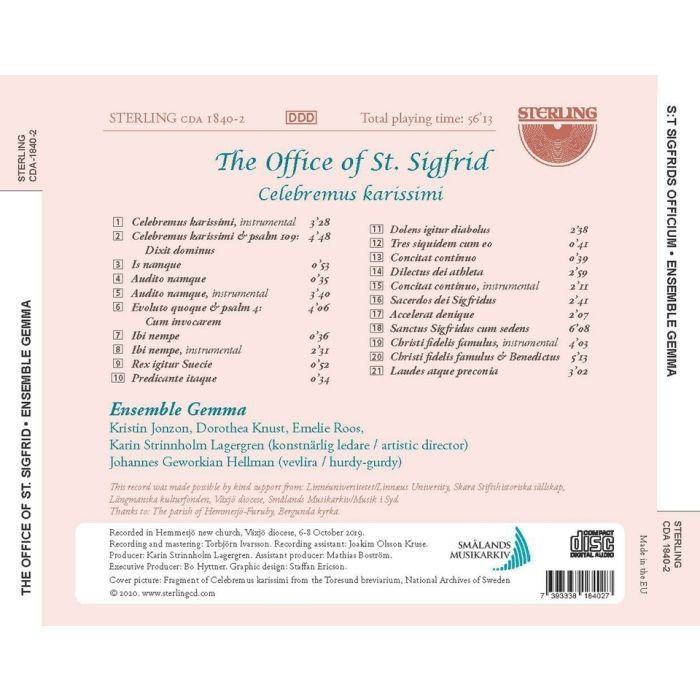
The Office Of St. Sigfrid: Celebremus Karissimi
£14.99
In stock
Catalogue Number
CDA1840
During the Middle Ages the legend of Saint Sigfrid was related on Saint Sigfrid’s Day, the 15th of February. It was reported how he by difficult paths arrived in Småland as a mis-sionary; upon his death he was buried in Växjö. The legend was presented in words and music in the form of an Office, that is, the services which in a monastic context – as was the case at Växjö Cathedral during the Middle Ages – were spread evenly throughout the day. This combination of recitation from the saint’s legend and chants about the saint is called an Office or historia.
There are many possibilities about how to interpret Gregorian chant today, just as there was in the Middle Ages. The ensemble Gemma strives for a flexible, text-based song where the accentuation of the words forms the foundation for the melodic line. In this recording we have used a pronunciation of the Latin as it is believed to have sounded during the High Middle Ages in Sweden. Three of the antiphons have been performed with psalmody, in order to some extent high-light the most important task of the Office: The weekly recitation of the 150 psalms from the Old Testament’s Book of Psalms and the cantica from the New Testament.
With this recording of excerpts from the Sigfrid Office, we wish to invite the listener to participate in the rich world represented by the medieval Office repertoire, and to offer an audio selection from Swedish music history.
Manufacturer: Wyastone Estate Limited, Wyastone Leys, Monmouth, NP25 3SR
Email: sales@wyastone.co.uk
Reviews:
The Office or Historia which is performed here – or rather excerpts of it – is about St Sigfrid, known as Sigfrid of Sweden, who was a missionary-bishop during the first half of the 11th century… A feature of the celebrations of saints is that many stories from their lives are undoubtedly legends. It is often hard to discern between historical facts and stories that are the product of fantasy… associate professor of Scandinavian languages at Linnaeus University in Växjö (the place where Sigfrid died), argues that the legend of Sigfrid’s life has been underappreciated as a historical source, …newer research has revealed that Christianity was established in the early 11th century, and Sigfrid may have been active at the time…
As no complete Office has been preserved from a particular time, the chants included here date from different eras, from the 13th to 16th centuries…The recording does not follow a strict liturgical order. Not all the chants are on original music; in some cases we have to do with adaptions from other chants.
In their way of singing the ensemble attempts to reconstruct the performance practice of the Middle Ages; the Latin pronunciation is based on what was common at the time in Sweden…Apart from improvisations on some of the chants, in several items the singers are accompanied by the hurdy-gurdy… it is rather meant “as a contribution to the whole through variation and dynamics.”
For those who are interested in liturgical music, and in particular ancient liturgical practices, this is a very interesting disc to have. Scandinavia is probably a part of Europe about whose religious and liturgical history they may know very little. The notes in the booklet are very useful to get to know more about it. The figure of St Sigfrid may also be largely unknown outside Scandinavia. From that perspective this disc fills some gaps in our knowledge of European religious and musical history. The singing of the ladies who are members of the Ensemble Gemma is excellent. It is very nice how they are able to realize the differences between the chants. Some are a clear expression of the excitement which can be part of the veneration of a saint, and that comes off very well here.
Full review here
Johan van Veen

|
| Sample Tracks |
|---|
|
CDA1840 Celebremus karissimi & psalm 109: Dixit dominus
CDA1840 Evoluto quoque & psalm 4: Cum invocarem
CDA1840 Sanctus Sigfridus cum sedens
CDA1840 Christi fidelis famulus & Benedictus
|
0.135 kg