We use cookies to make your experience better. To comply with the new e-Privacy directive, we need to ask for your consent to set the cookies. Learn more.


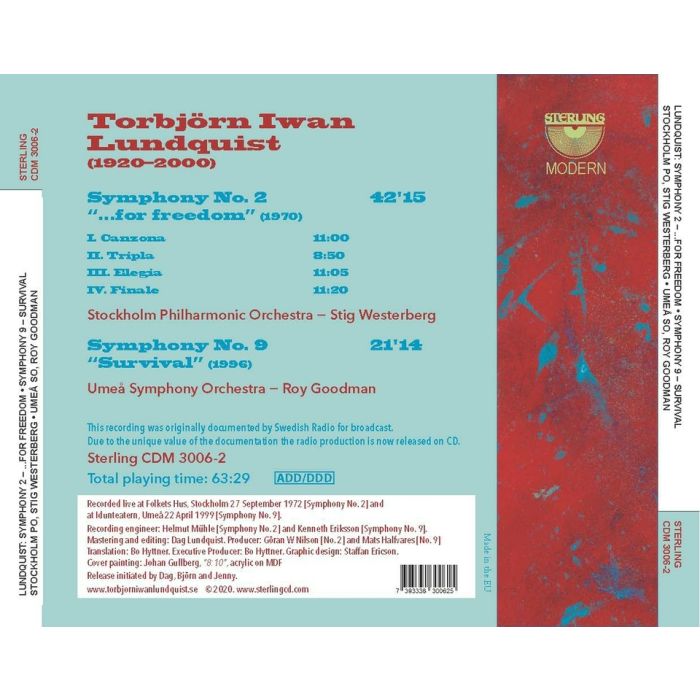
Torbjörn Iwan Lundquist: Symphonies Nos. 2 & 9
£14.99
In stock
Catalogue Number
CDM3006
His first contact with music, Torbjörn got at the age of three when his father Iwan brought home a gramophone and played the Hungarian Rhapsody No. 2 by Franz Liszt. It made an indelible impression on Torbjörn and already at the age of four, he had taken interest in his mother Ester’s inherited piano.
When the Soviet army marched into Prague in 1968 Torbjörn got the impulse to complete the Symphony No. 2 (for freeedom), already commenced at the time of the 1956 Hungary crisis, but not completed then due to lack of time. He was now an established composer, and the piece was well received at the première with Malmö Symphony Orchestra under his own direction in 1971.
Torbjörn Iwan fell ill in the spring of 1993 with cancer, and life and composing slowed down. He had since his move to the provinces less contact with the music scene in Stockholm and now it ceased almost completely. All available strength was used to complete the rediscovered symphony he surprisingly had found in his archive, which originally was intended to become number 5, but now was numbered 9. The symphony, which he called Survival after a series of successful treatments for the disease, and the song cycles Chamber Music to texts by James Joyce and Pour l’éternité to texts by Jean-Luc Caron were his last completed works. At his passing, an unfinished score of the Symphony No. 10 and another try with the Sarek symphony were found on his desk. Dag Lundquist
Manufacturer: Wyastone Estate Limited, Wyastone Leys, Monmouth, NP25 3SR
Email: sales@wyastone.co.uk
Reviews:
EDITORIAL REVIEWS
As obscure composers go, Torbjörn Iwan Lundquist qualifies hands down. I'm immensely thankful to Sterling Records for issuing this recording of the Second and Ninth Symphonies, the third release in their Lundquist series… Once again, Sterling have mined the archive, with live recordings dating from 1972 and 1999…
…The Symphony No. 2 had a lengthy fourteen years gestation, instigated at the onset of the Hungarian Revolution of 1956… The live performance we have here dates from a year later. What leaps out at me, even from the opening pages is Lunquist's deft handling of orchestration, and striving for colourful effects. The work is in four movements titled: 'Canzona', 'Tripia', 'Elegia' and 'Finale'. It's not an easy work and the first movements seem perturbed and filled with disquiet. The first movement is one of steely aggression and stark angularity. 'Tripia' seems to be a scherzo in all but name, and the relentless tread and underlying inquietude is unsettling. 'Elegia' is doleful and melancholic, concerning itself with pain and suffering. The last movement is exuberant and determined, though, at the end, the music dies away in soothing repose.
Cast in a single movement, the Symphony No. 9 dates from 1996… Lundquist's impressive orchestration incorporates a kaleidoscopic panoply of percussion, including vibraphone and marimba, in addition to a grand piano and, for the first time in one of his symphonies, an alto saxophone, which takes on a significant role in proceedings. The title "Survival" refers to the composer's individual life-situation, as he had been treated for cancer, and also to humanity as a whole. This one-movement canvas exploits many emotions. Intensely dramatic and ominous in parts, there are contrasting sections of beguiling lyricism and soulful introspection. Goodman surfs the ebb and flow with sympathetic understanding and purposeful cohesion.
Sterling are to be lauded for releasing these two well-recorded performances. With four symphonies now available, my hope is that the remainder of the cycle will eventually become available. Let's keep our fingers crossed.
Music Web International – Classical Review

|
| Sample Tracks |
|---|
|
Symphony No. 2 'for Freedom': II. Tripla
Symphony No. 9 'Survival'
|
0.135 kg