We use cookies to make your experience better. To comply with the new e-Privacy directive, we need to ask for your consent to set the cookies. Learn more.


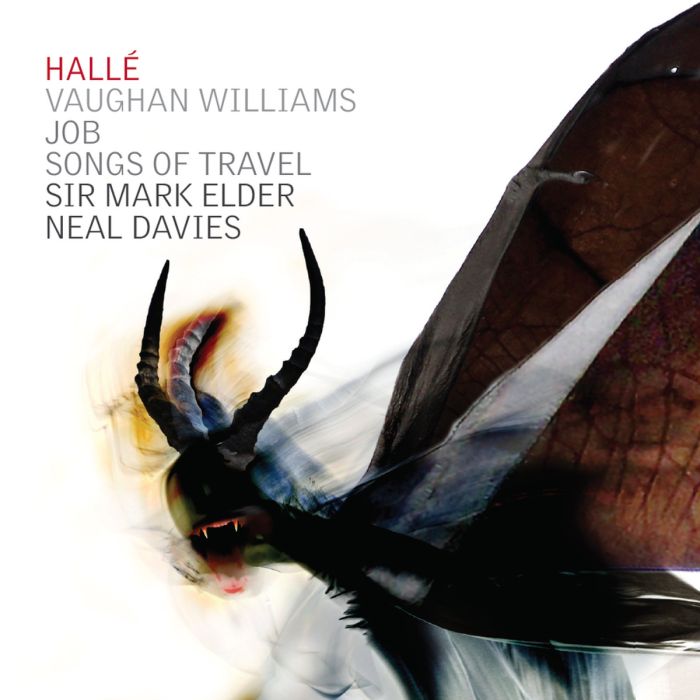
Vaughan Williams: Songs of Travel & Job
£12.99
In stock
Catalogue Number
CDHLL7556
The Hallé announces the latest release in their series of works by Vaughan Williams, with two landmark pieces which are pinnacles of the composer’s output.
Composed between 1901 and 1904, the Songs of Travel, settings of Robert Louis Stevenson for voice and piano (some orchestrated by the composer and some by composer and arranger Roy Douglas), proved a significant landmark in the emergence of Vaughan Willams’s personal voice. The work reflects the composer’s interest in folk song and is characterized by highly evocative orchestrations, ardent melodic lines, wide ranging expressions of emotion from joy to melancholy and highly effective word setting.
Winner of the Lieder Prize at the 1991 Cardiff Singer of the World Competition, Neal Davies has sung with the world’s leading orchestras, conductors and opera companies and received much critical praise for performances in concert, on stage and in recordings.
Ralph Vaughan Williams’s ‘masque for dancing’, Job, is one of his supreme achievements and was considered by Gustav Holst to be a masterpiece. Scored for large orchestra, the work was written between 1927 and 1930 and shows the composer’s imagination at its most vivid. Inspired by William Blake’s dramatic engravings, interpreting a Biblical narrative which examines human suffering in relation to a deity of justice, Vaughan Williams deploys traditional folk dances as a means of creating an idiomatic English dance style.
Manufacturer: Wyastone Estate Limited, Wyastone Leys, Monmouth, NP25 3SR
Email: sales@wyastone.co.uk
Reviews:
EDITORIAL REVIEWS
…The coupling is enterprising. VW's song cycle Songs of Travel is very frequently heard in recital in the original version for voice with piano; it's much less common to encounter it in its orchestral guise… I think he did a splendid job and had one not known it would be a challenge to differentiate between the scoring of VW and of Douglas.
In 'The Vagabond' I was conscious, at high-lying climaxes, of the vibrato that Jim Westhead noted but, overall, I liked Neal Davies' performance. Throughout the cycle the orchestral scoring is skilfully done so that it enhances and colours the music without distracting from the vocal line… This is a very good performance of Songs of Travel. I found much to admire in Neal Davies' singing while Sir Mark Elder and the excellent Hallé bring out all the felicitous details of the orchestral scoring…
In his first-class booklet note about Job, Andrew Burn describes this work as "one of [VW's] supreme achievements". Actually, I'd go further. I love and greatly admire all nine of the composer's symphonies but I regard Job as his finest orchestral work of all.
In the opening section Elder and his orchestra convey marvellously what Andrew Burn so felicitously calls the "Arcadian tranquillity" of the music… What a fine, sturdy tune this is!
One of the triumphs of Job is how seamlessly VW moves from snarling, malevolent music to tranquillity, as the scenario demands… The Hallé plays this delicate episode with the utmost refinement and then turns on all the power that's required to depict the awful moment when Satan cuts down Job's sons and their spouses.
A memorable addition to VWs orchestral palette in this work is the saxophone which we hear in the 'Dance of Job's Comforters'. The wheedling sound of the saxophone is perfect for this music... the Manchester organ is still pretty spectacular and it makes a tremendous contribution to the terrifying climax that Elder and his forces achieve.
…This radiant episode is played superbly by all concerned… The end of Job's story draws near and in the gently glowing Epilogue VW revisits the material of the opening. This Epilogue is beautifully played, the Hallé once again showing supreme sensitivity. After all his trials and tribulations, Job is at peace and VW's masterpiece ends in quiet, radiant calm.
This is a magnificent account of Job. With this performance Sir Mark Elder further confirms his stature as one of the finest of all Vaughan Williams conductors. His superb orchestra follows him every step of the way: their power and precision are awesome at times while the refinement with which they deliver the more subdued sections of the work is as balm to the soul – and to the ears. This is a singular achievement and a pinnacle in Elder's Vaughan Williams cycle.
Steve Portnoi has recorded both works expertly. The well-produced booklet benefits from expert notes by Andrew Burn; he's particularly strong on Job
Music Web International – Classical Review
I consider myself to be an enthusiast for the works of Ralph Vaughan Williams and have many recordings of his compositions. Few indeed are those which do not "speak" to me in a very special way. One of my favourites is Job – A masque for dancing, and of his early vocal works, I also count the Songs of Travel as being up there with the best.
Let me say at the outset that Elder conducts these songs in a totally committed and sympathetic manner, and the Hallé plays them beautifully, really allowing the composer's melodies to sing. Bass-baritone Neal Davies is a well-known international figure with a distinguished performance and recording career, and I note that he won the Cardiff Lieder Prize in 1991. Unsurprisingly, he interprets these highly melodic songs with care and insight, grading his dark, powerful voice from the gruffly powerful to the tender and introspective…
Job is a marvellous work, composed in 1930, preceded by the Benedicite and Te Deum and followed by the 4th Symphony. It was inspired by Blake's illustrations to the biblical Book of Job. Apart from the symphonies, I don't think that there is another orchestral work in which the composer displays such power and melodic inspiration… Readers who know the work will recognise my enthusiasm, and those who don't need urgently to explore the piece.
This is a very good performance, meshing lyricism in abundance with mighty orchestral (and organ) power when required. The playing is splendid and the crucial organ part is immensely impactive. The recording is sophisticated but slightly distant, requiring a modicum of volume increase for the full impact of sections such as Satan on God's Throne and God casting down Satan, to be fully realised. Having said that, the overall balance is judged very well, so that, for example, Elihu's Dance of Youth and Beauty is not distorted by a giant violin.
Overall, this is an excellent CD, and if you are not over-sensitive to Neal Davies' vibrato in The Songs of Travel, you may purchase it with confidence.
Music Web International – Classical Review