We use cookies to make your experience better. To comply with the new e-Privacy directive, we need to ask for your consent to set the cookies. Learn more.


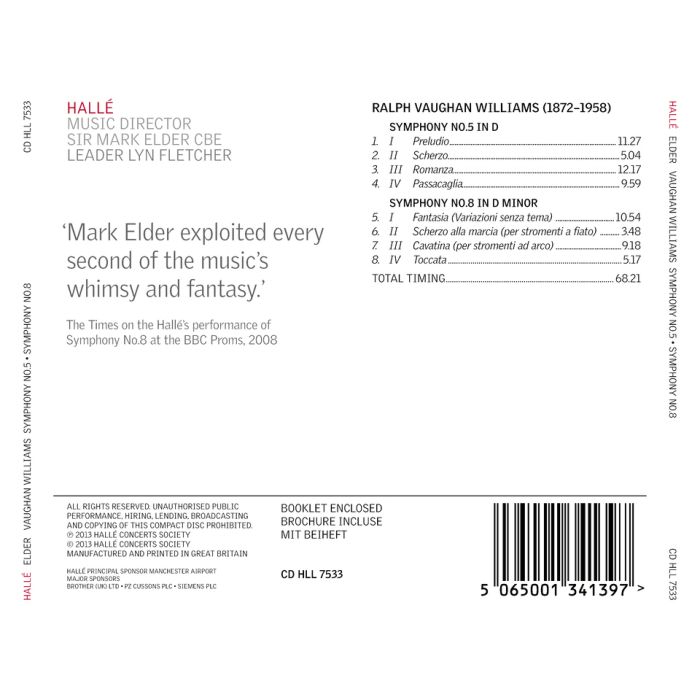
Vaughan Williams Symphonies Nos. 5&8
Special Price
£9.99
Regular Price
£12.99
In stock
Catalogue Number
CDHLL7533
The release combines two highly contrasting works to provide a disc which is both moving and uplifting. Symphony No.5 is a generally tranquil work with music influenced by Ravel, with whom Vaughan Williams had studied, and is scored for very traditional forces. Symphony No.8 is dedicated to Sir John Barbirolli and was premièred by the Hallé in 1956. It is the shortest and least serious of the symphonies and whilst not being without moments of somber mood, is generally light hearted in tone. It is has a more exotic instrumental colour, with an enhanced percussion section.
Manufacturer: Wyastone Estate Limited, Wyastone Leys, Monmouth, NP25 3SR
Email: sales@wyastone.co.uk
Reviews:
The Sunday Times Classical Album of the Week
'Vaughan Williams Eight was written for Barbirolli and gave the premiere in 1956, whe the composer was in his 84th year. As this brilliantly colouristic performance indicates, this hardly sounds the music of an old man...It is the performance of the fifth, with its hymnic melodic material and rapt serenity - the famous cor anglais solo od the Romanza is deeply moving - that sounds special here. Elder and the Halle claim this music as much their own as they do their Eight.' HC, The Sunday Times, March 2013
'A splendid disc that maintains the high standards of the recordings by Sir Mark Elder and the Hallé.' John Quinn musicweb-international.com
‘These wonderfully affectionate recordings of the Fifth and Eight Symphonies are essential listening for devotees of English music. The Fifth is mostly an oasis of serene and spacious modality written in wartime; the Eight is a moody firecracker, full of exuberant percussion writing, from a composer in his eighties. Both are gloriously played.’ Richard Morrison, The Times, March 31st 2013
'The Vaughan Williams symphonies still have champions in Manchester, where Elder and the Halle keep alive a tradition established by the composer’s confidant, Sir John Barbirolli. The Fifth’s slow movement, with its signature cor anglais theme and string threnodies, is treated to playing of outstanding beauty and elsewhere Elder keeps a fluent pace, resisting the temptation to soften or sentimentalise. The Eighth benefits from similar taut tempi and illuminating turn of phrase. A rewarding disc.' Andrew Clark, The Financial Times, April 2013
‘As expected from the current Halle vintage, it’s finely played in every department, with true live-recording atmosphere. It’s also on the quick-ish side, so that the work’s four movements sequence unfolds with smooth loveliness.’ Malcolm Hayes BBC Music Magazine May 2013