We use cookies to make your experience better. To comply with the new e-Privacy directive, we need to ask for your consent to set the cookies. Learn more.



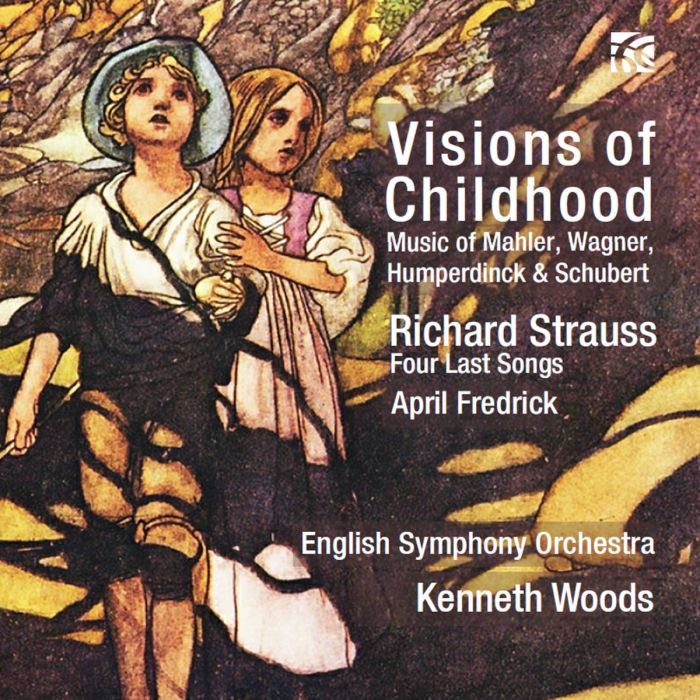
Visions of Childhood: Music of Mahler, Wagner, Humperdinck & Schubert
£14.99
In stock
Catalogue Number
NI6408

Given that this programme was to be an exploration of childhood, the obvious place to start is with birth. Richard Wagner wrote his Siegfried Idyll as a birthday present for his wife, Cosima, just after the birth of their son, Siegfried. Nowhere else in music is there so tender an evocation of those fragile, precious and fraught first days and weeks of life.
Engelbert Humperdinck’s great children’s opera, Hänsel und Gretel, a quasi-Wagnerian setting of the classic Brothers Grimm fairy tale, tells the story of two children in peril. The opera was composed in 1891-2. The two selections I have adapted come from Act II, Scene 2.
“Die Forelle” (“The Trout”) is one of Schubert’s simplest and most popular songs, composed in 1817, when Schubert was just 20, to words by Christian Friedrich Daniel Schubart. I have combined the three verses of the song with several, but not all, of the variations in the Trout Quintet, choosing to alternate strophes of the song with variations from the quintet that I thought suited the mood of the lyrics.
Gustav Mahler’s 100-minute Third symphony and his Fourth grew out of the musical material in the short, beautiful song which forms the final movement of the Fourth Symphony, “Das himmlische Leben” (“The Heavenly Life,”), and which concludes these Visions of Childhood. First, however, we hear his song “The Earthly Life” (“Das irdische Leben”) which forms a sort of bleak mirror image to that song. As with the Humperdinck, I have essentially stuck as closely as possible to Mahler’s own orchestration, which is a model of clarity and economy, but also full of extreme, even grotesque, colours.
Finally, we come to another combination of song and variations by Schubert, both known as “Der Tod und das Mädchen” (“Death and the Maiden”). The song is based on a poem by Matthias Claudius and was written in 1817, the same year as “The Trout.” It has only two verses – one in which the Maiden pleads with Death to pass her by, and one in which Death assures her that he is a friend.
In 1948, composer Richard Strauss returned to a poem by Joseph von Eichendorff called Im Abendrot (At Sunset) which he felt a particular affinity with and had wanted to set to music for nearly a decade. He then quickly composed three more songs on texts by Hermann Hesse, “Frühling” (Spring), “September”, “Beim Schlafengehen” (When Falling Asleep), each of which, like Im Abentrot, explores themes of farewell, fulfilment, lifelong love, and death. The set was to be Strauss’s final masterwork, Four Last Songs. This iconic song cycle has been a speciality of the ESO’s Affiliate Artist April Fredrick for several years, and it was the last piece she performed before the Covid-19 lockdown in 2020. She was to have performed the work with the ESO at Malvern Priory in June of that year.
Kenneth Woods
Manufacturer: Wyastone Estate Limited, Wyastone Leys, Monmouth, NP25 3SR
Email: sales@wyastone.co.uk
Reviews:
"April Fredrick and ESO latest recording impresses...
After performing Richard Strauss’s Four Last Songs with English Symphony Orchestra in March of last year, soprano, April Frederick, went down with Covid. For a month she was unable to sing due to numbing fatigue.
On the 26th July she returned to singing, recording Strauss’s magnificent songs on a new album called Visions of Childhood with ESO.
This is an astonishingly good CD with stunning orchestral arrangements by ESO’s principal conductor, Kenneth Woods. They provide new insights into well-known and lesser-known repertoire by Richard Wagner, Engelbert Humperdinck, Franz Schubert and Richard Strauss.
Highly recommended recording with April Frederick and English Symphony Orchestra on top form!" KH, ArtMuseLondon
"…Expertly arranged and performed, and sung beautifully and with convincing dramatic emphasis by April Fredrick, this is a fascinating and well-considered sequence. I wouldn't consider it particularly aimed at children, though it can of course be enjoyed by anyone. It has certainly made me look at some familiar music in a new light and, as we have all experienced childhood and many of us parenthood, it should prod some emotional responses out of even the most cynical listener.
This is likely to be the first time that Richard Strauss's Vier letzte Lieder has appeared as a 'filler', but this is also the world première recording of James Ledger's reduced orchestra arrangement, originally written for Dame Felicity Lott and first performed in Wigmore Hall. Ledger correctly observes that "an arrangement should be seen as a separate version in its own right" and not as "trying to improve on the original." Ideally we should be able to disconnect from associations with the more opulent orchestration, appreciating Strauss's music for its inherent qualities, and with an excellent performance and recording such as this one the task is made easy enough.
All sung texts are printed in the booklet, and this is an unusual but entirely engaging production that I have come to enjoy and appreciate more each time I have heard it." MusicWeb International
"This excellent disc is both rewarding and thought-provoking. Not only is the music-making highly accomplished but, in addition, the arrangements made me think afresh about music I know well. I enjoyed the performances when I first saw and heard them during the online streaming; I'm delighted that the audio has now been issued on disc for us to experience repeatedly… Arguably, the skillful arrangements by the likes of Stein and Ledger now have new relevance. Kenneth Woods' Schubert arrangements are in a different category because these don't contract the original scoring, rather they expand it. As I've indicated, I think these Schubert settings are highly successful.
The standard of performance throughout this imaginative programme is consistently excellent. The musicians have been expertly recorded by engineer Phil Rowlands, who also produced the disc. Kenneth Woods' notes are an authoritative and persuasive guide to the music." MusicWeb International
“A celebration of the art of transcription, Kenneth Woods and ESO's disc takes us from Wagner celebrating birth to Mahler's version of a child's vision of heaven. Rather than seeing the restrictions of recording under social distancing rules, Woods and the orchestra have instead celebrated the art of the chamber transcription. The music is engaging throughout and wonderfully gusty in the way emotions blow in and out quickly. Woods' version of the idyll is certainly not po-faced, nor is it symphonic music manqué, this feels like real chamber music. This version is a delightful way to experience the songs anew, in a genuine chamber feel with individual lines floating in and out of focus. Overall, this is a delightful disc, a celebration of the art of transcription and a way of looking anew at familiar repertoire.” Planet Hugill

|
| Sample Tracks |
|---|
|
Siegfried, WWV.103: Idyll (arr. Kenneth Woods)
Hänsel und Gretel: Der kleine Sandmann and Abendsegen (arr. Kenneth Woods)
Symphony No. 4: Das himmlische Leben
Vier letzte Lieder: IV. Im Abendtrot (arr. James Ledger)
|
0.135 kg