We use cookies to make your experience better. To comply with the new e-Privacy directive, we need to ask for your consent to set the cookies. Learn more.


Wilhelm Stenhammar: Tirfing Opera
£19.99
In stock
Catalogue Number
CDO1134
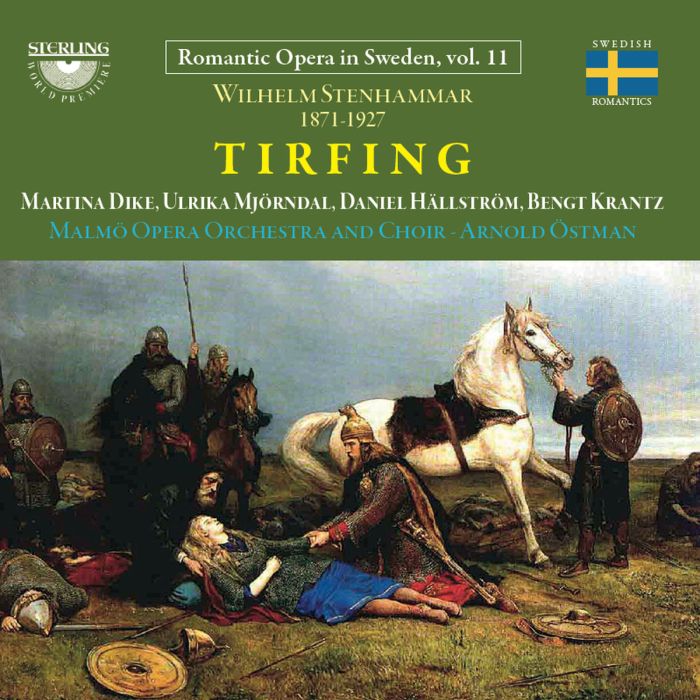
It’s the Viking era. The hero Angantyr has fallen. In his grave he has taken with him the magical sword Tirfing, a sword that never misses to kill the enemy. His daughter Hervor needs the sword to protect herself from the cruel world of the Vikings. From his grave Angantyr, who had no sons, demands that his daughter for ever must appear as a man in order to retrieve and use the sword. Hervor dresses as the warrior Hervardur, receives the sword which makes him/her an always unbeatable hero in the battlefields. However, the disguise will eventually prove to be her undoing. A love triangle develops between Hervardur and Vidar, “his” brother-in arms who in his way is in love with Hervor/Hervardur, and Vidar’s sister Gullväg who has fallen in love with the hero Hervardur, not knowing that he in fact is a woman. Gullväg is courted by the three kings Gestur, Svasur and Harald. Encouraged by her father, King Gudmundur, Gullväg asks three riddles to be solved by the courting cavaliers. She will marry the one who can solve them all. But she is in fact in love with Hervardur who succeeds in solving the riddles to Gullväg’s joy. But Hervardur must (for obvious reasons) reject Gullväg which makes Vidar furious, meaning that this is an unforgivable insult to his family. He therefore challenges Hervardur to a duel, whereupon he is killed by the invincible sword Tirfing. Hervardur is proclaimed an outlaw by King Gudmundur. Brokenhearted Hervardur tells Gullväg of her true origin and once again search out her father’s grave, returns the sword Tirfing and dies.
Manufacturer: Wyastone Estate Limited, Wyastone Leys, Monmouth, NP25 3SR
Email: sales@wyastone.co.uk
Reviews:
"Excerpts from the opera 'Tirfing' (1898), conducted by Leif Segerstam, were released on Sterling in 1999. The complete recording followed many years later, and now, finally, the live recording from the Malmö Opera House on October 15, 2011, is available on CD. A thoroughly successful recording, let it be said right from the start, strongly shaped by the compelling conducting of Arnold Östman, who realizes Anders Wiklund's critical edition of the score with great love, understanding, and dramatic energy… None of the soloists in the Malmö performance are celebrities in Germany – meaning we have a well-established ensemble here that doesn't have to prove anything to anyone, but rather serves the work. Martina Dike, who sang roles such as Waltraute and Fricka in Bayreuth from 2006 to 2010, knows how to vocally realize the multifaceted nature of the main role in an outstanding way. The bass Bengt Krantz lends Angantyr and King Gudmundur a balmy tone and princely dramatic conviction. Ulrika Mjörndal's luminous soprano, conveying a sense of fragility and primarily heard in concert performances, harmonizes superbly with Dike in the role of Gullväg. (In addition to solo singing, Mjörndal has distinguished herself as the director of the Hedvig Eleonora Chorus Reginae.) Daniel Hällström (Vidar) has pursued an operatic career in the most conventional sense; his warm baritone, while sometimes appearing somewhat calculated alongside his female colleagues, is no less effective and moving. The Malmö Opera Orchestra may not be a first-rate ensemble, but Östman unites the various forces into a thoroughly convincing and moving overall performance. Anyone wishing to experience Scandinavian opera will be very well served by this production." Dr. Jürgen Schaarwächter, Magazin.Klassik