We use cookies to make your experience better. To comply with the new e-Privacy directive, we need to ask for your consent to set the cookies. Learn more.



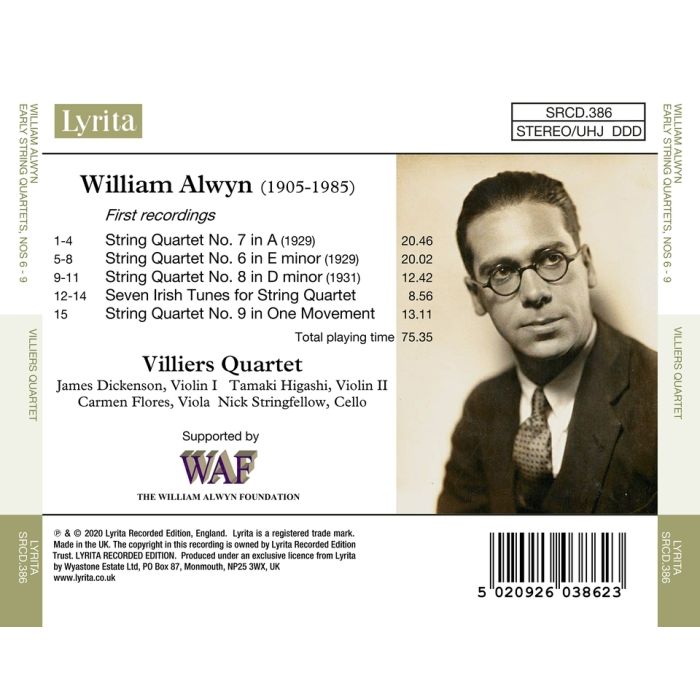
William Alwyn: Early String Quartets
£14.99
In stock
Catalogue Number
SRCD386
Named after Villiers Street in London's colourful musical epicentre, the Villiers Quartet encompasses the grand and iconic spirit of the extraordinary music tradition in London. Hailed as one of the most charismatic and "adventurous" quartets of the European chamber music scene The Strad, the Villiers Quartet has developed an international reputation for its performances of British music.
Alwyn’s musical style is in the main of a romantic nature firmly grounded in tonality, notwithstanding some forays into modernity, calling on dissonance and freedom of from when he felt the need. This approach can be keenly felt in the works included on this disc, all of which were completed when he was aged between eighteen and twenty-five. The medium of the string quartet held a long and lasting fascination for Alwyn, which began during the earliest years of his composing career. He was to compose a total of sixteen string quartets between the years 1920 and 1984. Alwyn considered that the string quartet was the ‘most intimate of mediums’ and revelled in the challenge to provide interesting material in which to balance the four instruments. The sixteen string quartets that he was to compose can be divided into two groups; the first thirteen quartets were composed between 1920 and 1936, and the last three quartets were composed between 1953 and 1984.
Manufacturer: Wyastone Estate Limited, Wyastone Leys, Monmouth, NP25 3SR
Email: sales@wyastone.co.uk
Reviews:
"Meanwhile this latest addition to the growing catalogue of William Alwyn's music is essential for all enthusiasts of the composer, and of great interest for those who are devoted to British music and/or the string quartet genre. It is splendidly recorded and convincingly played by the Villiers Quartet."
Music Web International – Classical Review
"These are conspicuously sensitive performances that respond to every facet of the composer's writing."
GRAMAPHONE
"These premiere recordings reveal youthful flirtations with structure and texture. No.6, dedicated to McEwen in 1927, divides into four movements, the outer ones being reasonably sized but housing two very brief inner movements, an Interlude and a Scherzo. There’s a slightly melancholic fluidity to the opening music and the Interlude sounds decidedly Bridge-like in places. The Scherzo shows one of the few really overt uses of folkloric influence in these particular quartets whilst the final movement explores Alwyn’s interest in variation form. The variations are well contrasted and youthfully vigorous - there’s one especially zesty section – as well as some forlorn-sounding senza vibrato writing...These are conspicuously sensitive performances that respond to every facet of the composer’s writing. It’s often at its most personal when most introspective and the quartet’s control of dynamic levels proves invaluable in these passages and movements. Some distinctive Alwyn touches can certainly be felt though he has yet fully to shape his material into truly coherent forms. Nevertheless, these early works offer a striking insight into his progress as a composer for chamber forces." - MusicWeb-International
"Quartet No. 7 is first on the disc rather than the earlier No. 6. The reason for this becomes clear when one has listened to both quartets. No. 7 starts out strongly, reminding one more than a little of Shostakovich’s early quartets. The passacaglia second movement is equally impressive, but becomes progressively more austere. The succeeding Rondo features a beautiful cello motif, cleverly developed. The final movement, Retrospect, emphasizes the E-minor home key in an original way; the coda, incorporating material from the preceding movements, shows real depth... The Villiers Quartet deserves nothing but praise for their work on this recording. They show real verve in all the quartets, especially in No. 7, and the clarity of the contrapuntal lines throughout the performances is exceptional. Each member of the quartet contributes beautiful solo work when called upon. The acoustic at Wyastone Leys again demonstrates its fine qualities, especially for chamber music. These recordings were made before James Dickenson left the Villiers Quartet and are a fitting tribute to his time with them. This disc is essential for all those interested in Alwyn, and a fine example of performance and recording into the bargain." - MusicWebInternational
"The 9th Quartet does describe itself as ‘In one movement’ and lasts just thirteen minutes. It is a truly romantic, Shakespeare inspired tone poem headed up with words from Romeo’s Death Scene. In fact, the format of each of these works is pleasingly different. The Quartet No 6 has four clear movements with the Scherzo placed third after a very brief ‘Interlude’. The Quartet No 8, which lasts not much more than twelve minutes, divides into seven tempo markings and is allotted three tracks. The first six are related to the opening material and the finale, an agitated Allegro, has its own track, and is half of the length of the entire work. The harmonic language might appear a little eclectic throughout the quartets (perhaps that’s what the composer objected to) with some modal passages, almost inspired by folk music. There are also passages in which the tonality is so ambiguous that you might wonder if Alwyn is experimenting with serial technique, as well as straight-forward diatonic passages. A close listen to the 7th Quartet will demonstrate what I mean There is a real attractive freshness to these early works that you do not find in the more intense and harmonically complex quartets of the 50s, which makes this disc well worth searching out." Full review here- Gary Higginson

|
| Sample Tracks |
|---|
|
String Quartet No. 7 in A Major: IV. Retrospect - Adagio e tranquillo
String Quartet No. 6 in E Minor: I. Moderato
String Quartet No. 8 in D Minor: VII. Allegro
Seven Irish Tunes for String Quartet: IV. The Ewe with the Crooked Horn - V. The Gentle Maiden - VI. Who'll buy my Besoms?
String Quartet No. 9 in One Movement: Adagio molto e tranquillo - poco agitato - Adagio
|
0.135 kg