We use cookies to make your experience better. To comply with the new e-Privacy directive, we need to ask for your consent to set the cookies. Learn more.



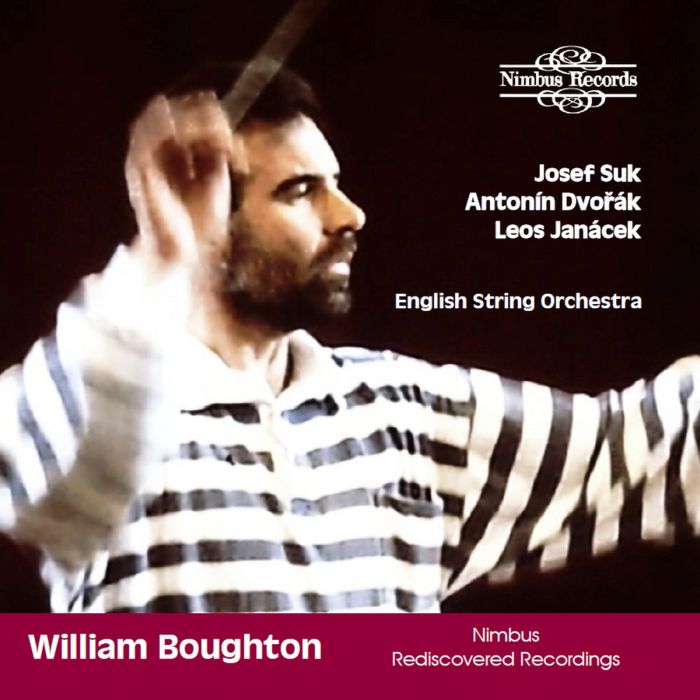
William Boughton & English String Orchestra: Nimbus Rediscovered Recordings
£10.99
In stock
Catalogue Number
NI7114

It was through a chance hearing by Nimbus founder, Numa Labinsky, that William Boughton came to visit Nimbus in 1982. Numa had been checking the quality of LPs going through the manufacturing plant. He liked what he heard on one of them by a new string orchestra called the Vivaldi Ensemble with William Boughton. The meeting happened, discussions went very well and the orchestra – renamed English String Orchestra – made its first Nimbus recording on 31 May 1983. A potpourri featuring harpist Susan Drake ‘Music for Harp and Strings’, Sadly this recording, a digital pioneer, has degraded beyond repair. The next recording was an altogether grander affair; popular string orchestra works of Elgar, made in the Great Hall of Birmingham University. The orchestra under William’s direction quickly became a regular feature of Nimbus’s releases, as did the Great Hall. The relationship was so close and so active that it might have appeared to be a house band – except that the orchestra and its music director had a rich and busy concert life quite independently of their work in the studio. Neither William nor I recall there being any particular reason why this recital was held back. However, I believe the following chronology of events holds a clue. Just two months after this record we were back in the Great Hall to record an album of Butterworth (A Shropshire Lad, The Banks of Green Willow, Two English Idylls), Parry (Lady Radnor’s Suite) and Bridge (Suite for Strings). When it was released, particularly in the USA, it became the orchestra’s, and Nimbus’s calling-card, instantly racking-up chart successes, a top spot in the Billboard 100 and endless radio play. In those days classical radio in the US stretched from coast-to-coast, so not wanting to miss an opportunity our American agent put William and me on a trans-American PR tour. The obvious question came from all sides – ‘what’s your follow-up?’ the only possible answer being ‘more English music’. Finzi, Delius, Holst, Tippett and Britten were the order of the day. Josef Suk, Antonín Dvořák and Leos Janácek have waited a long time for their day in the sun. © Adrian Farmer
Nimbus ‘Rediscovered Recordings’
Nimbus is pleased to present the first two titles of a short series of recordings sitting on the shelves of the Nimbus archive that were ‘rediscovered’ during the 2020 COVID shutdowns. In those quiet days idle hands and minds posed the question: ‘So, do we have anything unissued that we can use to construct a release programme?’ This casual enquiry initiated a full investigation that has continued for five years and revealed more than fifty recording projects that, for one reason or another, never made it into the world. Some of these recordings go back to the founding of Nimbus in the late 1960s. There is no single reason to account for their neglect, and in every case we have found no justification for holding them back any longer.
The original analogue tapes, typically one-inch, four track, 30ips, transferred to a digital medium with no problem. We decided to archive them at 192k, thus preserving them for next generation use. Early digital tapes, from 1981/82, using U-matic cassettes, sometimes required surgical intervention to repair passages of lost signal, but having been stored in the same warm, dark room for their entire lives also transferred reliably for the most part.
Manufacturer: Wyastone Estate Limited, Wyastone Leys, Monmouth, NP25 3SR
Email: sales@wyastone.co.uk
Reviews:
"As for the choice of composers on the album, this recording by the English String Orchestra, under the direction of William Boughton, is of remarkable richness. The three composers on which it is based – Josef Suk, Antonín Dvořák and Leoš Janáček – allow us to understand the ensemble not only as a selection of works, but as a journey through three different ways of articulating the Bohemian musical identity...The collaboration between Boughton and the English String Orchestra is defined by a search for a balance between analytical clarity and contained expressiveness. This interpretative option offers a coherent, stylistically informed and technically very solvent reading, which highlights the finesse and complexity of this repertoire for strings." Marçal Borotau, Sonogram Magazine

|
| Sample Tracks |
|---|
|
Serenade for Strings in E-Flat Major, Op. 6: I. Andante con moto
Waltz, Op. 54, No. 2
Suite for String Orchestra: IV. Presto
|
0.135 kg