We use cookies to make your experience better. To comply with the new e-Privacy directive, we need to ask for your consent to set the cookies. Learn more.



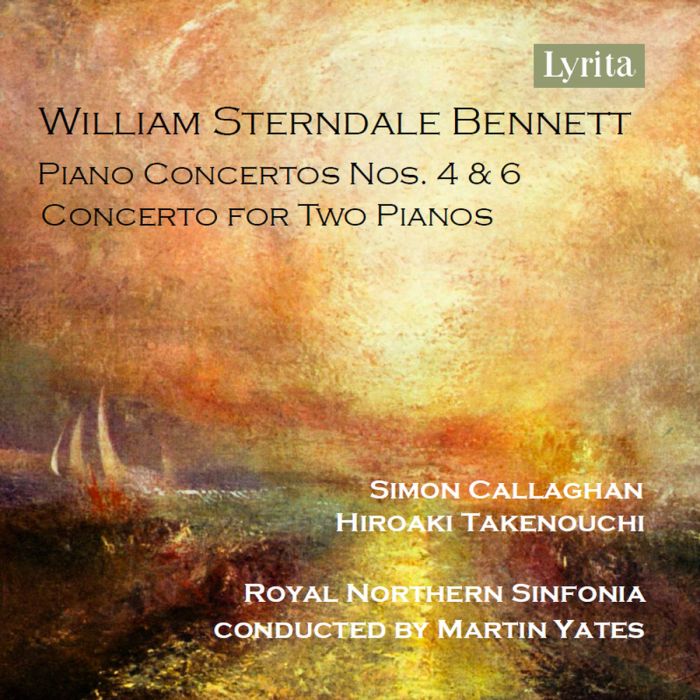
William Sterndale Bennett: Piano Concerto Nos. 4 & 6 and Concerto for Two Pianos
£14.99
In stock
Catalogue Number
SRCD448


Bennett was acknowledged both in England and Germany as an outstanding pianist and his finest and most characteristic music was composed for his own instrument. As well as numerous works for solo piano, including two sonatas, he composed six piano concertos and a single movement Caprice for piano and orchestra. He gave public performances of all his works for piano and orchestra with himself as soloist. It was during the heady days of Bennett’s third long visit to his friends in Leipzig, from January to March 1842, that he mentioned in correspondence that he was working on a new concerto, which he hoped to perform before leaving for London. In the event this did not happen, but a substantial amount of work must have been done at this stage on what was to become the unpublished Piano Concerto no. 6 in A minor, WO 48. Bennett did further work on the concerto in the summer of 1843 and hoped to publish it, but changes to his personal circumstances contributed towards further delays. His son claimed that he always intended it to be published, but as the years passed the more out-of-date it became. Martin Yates writes about his completion of Piano Concerto No. 6: The score existed in three clearly laid out movements and although the piano part looked in places to be more of a sketch than a finished article, it was fairly clear where the missing music was and also reasonably clear as to how these gaps could have potentially been filled in. Sometimes the piano part petered out altogether and in other places the right hand was written out whilst the left hand was missing or there was the start of an accompanying figure in the left hand which stopped after a just a few notes. The completion on my part was of course partly guesswork based on my knowledge of Sterndale Bennett’s style, the music of the period and also the music that was already completed on the manuscript. Unless a more complete score of this concerto materialises, I feel I have done what is possible in helping this concerto come back to life and in doing so hopefully contributing to the remarkable legacy of Sterndale Bennett; a considerable composer of stature and invention. The Concerto for Two Pianos in C major, WO 29, in actuality a single movement, was composed in the Spring of 1835 as a collaboration between Bennett and his fellow pupil at the RAM George Alexander Macfarren. Bennett and Macfarren were the leading students of composition in their year and, both being pianists, they determined to jointly compose and then perform with their fellow students a concerto for two pianos and orchestra. The composition of a double piano concerto was not a requirement of their studies, but rather for their enjoyment, with perhaps a touch of rivalry thrown in. The two men began by taking turns: Bennett composed the first thirty-seven bars, Macfarren the next fifty, and so on, with the last 125 bars or so apparently a collaboration. © Rosemary Firman
Related Products
Check items to add to the cart or
![William Sterndale Bennett: Complete Piano Concertos [3CDs]](https://www.wyastone.co.uk/media/catalog/product/cache/6af2da79007bbde83ac425b5e09ddcd4/s/r/srcd2449_cover.jpg)
Manufacturer: Wyastone Estate Limited, Wyastone Leys, Monmouth, NP25 3SR
Email: sales@wyastone.co.uk
Reviews:
"Our cultural memories are often short, or at least selective. When 19th-century Britain was dubbed the 'land ohne Musik' (land without music), that rhetorical statement erased the work of the likes of William Sterndale Bennett, who was once considered one of the country's leading musical lights. And it wasn't just a case of patriotism; Robert Schumann proclaimed that 'were there many artists like Sterndale Bennett, all fears for the future progress of our art would be silenced'.
The Sheffield-born Bennett, who was admitted to the Royal Academy of Music when he was just ten, sat at the heart of the burgeoning British musical establishment. An early Romantic (metaphorical) cousin of Mendelssohn and, as the atmospheric painting on the album cover suggests, to the painter JMW Turner, he was a fine pianist who composed six concertos for himself to play. Here, Simon Callaghan is the superb soloist in the Fourth and Sixth, in energising performances with the Royal Northern Sinfonia and conductor Martin Yates that feel tailored to the music's scale and sympathies.
The Fourth broods its way into being, Schumannesque in colouring and serious in tone, and ends with a sparkling finale. In between comes a gentle Barcarole which so the in-depth booklet notes by Rosemary Firman tell us, was his most popular piece, arranged as a piano solo and duet. The Sixth is even more of a rarity, astutely completed here for performance by Yates, and adding to the constellation of A minor piano concertos by both Robert and Clara Schumann and later, Grieg. It's a piece of lilting charm and lively spirits. And to end, a curiosity: the unfinished Concerto for Two Pianos, co-authored with his peer George Alexander Macfarre" Rebecca Franks, BBC Music Magazine
Presto Recording of the Week (2nd January 2026)
"In his new album, Simon Callaghan continues his fascinating and rewarding exploration of piano concertos by British composers, with works by William Sterndale Bennett (1816-1875) - an English contemporary of Mendelssohn and Chopin, whose music receives less attention in conversation and performance than it deserves. Callaghan proves a stimulating guide to works that are not only under-appreciated but which have also needed some reconstruction and research to bring them to life. This album is available as a single disc or download, or as part of a complete set of Bennett's piano concertos, both released today." Matthew Ash, Presto [read complete review]
"This recording (as well as the box-set) comes highly recommended. Besides the novel repertoire of the Concerto for two pianos and the Sixth Concerto, the quality of sound and balance are exceptional, as are the insightful interpretations from soloists, conductor and the Royal Northern Sinfonia, who are in fine fettle." Jeremy Dibble, Gramophone
"Simon Callaghan is an admirable exponent of this music.'
…The second movement caught me a bit by surprise because it is a barcarolle. The fine Royal Northern Sinfonia entranced me with the longish orchestral opening, and Simon Callaghan beguiled me with his most beautully elegant soft playing, as much as he had impressed me with his technical facility and controlled power in the first movement. The middle section is of a more martial character, and the pianist plays with more fire and bravura, before the calm and elegant nature of the opening section returns…
The recording sound quality is very clean, crisp and well balanced. The orchestra is fine and the direction sympathetic to the music. The accompanying booklet is informative and the two soloists are both fine pianists. To be honest I preferred the two solo concertos to the concerto for the two pianos, but it is also enjoyable and the two soloists are obviously enjoying the experience, so there is much on this disc to love." Geoff Pearce, Classical Music Daily (20 January 2026) [read complete review]
"True to its historical vocation, the Lyrita label continues to stand out for its exemplary work of recovering and disseminating British musical heritage, through recordings that restore unjustly forgotten works and composers to the present with first-rate artistic and musicological rigour. This recording of William Sterndale Bennett's piano concertos is a contribution of great relevance both from a musicological and interpretative point of view, as it allows this composer to be placed within the panorama of nineteenth-century European romanticism. Bennett was by no means a peripheral figure: he was a creator of remarkable formal solidity, with a voice of his own that dialogued naturally with the contemporary Germanic tradition, especially with the aesthetics of Felix Mendelssohn... Simon Callaghan becomes a central figure of the project thanks to a reading of great structural solidity, a precise articulation and a clear formal awareness of the concertant discourse. Hiroaki Takenouchi complements this vision with refined phrasing, careful sound control and lyrical sensitivity that enriches the most introspective passages. In the Concerto for two pianos, their interaction is characterized by constant mutual listening and an exemplary balance, which allows the piano dialogue to unfold with a fluidity typical of the music of Chamber.
The album incorporates an additional musicological dimension with the presentation of the Piano Concerto No. 6 in A minor, WoO 48, in a version completed by Martin Yates. Conceived as a completion —and not as a reconstruction—, his intervention is based on a deep knowledge of Bennett's style and the language of the period, and gives rise to a coherent and stylistically plausible edition, despite the fragmentary nature of the preserved manuscript. This musicological solidity is reinforced by the excellent direction of Yates himself, which guarantees cohesion, formal clarity and balance between soloist and orchestra." Marçal Borotau, Sonogram Magazine
"Here, Callaghan is supported by his regular piano partner, Hiroaki Takenouchi; the joint performance is seamless and beautifully dialogic. The orchestral part lags behind in terms of inventiveness, but it is performed with great professionalism (it may be of interest that Geoffrey Bush, himself a renowned English composer, arranged the concerto as a sonata for two pianos, which was first broadcast in 1969). The booklet text in English is extensive and very informative; the decision not to produce a multilingual edition is a tradition with the Lyrita Recorded Edition." Dr. Jürgen Schaarwächter, Klassik.com
'Simon Callaghan is an admirable exponent of this music.'
“William Sterndale Bennett is also one such composer, and often outside the UK, if he is remembered at all, it is often as a former Director of the Royal Academy of Music. Yet during his lifetime, he was friends with both Mendelssohn and Schumann, was much admired by them and attracted a big following in Germany and in England. His early works, especially the piano concertos, often with himself performing, were the subject of considerable excitement, but like many composers, his style was considered anachronistic by the time he died.
The first movement has a very long introduction before the piano makes its entrance. Like the piano concertos of Mendelssohn, a considerable dexterity is required and the music is not heavily dramatic in nature, but is reflective at times and at others more effervescent. On hearing this movement I am immediately surprised that this music is not more often performed. Simon Callaghan is certainly up to the stylistic and considerablke technical demands.
The second movement caught me a bit by surprise because it is a barcarolle… Simon Callaghan beguiled me with his most beautully elegant soft playing, as much as he had impressed me with his technical facility and controlled power in the first movement…
Simon Callaghan is an admirable exponent of this music. He is required to change mood quickly and not all pianists can show such flexibility.
The recording sound quality is very clean, crisp and well balanced. The orchestra is fine and the direction sympathetic to the music. The accompanying booklet is informative and the two soloists are both fine pianists. To be honest I preferred the two solo concertos to the concerto for the two pianos, but it is also enjoyable and the two soloists are obviously enjoying the experience, so there is much on this disc to love.” Copyright © 20 January 2026 Geoff Pearce, Sydney, Australia
"Sterndale Bennett’s music given superb advocacy here on a splendidly played and recorded release from Lyrita." Martin Cullingford, Gramophone, 2026

|
| Sample Tracks |
|---|
|
Piano Concerto No. 4 in F Minor, Op. 19: III. Finale. Presto agitato
Piano Concerto No. 6 in A Minor, WoO. 48: II. Serenade. Allegretto
|
0.135 kg